

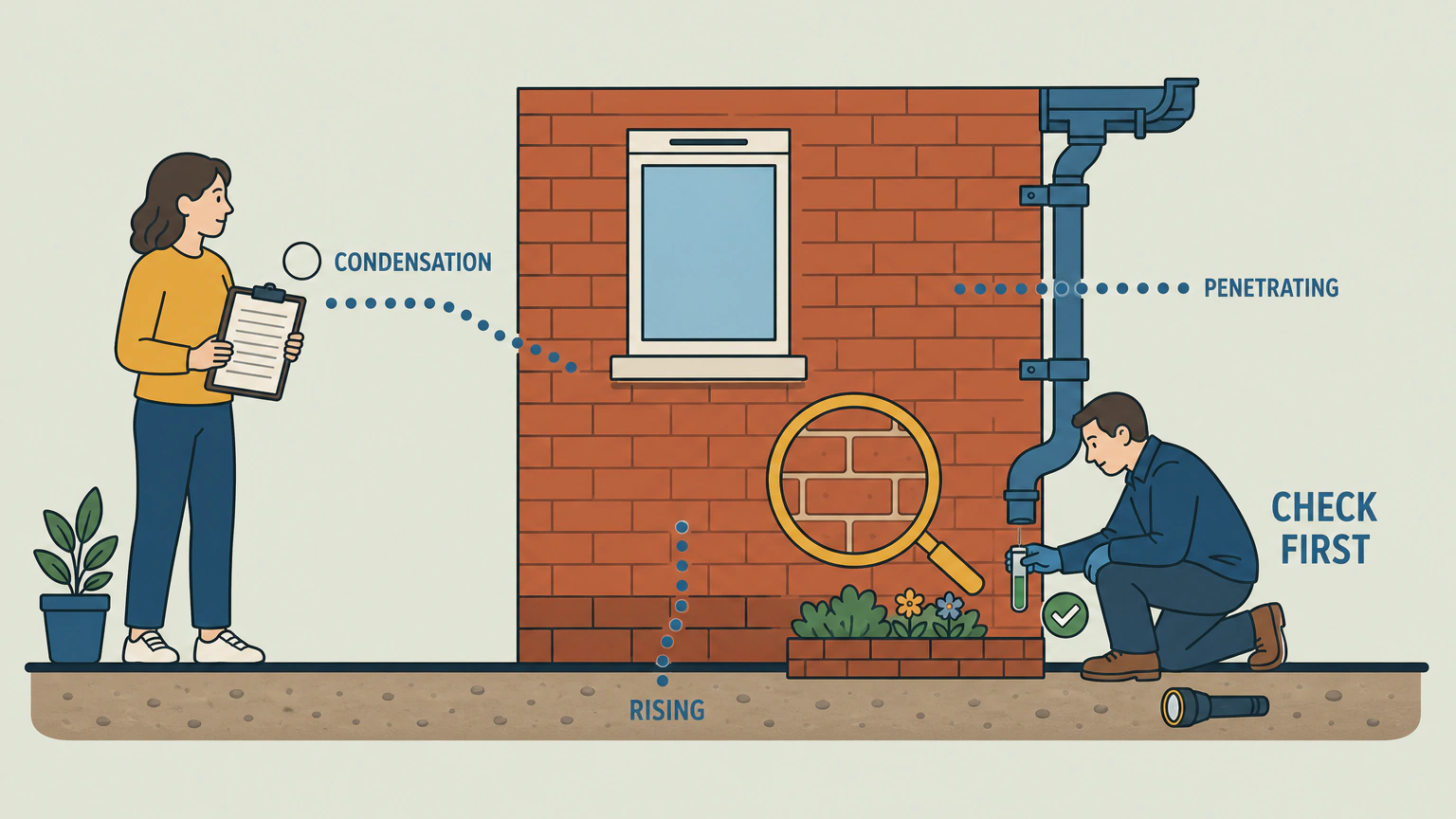
Someone has looked at a patch on your wall, said "rising damp", and left a quotation on the table. Before you sign it: the government's own national survey records rising damp in about 1% of English homes, and serious condensation, which looks much the same on a wall, in 3%. So ask what that report actually proves. Where the moisture is. What drilled samples and any salt analysis found. And that a bridged damp-proof course, a leaking downpipe or a ventilation problem was ruled out first.
On this page
- The short answer: three kinds of damp look alike, and only one of them needs a damp-proof course
- Which damp have you got? Four patterns and what separates them
- Why a free damp survey is not a diagnosis
- Rule out the cheap causes before you accept the expensive one
- What finding out costs, against what the cure costs
- What the law says, and where "rising damp" is actually a legal term
- If the diagnosis does stand up: what a proper job looks like
- Frequently asked questions
- What to do this week
The short answer: three kinds of damp look alike, and only one of them needs a damp-proof course
Inject a chemical damp-proof course into a wall that's wet because a downpipe has split, and you will still have a wet wall. Plus a bill.
What "damp proofing" actually means when someone quotes you for it
A remedial damp-proof course, the DPC everyone abbreviates, is a water-repellent cream or fluid injected into the mortar joint at the base of a wall. Its job is to stop ground water climbing through the masonry. One request costs you nothing: ask for the injection and the replastering to be priced separately.
What the national survey actually finds
The English Housing Survey for 2024 to 2025 found that 5% of dwellings, about 1.4 million homes, had a problem with damp. Serious condensation led at 3%. Penetrating damp came next at 2%. Rising damp came last, at 1%. And it sets a high bar: only damp serious enough for a surveyor's health and safety assessment gets counted.
None of which makes rising damp imaginary. It makes it the rarest of the three, and so the last conclusion a report should reach.
Which damp have you got? Four patterns and what separates them
Most of this you can do yourself, in ten minutes, with a torch. Do it before anyone carrying a quotation book is in the house.
Rising damp: strongest at the base, usually around a metre high
Ground water is drawn up through masonry by capillary action. So the wetness is worst at the bottom of the wall and fades as it climbs, often leaving a tide mark, decayed skirting boards and salt-stained plaster.
Citizens Advice gives the rule that settles most cases. Rising damp affects the ground floor, up to about 1 metre. Above the ground floor of a block of flats, whatever is on your wall, it isn't rising damp.
Penetrating damp: it follows the defect and it follows the rain
Water comes in from outside through one specific fault: a leaking downpipe, failed pointing, cracked render, a blocked gully. It worsens in wet spells and eases off in dry ones. And it appears at whatever height the fault sits, shaped like the fault rather than as a level band.
Condensation: cold surfaces, cold months and mould growth
The most common finding in the national survey. Airborne moisture settles on the coldest surfaces, so look at external walls, corners, window reveals and the wall behind a wardrobe.
Only 1% of dwellings had inadequate ventilation, but 60% of those had a damp problem.
The two that get missed: plumbing leaks and construction damp
A failed waste pipe or a heating pipe under a floor wets the base of a wall almost exactly like rising damp. Government guidance calls that traumatic damp. Construction damp is different again: residual moisture left behind by recent building work. Rule both out early.
| Type of damp | Where it appears | When it is worst | What usually causes it | What proves it |
|---|---|---|---|---|
| Rising damp | Ground floor, up to about 1 metre, fading with height | Varies with ground and building conditions | Ground water climbing past an absent, failed or bridged DPC | Drilled-sample moisture readings, with salt findings interpreted alongside other evidence; not a surface meter reading alone |
| Penetrating damp | Any height, shaped like the fault | During and after heavy rain | A split downpipe, failed pointing, cracked render or blocked gully | Finding the defect, and the patch drying once it is repaired |
| Condensation | Cold external walls, corners, reveals, behind furniture | Cold months, unheated rooms | Air moisture on cold surfaces where ventilation, insulation or heating is inadequate | Moisture and temperature readings across the room and the surface |
| Plumbing leak or construction damp | Localised, often near a pipe run | Often unrelated to the weather | A leaking waste, supply or heating pipe, or residual construction moisture | Tracing the pipe or source, and the damp stopping once it is addressed |
Why a free damp survey is not a diagnosis
Nothing here is an accusation. Most damp firms do competent work, and we'd say so to their faces. The problem isn't the people. It's on the invoice.
The problem is the invoice, not the surveyor
When the survey costs nothing and the treatment is chargeable, what lands on your doormat is a quotation with a diagnosis attached to it. That says very little about anybody's honesty. It says a great deal about what a free visit can afford to rule out, because ruling things out is slow, and nobody is paying for that hour.
What an electrical moisture meter can and cannot tell you
You'll know the device: hand-held, two pins, pressed into the wall. It measures electrical conductivity and converts that into a reading calibrated for timber. Not for masonry. Not for plaster.
Plenty of things conduct besides water. Salts left in old plaster do. So do foil-backed plasterboard and metal fixings, and all of them push the needle up with no water present. A high reading is a reason to investigate. It is never a diagnosis.
A stronger test: drilled samples and salt analysis
A defensible investigation looks different. Samples drilled from inside the wall, at intervals of depth and height. Moisture measured by calcium carbide or oven-drying instead of surface conductivity. Plaster analysed for chlorides and nitrates.
Two sources back that, and they sit on opposite sides of the counter. The Property Care Association, the industry's own trade body, says hygroscopic salts "are almost invariably present in groundwater and will therefore be found in walls and plaster suffering from rising damp". MHCLG and UKHSA guidance adds that rising damp "is often misdiagnosed", and that "chemical testing is the most appropriate way of confirming it".
Which leaves one question no sales visit can answer for you: does your report identify salts, and how were they measured?
Red flags in a damp report. These are faults in a document, not accusations against the firm that wrote it. Any one of them is worth a second opinion before you sign.
- A diagnosis reached from surface meter readings alone.
- No mention of salts, and no word on how the moisture was measured.
- No record that gutters, ground levels and plumbing were checked.
- A quotation attached to the diagnosis, in the same document.
- A whole-house recommendation where the damp is on one wall.
Rule out the cheap causes before you accept the expensive one
A good surveyor works through this sequence anyway. So ask to see it written down.
Ground levels and a bridged damp-proof course
Start with the ground outside. A common, benign explanation lives there. Approved Document C, England's building regulations guidance, says an external wall's damp-proof course should sit at least 150mm above the adjoining ground. Then somebody lays a patio over that line. Or a driveway, a raised bed, decking. Water walks straight past a barrier that works perfectly well.
The trade body's own advice is that removing the bridge should then be enough. That may be work for masonry and repointing specialists, rather than an injection.
Gutters, downpipes and rainwater goods
A split or blocked downpipe can soak one strip of wall, and a moisture meter reads that strip enthusiastically. Government guidance for landlords puts damaged or blocked pipes, gutters and downpipes at the top of its external checklist.
Go and look while it's raining hard, not afterwards, and look from the ground.
Ventilation, heating and the condensation loop
Extractor fans venting into a loft. Trickle vents painted shut. Rooms that never get heated, laundry drying on the radiators.
If you've been told that last one makes the damp your own doing, the government disagrees. MHCLG and UKHSA call it "totally unreasonable to blame damp and mould in the home on 'lifestyle choices'". The fix may involve insulation and ventilation installers.
Rule these out before you accept a rising damp diagnosis:
- Is the external ground level (patio, path, driveway, flowerbed or decking) above the damp-proof course line?
- Is soil, render, mortar or debris bridging the DPC anywhere along the affected wall?
- Are the gutters, downpipes and gullies clear, and does the wall stay dry during heavy rain?
- Is there a bathroom, kitchen or heating pipe run behind or below the damp area?
- Does the damp appear above the first metre, or above the ground floor? (If so, rising damp is less likely.)
- Does an extractor fan actually vent outside, and do the windows have working trickle vents?
- Is the affected wall the coldest in the room, such as an external corner, or behind a wardrobe?
- Does the report identify hygroscopic salts, and does it say how they were measured?
- Is the person who wrote the report also quoting for the work?
What finding out costs, against what the cure costs
Nobody wants to pay for an opinion while somebody else offers one free. But set against the treatment it is meant to justify, a paid diagnosis is the cheapest step in the process.
The price of an independent opinion
On our own figures, a home inspection averages £425, and damp and mould inspection specialists average £853. Masonry work, the trade that fixes a bridged DPC, averages £6,167.
Treat those as orders of magnitude, not quotations for your wall. Hundreds to find out. Thousands to put right.
How to find someone who does not sell the treatment
The Property Care Association's member search separates "Independent/Freelance Surveyor" from "Surveying & Contracting Company". Useful, but read the definitions, because those two words don't mean the same thing. A PCA Independent Surveyor has no commercial link with anyone profiting from building preservation work. A PCA Freelance Surveyor has one, and declares it.
Otherwise instruct a RICS-regulated building surveyor, or find an independent surveyor directly. Damp proofing carries no licence at all, which is why it helps to know how to check a tradesperson's registration.
Then send one line, in writing, before anybody visits: please confirm whether you or any associated company would be paid for remedial work arising from your report.
We'd send that to every firm on the list. The answer, or the silence, tells you what you need.
| Step | Our national average | Range | Based on |
|---|---|---|---|
| Home inspection or survey | £425 | £259 to £629 | 657 cost profiles |
| Damp and mould inspection | £853 | £190 to £3,462 | 786 cost profiles |
| Masonry work | £6,167 | £1,058 to £18,376 | 610 cost profiles |
| Insulation work | £2,154 | £629 to £4,595 | 821 cost profiles |
These are our own aggregate of jobs quoted through our directory rather than a market survey, and the panel adapts to location.
What the law says, and where "rising damp" is actually a legal term
What follows is what the statutes say. It isn't legal advice, and we're not your solicitor: your own position turns on facts only a council, a tribunal or a solicitor can weigh.
Scotland: the tolerable standard names it
Scots law names the condition out loud. The Housing (Scotland) Act 1987 says a house meets the tolerable standard only if it "is substantially free from rising or penetrating damp", and a subsection added in December 2025 lets Scottish Ministers specify by guidance when that test is met.
That standard forms part of the repairing standard, and the repairing standard has teeth. An eligible private tenant can ask the First-tier Tribunal to rule that a landlord has failed it.
England and Wales: "freedom from damp", and the route through the council
Neither of them names rising damp, so an English tenant and a Scottish one argue about different words.
The Landlord and Tenant Act 1985 lists "freedom from damp" among the matters that decide whether a home is unfit for human habitation. In England it also pulls in the hazards prescribed under the Housing Act 2004, and that list opens with damp and mould growth. Damp was a Category 1 hazard in 1% of English dwellings in 2024.
A council inspection costs you nothing, which makes it the cheapest second opinion you can get.
If you rent, whose job is it
Citizens Advice is blunt about this. Your landlord should not blame you for damp, and finding the cause is their responsibility. A failed damp-proof course is likely a repair they must do. Where the home never had one, installing it may count as an improvement instead, which is a different argument.
If you rent from a social landlord in England, Awaab's Law puts clocks on it. Phase 1 came in on 27 October 2025, covering emergency hazards and significant damp and mould hazards. Phase 2 follows on 30 November 2026. The landlord has to investigate within 10 working days, report to you within 3 working days of concluding, and complete safety work within 5 working days of that conclusion.
Private renters get no such timetable, and the survey records the highest damp rates in that sector. Put it in writing anyway.
Northern Ireland and Wales: where to check
Northern Ireland names dampness, though not rising damp. The Housing (Northern Ireland) Order 1981 makes a house unfit unless it "is free from dampness prejudicial to the health of the occupants", and that judgement sits with the Northern Ireland Housing Executive. Citizens Advice does not cover Northern Ireland, so take your advice locally.
Wales runs its own regime. The Renting Homes (Wales) Act 2016 requires a landlord to keep a dwelling fit for human habitation throughout an occupation contract, and the first fitness matter the regulations prescribe is damp, mites and mould.
| Nation | Is "rising damp" named in statute? | The standard that applies | Where to complain |
|---|---|---|---|
| Scotland | Yes | Tolerable standard, Housing (Scotland) Act 1987 s.86(1)(b), "substantially free from rising or penetrating damp"; s.86(1D) added 6 December 2025 | Council; eligible private tenants may apply to the First-tier Tribunal under the 2006 Act s.22 |
| England | No | "Freedom from damp" among the fitness matters, Landlord and Tenant Act 1985 s.10; damp and mould growth is hazard 1 on the Housing Act 2004 HHSRS list; Awaab's Law in social housing | Council environmental health |
| Wales | No | Fitness for human habitation, Renting Homes (Wales) Act 2016 s.91, matters prescribed by the 2022 Regulations | Council environmental health |
| Northern Ireland | No, but "dampness" is | Unfit unless "free from dampness prejudicial to the health of the occupants", Housing (NI) Order 1981 art.46(1)(c) | Northern Ireland Housing Executive or district council |
If the diagnosis does stand up: what a proper job looks like
Sometimes the answer really is a remedial damp-proof course. Once a report has cleared all nine checks, the question changes. Not whether to treat, but how the work is done.
Why the quote is mostly plaster
Water rising from the ground carries salts into the wall and the plaster. The trade association's position is that this contamination often means the plaster must come off and be replaced with a salt-resistant system. So a quotation that is largely replastering may be describing the scope of the work rather than padding it.
Drying time, and why the wall will still read damp afterwards
A thick masonry wall dries over months rather than weeks. Run a meter across fresh plaster or residual salts and it keeps reading high long after the wall is sound, which is how a good job gets called a failure.
So agree in advance what "dry" means and how it will be tested. And don't redecorate early. Paint on a wall still releasing moisture fails, and that looks exactly like the treatment failing.
Guarantees: what an insurance-backed guarantee is, and what a company guarantee is not
A guarantee from the installing company is worth whatever that company is worth in ten years. Which may be nothing.
An insurance-backed guarantee is a different instrument: a separate policy that can protect you if the firm stops trading, subject to its terms. Ask three things before you take comfort from one. Who underwrites it? For how long? What invalidates it?
If you have already paid for treatment that failed, here are your options if the work is paid for and not done.
Older solid-wall houses: the breathability question
Approved Document C describes what a solid wall actually does. It holds moisture from rain and snow until a dry spell lets it go again, without the water reaching the inside.
Cement renders, waterproof plasters and impermeable finishes interrupt that cycle. They don't remove the moisture. They move it elsewhere. If your home is listed or sits in a conservation area, get traditional-construction advice before anyone seals anything.
Frequently asked questions
Is rising damp a myth?
No, and anyone telling you otherwise has overcorrected. It is a real mechanism, named in Scots statute and described by the industry's trade association as ground water drawn up through brickwork by capillary action. What it isn't is common. The English Housing Survey records it in 1% of homes, against 3% for serious condensation.
How do I know if I need a damp proof course?
Only when a report has shown that ground water is genuinely rising through the wall and that the barrier is absent, failed or bridged. That means a moisture pattern measured in samples drilled from the wall, with any salt findings interpreted in context, and gutters, ground levels and pipework checked first. A meter reading alone is not that.
Can you ever get rid of rising damp?
Yes. Where the cause is a bridged damp-proof course, the trade association says removing the bridge should be enough on its own: lowering the raised ground, or cutting the render back. Where the barrier is absent or has failed, the remedy is a remedial DPC plus replacement of the salt-contaminated plaster.
Do all houses have a damp proof course?
No. Plenty of older properties were built without one. The trade association describes the early ones as slate, lead or engineering bricks, where modern ones are polyethylene. An absent DPC is not automatically a defect. Citizens Advice notes that fitting one into a rented home may count as an improvement rather than a repair, which matters if you're asking a landlord to pay.
Who is responsible for damp in a rented property?
Usually the landlord. Citizens Advice states that a landlord should not blame you for damp and that finding the cause is their responsibility, and a failed damp-proof course is likely a repair they must do. Government guidance is explicit that blaming damp on tenants' "lifestyle choices" is unreasonable. Report it in writing, and keep a copy.
Do I need a damp proof certificate to sell my house?
No general legal requirement makes you produce one before you sell. If treatment was carried out, though, the guarantee that came with it is relevant sale paperwork, so dig it out. A buyer's survey can still prompt a request for specialist assessment, or move the negotiation.
How much does a damp survey cost?
On our own cost panels, damp and mould inspections average £853, with quoted jobs running from £190 to £3,462. A general home inspection averages £425. Those are aggregates of jobs quoted through our directory rather than a market survey, and the figures shift with location.
What to do this week
- Photograph and date the affected wall, including one shot showing how high the damp reaches and one of the outside of that same wall at ground level.
- Work through the nine checks, especially ground levels against the 150mm line, the downpipes during rain, and whether a pipe run sits behind the damp.
- Commission one report from someone with no interest in the outcome, asking in writing whether they or any associated company would be paid for the remedial work.
If that report shows a moisture pattern in drilled samples consistent with rising damp, interprets any salt findings and eliminates the cheap causes, you have a fair basis for spending the money. If it doesn't, you have avoided paying for a diagnosis nobody could support.