

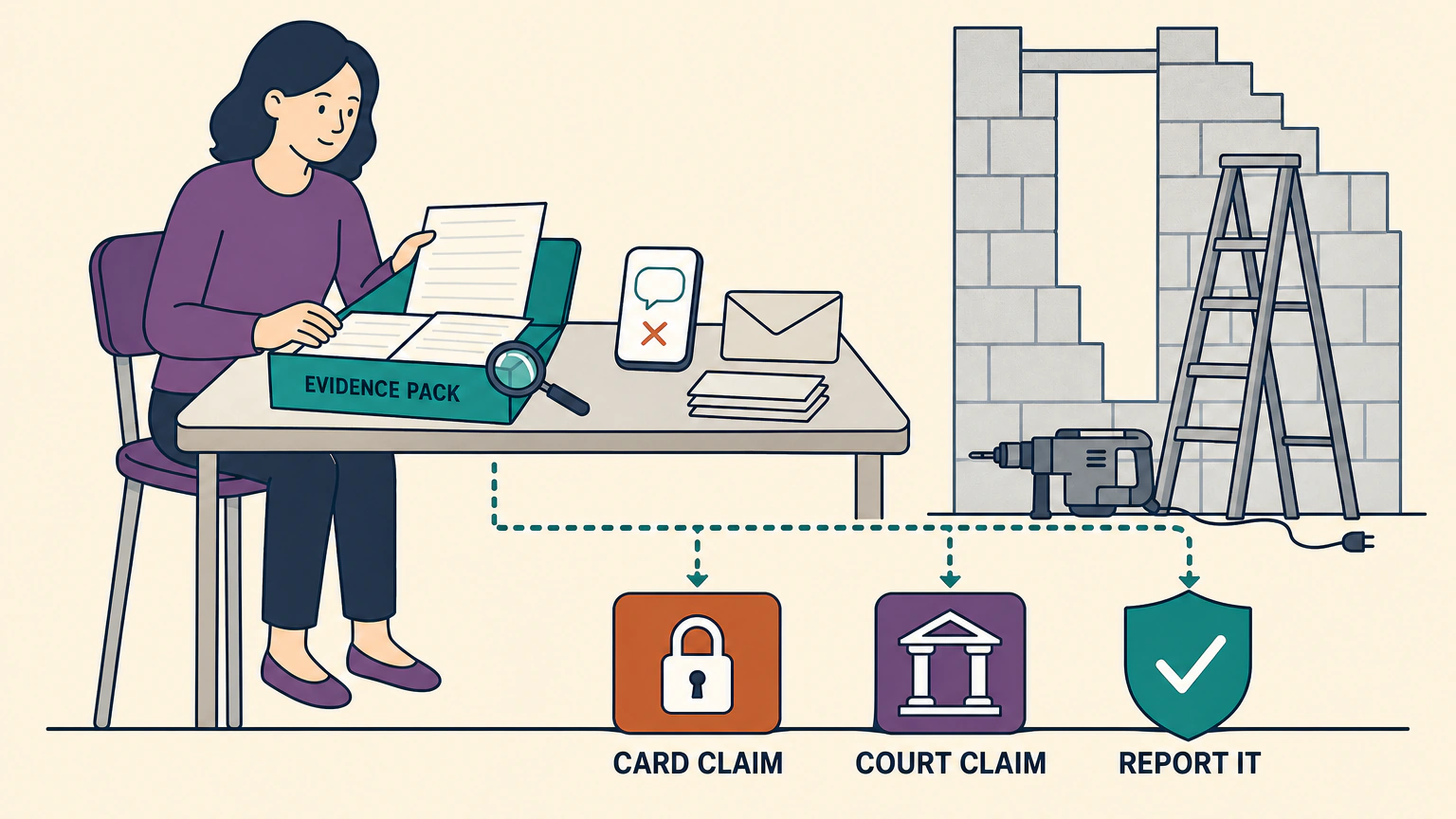
"My builder took my money and disappeared" describes two different things in law. One is a civil breach of contract. The other is fraud, if the trader intended to deceive you when they took the payment. How you paid, who you contracted with and the evidence of intent shape which routes are open.
| How you paid | What protects you | Who you claim from | Practical ceiling | Realistic timescale |
|---|---|---|---|---|
| Credit card | Section 75, Consumer Credit Act 1974 | Card provider and builder | Cash price over £100, not more than £30,000 | Varies; a formal complaint response is usually due within 8 weeks |
| Debit card | Chargeback, a scheme rule | Your bank, at its discretion | What you paid on the card | Usually around 120 days to raise; resolution time varies |
| Bank transfer | APP reimbursement rules | Your bank, if it was a scam | £85,000, civil disputes excluded | 5 business days, up to 35 |
| Cash | Nothing | The builder, in court | None | Months |
| Cheque or standing order | Qualifying APP scam protection can apply to a standing order; no equivalent payment route for a cheque | Your bank for a qualifying standing-order APP scam; otherwise the builder | £85,000 for qualifying APP claims; otherwise none | Normally 5 business days, up to 35 for qualifying APP claims; court timing varies |
Please note: this is general information about UK consumer law, not legal advice on your own facts. For that, the Citizens Advice consumer service covers England and Wales, Advice Direct Scotland covers Scotland, and Consumerline covers Northern Ireland.
On this page
- Before anything else: the three questions that decide your route
- Step one — put it in writing, set a deadline, and start the evidence pack
- What the Consumer Rights Act 2015 actually gives you
- The card route: Section 75, chargeback and the ombudsman
- The court route, and what it is capped at where you live
- Reporting it, and what to do if the company has vanished
- The gap nobody warns you about: the limits do not match what the work costs
- How to pay next time so a route stays open
- Frequently asked questions
Before anything else: the three questions that decide your route
Answer all three first. Each one can close a route on its own.
How did you pay?
A qualifying credit-card transaction gives you a statutory claim against the card provider. A debit card gives you less: chargeback, a card-scheme rule rather than a legal right. A qualifying APP scam paid by bank transfer can fall inside the mandatory reimbursement rules, and a standing order sent through Faster Payments counts as one of those transfers. A civil dispute does not. Cash gives you neither a card route nor an APP reimbursement route.
Which UK nation are you in?
England and Wales run one civil court system between them, so the forms, the ceilings and the fees are the same in Cardiff as in Carlisle. Scotland and Northern Ireland have their own ceilings, fees and time limits. Follow an English guide from a flat in Glasgow and you will fill in the wrong form.
Does the business still exist?
Take the name or number off your quote and search the Companies House register, then read the status carefully, because the labels are narrower than they sound. "Active" only means the company is still on the register, not that it is trading or could pay you a penny. In liquidation or administration, contact the insolvency practitioner about proving the debt. A dissolved company no longer exists, and a creditor normally has to restore it before pursuing recovery against it. No entry may mean a sole trader or an ordinary partnership, or that the details are wrong, so identify the contracting person or entity before you claim. Our guide on how to check a builder is registered covers these searches.
Step one — put it in writing, set a deadline, and start the evidence pack
A missed contractual obligation can be a breach. Your letter doesn't create that breach, but it records what you require and preserves evidence. For late work you will generally need to give a reasonable second deadline, unless the original timing was essential. And repeat performance isn't required where it is impossible, or where it can't be done within a reasonable time and without significant inconvenience to you.
What the letter has to do
Four jobs, none needing a paragraph: what was agreed, what has not happened, a specific date, and what you will do if that date passes. Send it so you can prove it arrived. Citizens Advice publishes a template for a service not provided on time, and there is no prize for writing your own.
The evidence pack to build while you wait
The same pack works whichever route you take, so start it today.
- The written quote or estimate, with any specification or drawings.
- Every payment record: card statements, transfer confirmations, cash receipts.
- All messages in date order, exported rather than screenshotted.
- Dated photographs, including a wide shot of each room or elevation.
- The deadline letter and proof of delivery.
- Two written quotes from other tradespeople to finish or put right the work, from plumbers or the relevant trade.
- The company name, number and registered address, with today's Companies House status.
- Any certificate, guarantee or building-control notification promised and never received.
Red flag: four things that can weaken your position. Bringing in a replacement without first giving a reasonable chance to return, where the law requires one. Refusing to pay an undisputed sum for work completed acceptably. Settling verbally without recording the terms. Paying more to restart the job without documenting why the cost was reasonable.
What the Consumer Rights Act 2015 actually gives you
Your contract does not stand on its own. The Act sits underneath it, and these are the sections worth quoting back.
Repeat performance, and when you cannot ask for it
Section 49 writes a term into every service contract: the trader must perform with reasonable care and skill. Section 55 is the one that lets you demand a second go. The trader has to perform again to the extent needed to complete the job in conformity with the contract, within a reasonable time, without significant inconvenience to you, and bearing the cost, labour and materials included.
Section 55(3) takes that right away where completing the work in conformity with the contract is impossible. A builder who has vanished has not, by vanishing, proved the job impossible. That is the statutory test.
Price reduction, and the 14-day refund clock
Section 56 lets you require the price to be reduced by an appropriate amount, and section 56(2) says that amount may be the full price. Section 56(4) is the sentence to put in your letter: a refund must be given without undue delay and in any event within 14 days beginning with the day on which the trader agrees that you are entitled to it. Read that trigger twice. The clock starts when the trader agrees, not when you ask. Sections 56(5) and 56(6) require the same means of payment and forbid a fee.
The remedies the Act leaves open
The statutory remedies don't replace the ordinary ones. Section 54(7) keeps all of them alive: damages, recovery of money paid where the consideration has failed, specific performance, specific implement in Scotland, relying on the breach against a claim the trader brings against you, and treating the contract as at an end. Section 54(6) lets you use those instead of the statutory remedies or alongside them, with one limit: you cannot recover twice for the same loss. On an abandoned job the claim is usually damages for the cost of finishing.
If you agreed it at your kitchen table or over the phone
A distance or off-premises contract normally carries a 14-day cancellation period. There is a catch. If you expressly asked the trader to start during that period, you may have to pay a proportionate amount for service already supplied. Custom-made goods, specifically requested urgent repairs and other statutory exceptions can change the result too.
The card route: Section 75, chargeback and the ombudsman
Three routes sit behind a card payment, and they are not equals. Work down them, strongest protection first.
Section 75, and what the £100 and £30,000 limits really mean
Section 75(1) of the Consumer Credit Act 1974 makes your card provider jointly and severally liable with the supplier for misrepresentation or breach of contract. So you can claim from either or both. Section 75(4) keeps the claim alive even if you had gone over your credit limit.
The limits are narrower than the headline suggests. Section 75(3)(b) removes the claim so far as it relates to any single item with a cash price of £100 or less, or more than £30,000. The figure that counts is the cash price, not the card payment: the Financial Ombudsman Service says Section 75 applies even if you only made part of the payment using credit.
Above £30,000 the door isn't shut, it moves. Section 75A can apply where a linked credit agreement arranged through the builder financed the job and the supplier cannot be traced, has not responded, is insolvent, or has not satisfied your claim after reasonable steps. It generally does not apply where the credit exceeds £60,260, except for a residential-renovation agreement, and other statutory exclusions apply. If your kitchen fitter contract and its linked finance meet those conditions, raise section 75A by name.
Pro tip: why a small card payment can matter. For a qualifying debtor-creditor-supplier transaction, it is the cash price that controls the Section 75 price test, not the size of the credit-card part-payment. Confirm that the legal chain and price limits apply before you rely on this protection.
Debit card: chargeback is a scheme rule, not a legal right
Ask for it anyway. Chargeback is a card-scheme rule rather than a statutory entitlement, and Visa, Mastercard and American Express each write their own. The Financial Ombudsman Service is blunt: your bank does not have to raise one. You usually have around 120 days from when you expected the service, so this is the route that quietly expires while you wait for the builder to ring back.
Bank transfer: why "he took my money" is usually a civil dispute
Mandatory reimbursement for authorised push payment (APP) fraud covers Faster Payments and CHAPS payments made on or after 7 October 2024. The maximum claim is £85,000. Firms may apply an optional excess of up to £100, which cannot be applied to vulnerable consumers. Report within 13 months. Reimbursement is due within five business days, with an outcome required within 35.
Now the part that catches people out. The rules exclude civil disputes, which the Payment Systems Regulator describes as paying a legitimate supplier for goods or services not received or defective, with no intent to defraud. Its guidance says plainly that non-receipt does not on its own indicate an APP scam. Report it anyway if there were signs of deception at the outset, but expect the civil-dispute answer.
If the bank says no: the Financial Ombudsman Service
The ombudsman is free, and you don't need a solicitor or a claims management company. Complain to the firm first. It gets eight weeks for most complaints, but only 15 days for fraud, scams and payment services, which is where a bank transfer sits. You then have six months from the final response, which is easy to lose while you wait. Its award limit is £455,000 for complaints referred on or after 1 April 2026 about acts or omissions on or after 1 April 2019.
The court route, and what it is capped at where you live
Three systems, three sets of rules, and in none of them do you need a solicitor.
What it costs, nation by nation
| Nation | Procedure | Ceiling | Above the ceiling | Where to start |
|---|---|---|---|---|
| England and Wales | County court money claim, small claims track | Not more than £10,000 (CPR 26.9(4)) | Fast track or above | GOV.UK, or form N1 |
| Scotland | Simple Procedure in the sheriff court | £5,000 or less | Ordinary cause procedure | Civil Online; paper needs sheriff approval |
| Northern Ireland | Small claims in the County Court | Not more than £5,000 | Abandon the excess, or issue a civil bill (up to £30,000) | Civil Processing Centre, Laganside |
England and Wales share one system, so there is no separate Welsh procedure or ceiling. Start a new money claim through GOV.UK and it will direct an eligible claim to the appropriate service. An existing case continues in the service through which it was issued. The fee follows the amount claimed:
| Claim amount | Fee |
|---|---|
| Up to £300 | £35 |
| £300.01 to £500 | £50 |
| £500.01 to £1,000 | £70 |
| £1,000.01 to £1,500 | £80 |
| £1,500.01 to £3,000 | £115 |
| £3,000.01 to £5,000 | £205 |
| £5,000.01 to £10,000 | £455 |
| £10,000.01 to £200,000 | 5% of the claim |
Help with fees is there if you are on a low income or certain benefits. Scotland and Northern Ireland set their own: from 1 April 2026 a Scottish simple procedure claim form costs £23 for sums of £300 or less and £127 otherwise, while Northern Ireland small claims run £49 up to £300, £81 to £500, £113 to £1,000, £163 to £3,000 and £244 above that.
Winning is not the same as being paid
A judgment against a company with no assets is a piece of paper with your name spelled correctly on it.
Enforcement is a separate application with its own fee, and it works only if there is something to enforce against: wages, a bank account, goods or a debt. We'd find that out before paying the issue fee. There is also a deadline for starting the claim. England, Wales and Northern Ireland give you six years on a simple contract. Scotland gives you five, and Scottish law goes further than a deadline: after five years with no relevant claim and no acknowledgment, the obligation is extinguished altogether.
Reporting it, and what to do if the company has vanished
Complaining is aimed at the trader. Reporting is aimed at the authorities. Only claiming gets your money back.
Trading Standards, through the Citizens Advice consumer service
Consumer services can pass what you tell them to Trading Standards as enforcement intelligence, but nobody there is pursuing your individual recovery. Use the Citizens Advice consumer service in England and Wales, Advice Direct Scotland in Scotland, and Consumerline in Northern Ireland.
You have plenty of company. Citizens Advice recorded 36,534 home maintenance and improvement complaints in a single year, more than 700 a week, with one in seven (5,230) involving scams or rogue traders. Roofing, roof sealing and chimney repairs was the largest category at 8,126 complaints, or 22.2%. If you are comparing roofers, preserve the same evidence.
When it crosses from a dispute into fraud
Some signs point past bad business towards deliberate deception: an address that does not exist, a company number belonging to another business, a name that changes between quote and invoice, or a pattern of taking deposits and vanishing. Signs like those can indicate fraud rather than only a consumer dispute. Report suspected fraud to Report Fraud in England, Wales and Northern Ireland, or to Police Scotland on 101 in Scotland, and give the report reference to your bank when you make an APP claim.
If the company has been dissolved or gone into liquidation
In liquidation or administration you will usually be an unsecured creditor. Submit details of the debt to the insolvency practitioner named on the register, but recovery depends on the assets available and on the competing claims.
Dissolved means struck off. A creditor normally needs the company restored before pursuing recovery against it, so take advice before you pay a fee.
If a new company turns up at the same address, with the same director and a near-identical name, take a dated screenshot. It is not proof of liability. It may be very useful reporting information.
The gap nobody warns you about: the limits do not match what the work costs

Several routes carry eligibility thresholds or procedural allocation limits. That is not the same as a cap on what a court can award, and the small-claims figures in particular are thresholds rather than ceilings on a judgment. Industry Oversight's own cost profiles, set against the three thresholds shown:
| Our category | National average | Sample | Against the ceilings |
|---|---|---|---|
| Builders (general contractors) | £32,109 | 828 cost profiles | Above all three, past the £30,000 Section 75 figure |
| Fitted kitchens | £32,149 | 721 cost profiles | Above all three |
| Roofing | £9,869 | 847 cost profiles | Inside £10,000, nearly twice £5,000 |
| Electrical work | £420 | 791 cost profiles | Inside every ceiling, above the £100 floor |
Those are our own aggregates rather than market statistics, and they move, so check the builders in your area panel for the current figure. The two £32,000-plus averages sail past Section 75's cash-price test and past all three small-claims thresholds shown. That is not the end of the road: qualifying APP reimbursement and the higher court tracks can exceed those figures. But the quickest routes run out first, at roughly the price of an average fitted kitchen.
How to pay next time so a route stays open
None of this helps with the money already gone. It helps with the next job.
For a qualifying debtor-creditor-supplier transaction with a cash price over £100 and not more than £30,000, a credit-card part-payment can preserve a Section 75 claim for the contract even when the rest is paid another way. Worth knowing before the deposit leaves your account.
Tie stage payments to visible, documented milestones rather than diary dates. And do not assume that splitting a contract into instalments resets Section 75's cash-price test.
Cash removes card and APP reimbursement routes and can make proof harder. If you do pay cash, insist on a written contract, invoice and signed receipt. A discount offered in exchange for missing paperwork is the most expensive discount in the trade.
Keep the quote, the messages and the payment records from day one, and check the trader before the money moves: our guide on how to check a builder is registered covers the register searches, and you can compare builders in your area before you appoint anyone.
Frequently asked questions
Can I get my deposit back from a builder who has not started?
Possibly, but not automatically. Whether you can recover it turns on the contract, the builder's breach, any work or costs already incurred, and any cancellation right. Ask in writing, use any qualifying payment remedy, and check the 14-day cancellation rules for a distance or off-premises contract, including what they say about work begun at your request.
What can I do if my builder abandons the job?
Get the missed obligation and a reasonable deadline down in writing, unless an essential deadline has already passed or repeat performance is unavailable. Then use whichever payment remedy applies to how you paid, and consider court after that. Obtain written quotes for reasonable completion or remedial work, because that cost may form part of the loss you claim.
Can I withhold payment for poor building work?
Sometimes, and carefully. Section 54(7) preserves your right to rely on the builder's breach against a payment claim, but the amount depends on the contract and the loss. Identify the disputed work and sum in writing, pay anything genuinely undisputed, and take individual advice before you withhold a substantial payment.
Can I take a builder to small claims court?
Yes, and without a solicitor. In England and Wales the small claims track handles claims of not more than £10,000, in Scotland Simple Procedure covers £5,000 or less, and in Northern Ireland small claims stop at £5,000. Above those figures a costlier procedure applies.
Does Section 75 cover bank transfers?
No, and this one catches people out. Section 75 works only where a credit agreement sits behind the payment, because section 75(1) makes the creditor liable alongside the supplier for a transaction financed by that agreement. A bank transfer has no creditor in it, so there is nothing to claim against. Transfers fall under the APP rules, which exclude civil disputes.
How do I report a cowboy builder?
Through the Citizens Advice consumer service in England and Wales, Advice Direct Scotland in Scotland, or Consumerline in Northern Ireland, all of which can pass intelligence to Trading Standards. Where there are signs of deliberate deception, use Report Fraud in England, Wales and Northern Ireland or Police Scotland on 101 in Scotland. Reporting does not itself recover money, but give the reference to your bank when you make an APP claim.
How much does it cost to take a builder to court?
In England and Wales the issue fee starts at £35 for claims up to £300 and reaches £455 for claims between £5,000.01 and £10,000, then runs at 5% above that. A Scottish simple procedure claim form costs £23 or £127. A Northern Ireland small claims application runs from £49 to £244.