

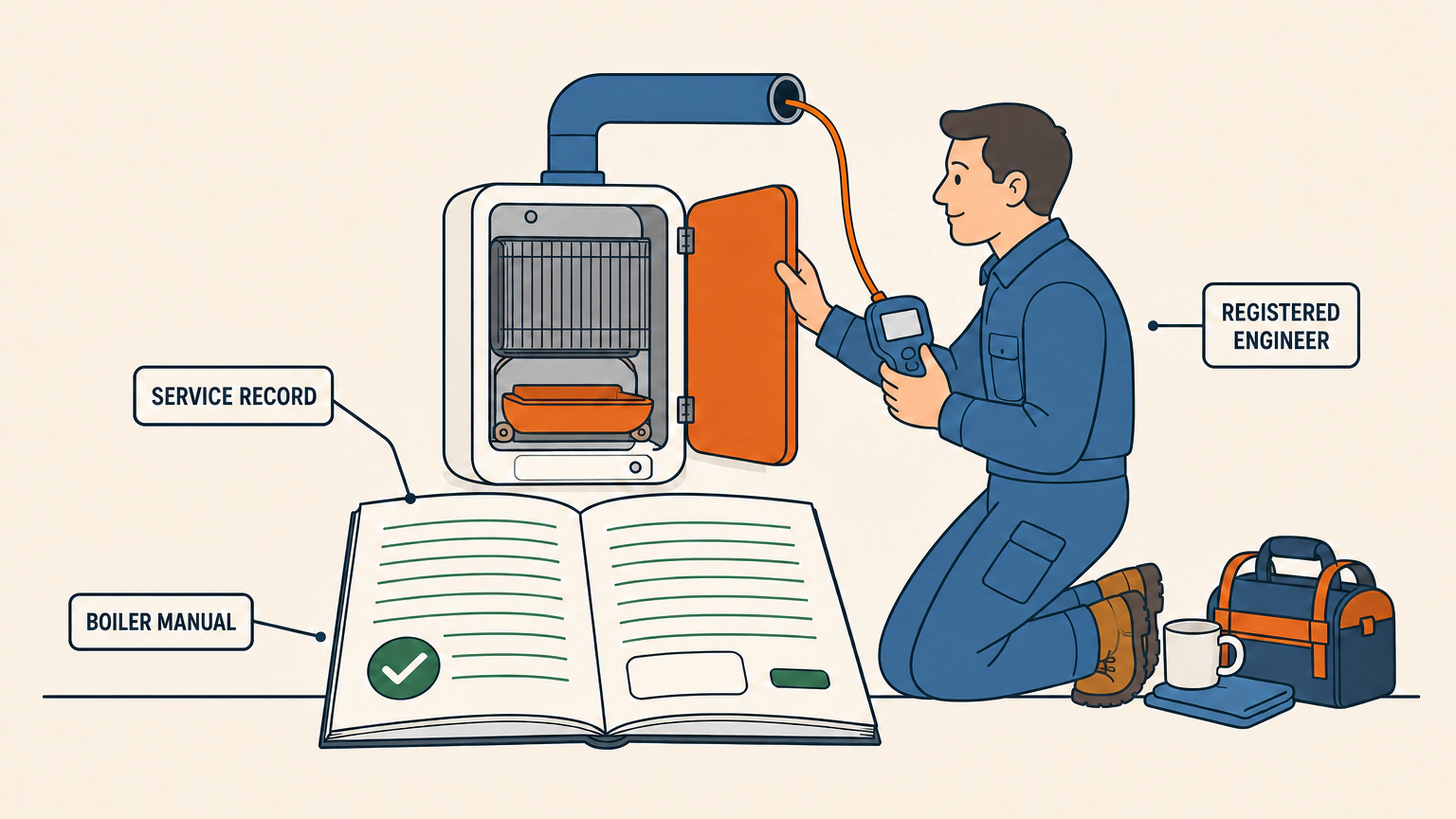
Regulation 26(9) names four checks after work on a gas appliance. The engineer must examine the flue, the combustion air supply, the gas pressure or heat input, and whether the appliance is operating safely. Other legal duties can apply, and the boiler's manual sets much of the service above that floor. That's why two neighbours with identical boilers can still get different visits under different service terms.
A service, a landlord's safety check and a manufacturer's service record are three separate things. The safety check is the one with a fixed legal timetable.
On this page
- The short answer, four checks follow gas work and the manual sets much of the service
- A service, a safety check and a certificate are three different things
- What a proper service covers, and what may cost extra
- The Benchmark service record, and the warranty riding on it
- Oil, LPG and homes off the gas grid
- Owner, landlord or tenant, who actually has to do this
- What it should cost, and why now is the month to book
- Frequently asked questions
The short answer, four checks follow gas work and the manual sets much of the service
Picture the visit as two layers. Regulation 26(9) sets a four-check floor after work on a gas appliance, and it's smaller than almost anyone expects. Other legal duties can apply when the job affects things such as gas tightness. Those Regulations run in England, Wales and Scotland. Northern Ireland has its own set, made in 2004, and the two aren't identical.
Above that floor, the boiler's manual and the service terms set the job. Manufacturers publish servicing instructions model by model, and a good engineer works to those. So when every "what's included" list you read disagrees with the next one, they may be describing different boilers or different terms rather than one national standard.
One thing is fixed at both layers. The person doing gas work must be competent, and their employer or business must be in the class the Health and Safety Executive approves. In practice, that means Gas Safe. Before the visit, it's worth knowing how to check the engineer is on the register.
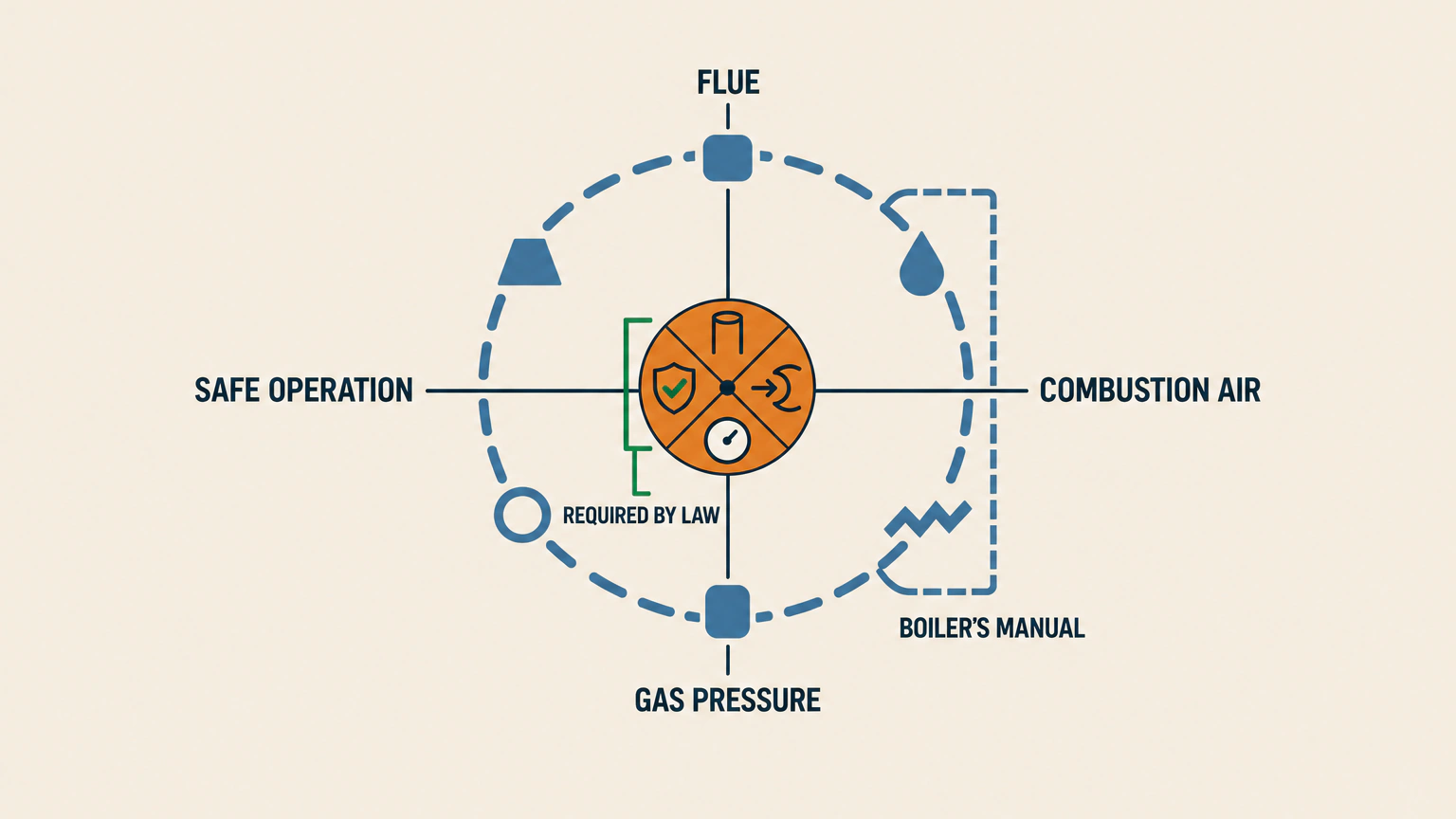
The four things the gas regulations actually name
Regulation 26(9) is one sentence. Anyone who works on a gas appliance has to examine four things straight afterwards:
- "the effectiveness of any flue"
- "the supply of combustion air"
- "its operating pressure or heat input or, where necessary, both"
- "its operation so as to ensure its safe functioning"
Then they must take all reasonably practicable steps to notify the responsible person and, if different, the owner about any defect. If neither can reasonably be reached, the regulation names the LPG supplier or gas transporter instead. An amendment in force since April 2018 added one alternative. Where examining the operating pressure or heat input isn't reasonably practicable, the engineer examines combustion performance instead.
Notice what the duty hangs on. It's triggered by work on the appliance, not by the word "service" on your invoice. Regulation 2 includes maintaining, servicing, permanently adjusting and repairing in its definition of work, so those four examinations follow a boiler service. Regulation 26(10) makes narrow exceptions for direct disconnection and some purging work.
A service, a safety check and a certificate are three different things
Three words get swapped about as though they meant the same thing. They don't, and the difference lands in two places: whether anyone could be prosecuted for skipping it, and whether you're left holding paper that proves it happened.
The Health and Safety Executive is blunt about the first half. Its guidance for landlords warns that you "should not assume that an annual service inspection includes the points required by a safety check". In the same breath, it says not to assume a safety check delivers effective maintenance either.
| What it is | Required by law | Who can carry it out | What you are left holding |
|---|---|---|---|
| Annual boiler service | No, not for an owner-occupier | A Gas Safe registered engineer, or a competent oil technician. OFTEC registration is a useful check | A service record, usually the Benchmark pages in your manual |
| Landlord's gas safety check | Yes. Regulation 36 fixes an annual deadline, and regulation 36A lets an early check in the final two months keep that anniversary | Someone registered with an HSE-approved body, as regulation 36(4) requires | The record described in regulation 36(3)(c), the CP12 or gas safety record |
| Benchmark service record | No, but warranty conditions may require it | The engineer who did the work | The completed Service Record pages in the installation instructions |
What a landlord's gas safety check has to record
Regulation 36(3)(c) sets out what belongs on the record, and it's a list of nine:
- the date of the check
- the address of the premises
- the landlord's or agent's name and address
- a description and location of every appliance and flue checked
- any safety defect found
- any remedial action taken
- confirmation the check meets regulation 36(9)
- the name and signature of the person who did it
- their registration number, or their employer's
Run your eye down all nine when the record lands. The name, signature and registration number tie a registered person to the check and its findings. The original record must carry them, although a new tenant's copy may omit the signature if it says a signed copy is available to inspect. Asking for a corrected record costs an email.
The 28 day rule, and the two month window most landlords miss
Two dates settle most arguments about gas records, and both sides can act on them.
First, the copy. A record has to reach each existing tenant within 28 days of the date of the check, and a new tenant gets the last record before they move in. GOV.UK tells tenants the same thing in almost the same words, so it isn't a matter of interpretation. Tenants: if 28 days have gone by and nothing has arrived, ask in writing and keep the reply.
Second, the one landlords keep paying for. Since April 2018, regulation 36A treats a check completed in the two months before the deadline as though it happened on the deadline itself. Book in September for an October anniversary and you lose nothing off the clock. Leave it to the last fortnight and you're bidding for the same engineer as everybody else.
Keep the record until two further checks have been carried out. If an appliance or flue is removed before then, keep its last record for two years. If an electrical report in the file has come back with codes, here's what the electrical report codes mean.
What a proper service covers, and what may cost extra
Above the legal floor, a decent visit to a gas combi runs like this. The casing comes off. The burner and heat exchanger are inspected and cleaned. Seals and the flue terminal get checked, and combustion readings are taken. The gas pressure is checked against the manufacturer's own figures, safety devices and controls are tested, and the condensate pipe is checked for a clear run. The system side is a separate question: the magnetic filter, the pressure and the inhibitor. Whether any of that is touched depends on the firm's terms.
Now the boundary that booking pages can blur. A one-off service is mainly an inspection with some cleaning. Repairs, radiator work, flushing and replacement parts may cost extra, depending on the terms you booked. Cold radiators and falling pressure can come from the wider heating system as well as the boiler. So the next call may be to one of the plumbers rather than a gas engineer.
This is general guidance on what a service covers and what the regulations require. Gas work is one of the very few household jobs where the law says the person doing it has to be on a register. So if anything about your appliance worries you, stop using it and call a registered engineer.
Ask for these before the engineer drives away
- Ask for the flue gas analyser reading, and ask for the numbers to go on the service record rather than into a phone.
- Ask which of the four regulation checks were done, and what the engineer found on the flue and the combustion air supply.
- Hand over the boiler's installation instructions and ask for the Benchmark Service Record page to be completed and signed on the day.
- Ask for anything the engineer thinks needs doing to be written down as remedial or improvement work, with a price, rather than mentioned at the door.
- Ask whether the system side was touched at all, so you know whether the filter, the pressure and the inhibitor were in the price or not.
- Check the record carries the engineer's name, signature and registration number before you pay.
The analyser reading you should ask to see
A flue gas analyser is a handheld meter with a probe that sits in the flue while the boiler fires. It reads what's coming out: carbon monoxide in parts per million and the carbon dioxide figure. Both are taken at maximum rate, and at minimum rate too where the boiler allows. Those numbers separate an engineer who measured your boiler from one who looked at it.
There's a reason you can ask without feeling awkward. The service record in the back of your manual has boxes printed for exactly these readings. Baxi's installation and servicing guide for one of its combis ends with twelve blank service slots. Each slot has spaces for the date, the engineer's name, the company and the phone number. Then there's the Gas Safe registration number, the carbon monoxide and carbon dioxide readings at maximum and minimum rate, the inhibitor check, comments and a signature.
So you aren't asking a favour. You're asking for a form to be filled in.
The Benchmark service record, and the warranty riding on it
Benchmark is a scheme run by the Heating and Hotwater Industry Council, and it's the reason your manual has forms in the back of it. Manufacturers in the scheme print a Commissioning Checklist and a Service Record inside the installation instructions. Engineers who follow the scheme's Code of Practice fill them in.
Pro tip: Those pages live on the inside back pages of the installation instructions, not in the slim user guide stuck to the fridge. If the manual is long gone, check the manufacturer's website for the installation and servicing instructions for your model. Dig it out before the appointment, not after.
The HHIC's own guidance for customers is unusually direct about what that means for you. It says: "The service engineer should complete the relevant Service Record on the Benchmark Checklist after each service." A later customer sheet says installers must work to the Benchmark commissioning checklist for warranty purposes.
The Code of Practice adds a duty most people have never heard of. Engineers in the scheme must "highlight to the customer any remedial or improvement work identified during the course of commissioning or servicing work". When one mentions something on the way out of the door, that's the line that gets it written down.
Red flags that mean ask again
- Ten minutes, and nothing was opened. Ask for the analyser reading and what was checked. The Energy Saving Trust says a service can take around 40 minutes to an hour, though the boiler's age and condition matter.
- Nothing written down, or the paperwork is a compliments slip. Ask for the Benchmark Service Record in your manual to be completed and signed before you pay.
- You're told the warranty is fine without a record. Check your manufacturer's own published terms, because that's where the condition lives, and get the pages filled in now.
- A landlord's record arrives with no registration number. Ask for a corrected record. If you're a new tenant and only the signature is missing, the copy must say a signed version is available to inspect.
What blank pages cost you
Manufacturers don't hide this. They just bury it. Baxi publishes its Benchmark conditions in plain sight. The installer completes the checklist on finishing the installation. The warranty is registered within 30 days. The boiler is serviced every year by a Gas Safe registered engineer. And Baxi says: "We may ask to see the Benchmark checklist if you make a claim while your boiler is under warranty."
So picture year five. The heat exchanger fails, the part is expensive, and somebody asks to see the checklist. Ten years of blank pages is a hard thing to argue with.
If yours are already blank, nobody can honestly backdate them. You can still start the record at the next service, keep the invoices from years you did pay for one, and ask the engineer to note in the comments box that this is a first entry on an older boiler. A part-filled record with dates and readings beats an empty one.
Oil, LPG and homes off the gas grid
If your heating burns oil, none of those gas regulations apply to it. Look for an OFTEC-registered technician rather than Gas Safe. OFTEC runs a competent person scheme the government recognises for liquid-fuel work.
OFTEC says plainly that "the servicing and repair of heating equipment is not covered under building regulations, but should always be done by a competent person". It adds that its registered servicing businesses work to industry and manufacturers' approved standards. So on oil there's no equivalent statutory four-check floor. The service follows those standards and your model's instructions, so ask for its servicing schedule. And note what the certificates OFTEC issues and replaces are. They cover installation work under the building regulations, not servicing.
Check the back of the manual anyway. Benchmark covers oil and gas cooker/boilers as well as gas systems, so the record pages may well be sitting there.
LPG is different again. It's a gas, and the 1998 Regulations plainly cover it. Regulation 26(9) names the supplier of liquefied petroleum gas among the people an engineer must notify of a defect. Your engineer still needs to be Gas Safe registered.
Owner, landlord or tenant, who actually has to do this
Start with the question the search box asks outright. If you own your home and live in it, the 1998 Regulations don't put an annual servicing duty on you. Part F, the maintenance part, names employers and self-employed people for appliances at work, and landlords. Owner-occupiers aren't in it.
Three reasons to book anyway, and none is fear. The warranty condition is real and it's yours to lose. A poorly performing boiler may cost more to run. And a service before winter gives you time to deal with a fault before the coldest weather.
Northern Ireland deserves its own line. Its 2004 Regulations carry the same four checks and a parallel landlord regime, but they never picked up the 2018 amendments. So there's no combustion-performance alternative there, and no two-month early-booking rule.
| You are | What the law requires of you | What your warranty requires | What you should be handed |
|---|---|---|---|
| Owner-occupier, England, Wales or Scotland | Nothing. The 1998 Regulations put no servicing duty on you | Usually an annual service by a Gas Safe registered engineer | A completed Benchmark Service Record page |
| Landlord, England, Wales or Scotland | A safety check on each appliance and flue at least every 12 months, by a registered engineer, with a record kept (regs 36(3), 36(4)) | The same annual service the manufacturer asks for | Your copy, plus proof the tenant had theirs within 28 days |
| Tenant, England, Wales or Scotland | Nothing, beyond letting the engineer in | Not your document. It follows whoever owns the boiler | The record before you move in, or within 28 days of any later check |
| Landlord, Northern Ireland | The same 12-month check, nine-item record and 28-day duty, under reg 36 of the 2004 Regulations. No reg 36A, so no two-month window | The same annual service the manufacturer asks for | The record, kept two years from the date of that check |
What it should cost, and why now is the month to book
The Energy Saving Trust puts a one-off gas boiler service at around £80 to £120 and says it takes roughly 40 minutes to an hour.
Timing is the other half. If you're a landlord, a check completed in the two months before its deadline keeps the original anniversary under regulation 36A. If you're an owner, an early autumn service gives you time to deal with any fault before the coldest weather.
Do one thing before the engineer arrives. Find the installation instructions and put them on the kitchen table. That's the difference between a service that leaves a record and one that leaves a memory.
If you need somebody, our list of heating and gas engineers near you is a place to start. We set out how we check the businesses we list in plain words. A listing still isn't a substitute for reading the paperwork, and we'd rather say so than pretend otherwise. If the visit comes back with a verdict of replace rather than repair, the next question is whether you qualify for the heat pump grant before you commit to another gas boiler.
Frequently asked questions
Is it a legal requirement to service a gas boiler?
Not if you own your home and live in it. Nothing in the Gas Safety (Installation and Use) Regulations 1998 puts a servicing duty on an owner-occupier. Landlords are the exception: regulation 36 requires a safety check on each appliance and flue at intervals of not more than 12 months, plus a record of it. Your manufacturer's warranty may still demand an annual service.
Does a boiler service include the radiators?
Usually not. The service covers the appliance, and radiators belong to the wider system. Bleeding one or two is a courtesy some engineers throw in, but cold radiators, sludge and a power flush may be separately quoted. Ask before the visit whether the system side, meaning the filter, the pressure and the inhibitor, is in the price.
Does a boiler service check for carbon monoxide and gas leaks?
Yes, at the appliance. The engineer's flue gas analyser measures carbon monoxide in parts per million while the boiler fires, and there's a printed box for that reading on the Benchmark service record. If servicing might affect gas tightness, regulation 6 requires an immediate tightness test at least as far as the nearest upstream and downstream valves. Regulation 26(9) separately requires the flue and the combustion air supply to be examined after work on the appliance. Ask for the numbers in writing.
How long should a boiler service take?
Around 40 minutes to an hour, according to the Energy Saving Trust, though it depends on the boiler's age and condition. Ten minutes with nothing opened is a reason to ask what was checked. If yours was that quick, ask for the analyser readings and which of the four regulation checks were carried out before you pay.
Can a boiler service be backdated?
No. A service records what an engineer found on a particular day, so nobody can honestly write it up for a date they weren't there. If you've missed years, start the record now and keep it running. Baxi, for one, says it may ask to see the checklist on a warranty claim, and a part-filled record beats an empty one.
What happens if you miss a year?
Missing one year won't make the boiler stop, but two things change. Your warranty condition may no longer hold: Baxi's terms, for one, require an annual service by a Gas Safe registered engineer. And you've missed the planned check of the flue, the combustion air supply and the combustion readings. Book the service and open the record page at that visit.