

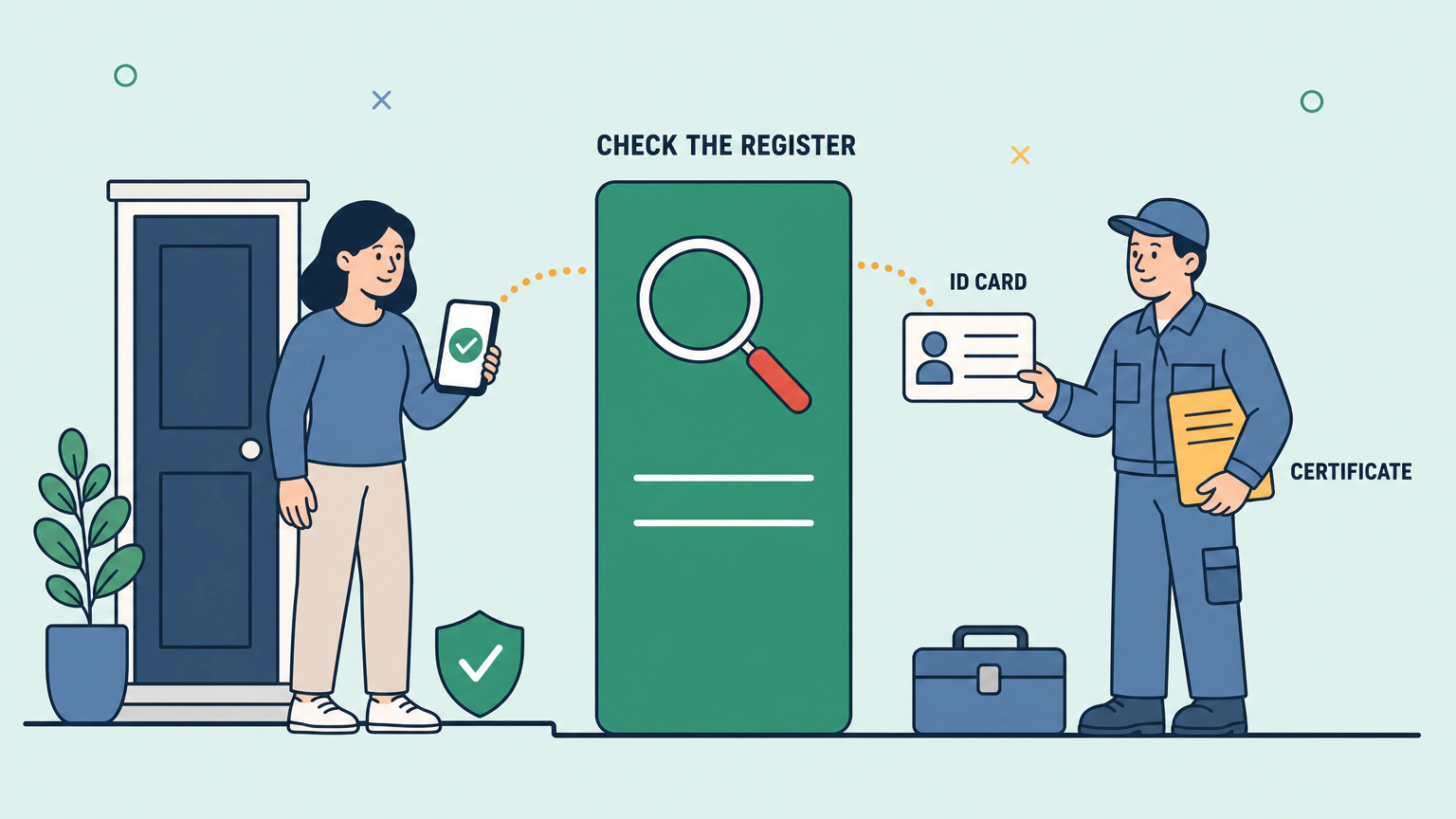
There is no builder's licence in the UK, and no national register that tells you whether a general builder may trade. The legal check depends on the job: gas work requires Gas Safe registration; work on heat-pump equipment containing F-gas can require certified people and businesses; higher-risk asbestos work in Great Britain requires an HSE licence; and authorised firms can self-certify specified building work. For everything else, you need voluntary-scheme and business checks.
So the question that gets you an answer isn't "is this builder registered". It's "what work am I having done, and which nation am I in".
On this page
- The short answer: "registered" means five different things, and only one of them is the law
- Which register applies to your job
- Gas work: the register you cannot skip
- Competent person schemes: the self-certification layer in England and Wales
- Scotland, Wales and Northern Ireland: the same job, a different gate
- TrustMark, trade bodies and platform vetting: useful, but not the law
- Five checks that apply to every trade, licence or not
- Red flags that mean stop
- What to do if the work is already done and you have no certificate
- Frequently asked questions
The short answer: "registered" means five different things, and only one of them is the law
When a tradesperson says they're registered, they could mean any of five things: legally required registration, competent person self-certification, a company number at Companies House, trade association membership, or a directory's vetted badge.
Only the first can be compulsory. The first two can produce certificates relevant to the work. The last two are the easiest to imply while holding nothing, because a logo on a van is not proof of membership.
Why the UK has no builder's licence (and what that actually means for you)
Extensions, plastering, kitchen fitting, driveways, decorating: none of it carries an entry requirement. Anyone can call themselves a builder tomorrow morning, with no qualification, no exam and nobody to strike them off.
The government's Regulated Professions Register lists every occupation in the UK protected by law. Search it for "builder" and three results come back, all of them something else: Chartered Building Services Engineer, and Professional Diver twice. Search it for gas and Registered Gas Engineer appears at once, under the Health and Safety Executive for England, Scotland and Wales, and under HSENI for Northern Ireland.
That absence is what gives the free checks their weight. If you're still gathering names, our directory of builders in your area is a starting point rather than a substitute for them.
The one question that tells you which check applies
Stop asking whether the person is registered and ask which legal check follows the job. Gas work requires Gas Safe registration. Work on heat-pump equipment containing F-gas can require certified people and businesses, and higher-risk asbestos work in Great Britain requires an HSE licence. Other work may need building control approval even though the builder's job title is not licensed.
Which register applies to your job
Two columns carry the weight. The legal-status column tells you whether a statutory rule applies and whether you may need evidence of compliance when you sell. The last column is the one to read out loud before anybody starts, because agreeing what you'll be handed at the end is the cheapest thing you can do today. For replacement windows and external doors that document could be a FENSA or CERTASS certificate, or one from another authorised scheme, worth settling before you sign with any of the window and door installers who quoted.
England and Wales first, because that's where the per-job scheme lists sit in the Building Regulations themselves. Scotland and Northern Ireland run on a different system entirely.
| The job | Required by law? | Register or scheme | How to check, free | What you should receive |
|---|---|---|---|---|
| Gas boiler, gas fire or any gas appliance | Yes, UK-wide | Gas Safe Register | Search the register, or ring 0800 408 5500 | Compliance certificate for a new appliance, plus the engineer's own record |
| Heating or hot water system and its controls | No; self-certification is available when approval is needed | Competent Persons Register | Postcode or business name | Compliance certificate within 8 weeks when self-certified |
| Oil-fired boiler or oil storage tank | No; self-certification is available when approval is needed | Competent Persons Register (OFTEC and five others) | Postcode or business name | Compliance certificate within 8 weeks when self-certified |
| Solid fuel or wood-burning stove | No; self-certification is available when approval is needed | Competent Persons Register (including HETAS) | Postcode or business name | Compliance certificate within 8 weeks when self-certified |
| Fixed electrical work in a home | No, and only some jobs are notifiable | Registered Competent Person Electrical | Postcode or company name | Electrical installation certificate to BS 7671, plus a Part P certificate for notifiable work |
| Replacement windows, rooflights or doors | No; self-certification is available when approval is needed | Competent Persons Register (FENSA, CERTASS, Assure and three others) | Postcode or business name | Compliance certificate within 8 weeks when self-certified |
| Replacement roof covering | No; self-certification is available when approval is needed | Competent Persons Register (NAPIT or CompetentRoofer) | Postcode or business name | Compliance certificate within 8 weeks when self-certified |
| Cavity, internal or external wall insulation | No; self-certification is available when approval is needed | Competent Persons Register | Postcode or business name | Compliance certificate within 8 weeks when self-certified |
| Bathroom fittings, sinks and cold water supply | No; self-certification is available when approval is needed | Competent Persons Register | Postcode or business name | Compliance certificate within 8 weeks when self-certified |
| Solar PV, heat pump or other microgeneration | Sometimes: covered installation or servicing work on heat-pump equipment containing F-gas requires certified people and businesses; self-certification is available when building approval is needed; grant funding needs MCS | Competent Persons Register; an approved F-gas certification body where applicable; MCS for a Boiler Upgrade Scheme grant | Search the relevant register or certification body by business name | Compliance certificate when self-certified, plus MCS paperwork for the grant |
| General building work with none of the above (extension, plastering, kitchen fitting, driveway, decorating) | No general builder register; specialist parts can carry separate legal checks | None for general building; use the relevant specialist register or licence check where applicable | Companies House, the insurance certificate, a trade body's own directory, and any relevant specialist register | A written quotation, plus a completion certificate for any part needing approval |
Which Register Should You Check?
Gas boiler, gas fire or any gas appliance
Required by law In England
What the rule is
Gas work may only be carried out by a member of a class of persons approved by the Health and Safety Executive, and it is an offence to falsely pretend to be one - Gas Safety (Installation and Use) Regulations 1998, regulation 3(3) and 3(7).
Where to check, free
Gas Safe Register; search a business by postcode or registration number, check an engineer with the licence number on the ID card, or call 0800 408 5500.
What you should receive
A Building Regulations compliance certificate for a new appliance, plus the engineer's own record of the work.
One thing to watch
An in-date ID card is not enough on its own - the work categories on the back of the card must cover the appliance being worked on.
England and Wales self-certification answers are drawn from Schedule 3 to the Building Regulations 2010. Scotland and Northern Ireland are answered at building-control system level. Gas and F-gas cards also apply the separate statutory registration or certification rules for that work. Your council's building standards or building control team is the authority on whether your job needs approval.
Gas work: the register you cannot skip
Regulation 3(3) of the Gas Safety (Installation and Use) Regulations 1998 is blunt. No employer may let an employee work on a gas fitting or service pipework, and no self-employed person may do that work, unless they belong to a class of persons approved by the Health and Safety Executive. That class is the Gas Safe Register.
Northern Ireland has near-identical wording of its own, in regulation 3(3) of the Gas Safety (Installation and Use) Regulations (Northern Ireland) 2004. HSE confirms the register covers Great Britain, Northern Ireland, the Isle of Man and Guernsey. Wherever you live, this one isn't optional, which is worth knowing before you ring round heating and gas engineers in October.
If you ever smell gas, ring the National Gas Emergency Service on 0800 111 999, open the doors and windows, and turn the supply off at the meter control valve if you know where it is. HSE's other line is worth repeating: it is illegal for anyone to use a gas appliance they suspect is unsafe.
What is actually on a Gas Safe ID card
HSE describes the card plainly. The front carries a photograph, a registration number and an expiry date, and the reverse lists the categories of work the engineer is qualified to do: cookers, boilers, gas fires and so on. That reverse side is the half most people never turn over, and it's the half that matters, because an in-date card proves the engineer is on the register and nothing more.
Then check the register rather than the card. Gas Safe Register's Check an Engineer service takes the licence number printed on the card and returns the registered engineer's photograph and qualifications, so you can confirm the person on your doorstep matches the record. If you'd rather not use a website, ring 0800 408 5500.
Faking it is a criminal offence, and what to do if they can't show a card
Regulation 3(7), in Great Britain and Northern Ireland alike, says no person shall falsely pretend to be a member of the approved class. Claiming to be Gas Safe registered when you aren't is an offence in itself, separately from anything that happens to the pipework.
So if the card doesn't appear, the work doesn't start. Not "we'll sort it later", not "it's in the van". Report suspected illegal gas work on 0800 408 5500. If you suspect the appliance is unsafe, do not use it until a Gas Safe registered engineer has checked it.
Competent person schemes: the self-certification layer in England and Wales
The mechanism is simpler than the vocabulary. Instead of you applying to the council for building regulations approval and waiting, a firm registered with an authorised scheme certifies its own work and notifies the council on your behalf. Schedule 3 to the Building Regulations 2010 names which type of work each scheme operator may sign off.
The brand on the van is not the name in the law
The names in Schedule 3 are legal entities. The names on the van are brands. The statute says "Certsure LLP", the sticker says NICEIC. It says "Fensa Limited under the Fenestration Self-Assessment Scheme", "Oil Firing Technical Association Limited" for what everyone calls OFTEC, and "the National Federation of Roofing Contractors Limited" for the scheme trading as CompetentRoofer.
Pro tip: Searching the open web for a firm plus "NICEIC" and finding nothing proves nothing. Use the register's own search box, search by business name or postcode rather than by scheme brand, and let it tell you which operator the firm sits under.
Electrical work and Part P
Part P of Schedule 1 sets one requirement, P1: reasonable provision must be made in the design and installation of electrical installations to protect people operating, maintaining or altering them from fire or injury. It covers low and extra-low voltage work in or attached to a dwelling, in shared parts of a building, and in a garden fed from the house supply.
Two lawful routes exist. Use a scheme-registered electrician who self-certifies, or notify building control before the work starts. Either way you should end up with an electrical installation certificate confirming the work meets BS 7671, plus the Building Regulations compliance certificate most people call a Part P certificate.
Here England and Wales genuinely part company, and almost every guide misses it. In England, regulation 12(6A) narrows notifiable electrical work to three things: a new circuit, a replacement consumer unit, or an addition or alteration to an existing circuit in a special location, meaning the zones around a bath or shower and rooms with a swimming pool or sauna heater. That paragraph stopped applying in Wales in June 2018. So a Welsh homeowner adding a socket in the kitchen or a supply to a garden shed is having notifiable work done, where an English one usually isn't. In Wales, put it to the electricians who quoted: who is notifying the council?
The certificate you should get within eight weeks
GOV.UK puts a deadline on it. A registered installer "will give you a certificate within 8 weeks of completion which can be used as evidence of compliance", and it "will also show up in solicitors' searches if you come to sell your home".
Put that date in your calendar on the day the work finishes. Chasing a certificate at week nine is a phone call. Chasing it three years later, mid-sale, with a buyer's solicitor waiting, is a problem.
The two free registers to search
Two searches cover most of this, both free and both public. The Competent Persons Register at competentperson.co.uk takes a postcode or a business name and filters by trade: glazing, insulation, heating, gas, roofing and renewables. For domestic electricians in England and Wales, the register at electricalcompetentperson.co.uk lists everyone signed up for full-scope domestic work. In its own words, they are "authorised by Government to self-certify that their work is compliant with Building Regulations".
A firm that doesn't appear isn't automatically a bad firm. It means the shortcut isn't available. If the job needs approval, someone must apply to building control before work starts.
Scotland, Wales and Northern Ireland: the same job, a different gate
Almost every page on this subject describes England and calls it the UK. That holds until a reader in Glasgow or Ballymena follows it.
| Nation | Who approves the work | Can the tradesperson self-certify? | Is gas different? | Where to check |
|---|---|---|---|---|
| England | Council building control, or a registered building control approver | Yes, through a competent person scheme | No, Gas Safe applies UK-wide | Competent Persons Register, then your council |
| Wales | Council building control, or a registered building control approver | Yes, though more electrical work must be notified than in England | No, Gas Safe applies UK-wide | Competent Persons Register, then your council |
| Scotland | Council building standards, through a building warrant | No, approved certification exists but is optional | No, Gas Safe applies UK-wide | Scottish Government Certification Register, then your council |
| Northern Ireland | Your district council's Building Control service | No competent person scheme route for this building work | No, Gas Safe applies UK-wide | buildingcontrol-ni.com, then your council |
England and Wales
One system, two routes: a competent person scheme, or an application to a building control body before work starts. That body can be your council or a private registered building control approver.
Scotland: the building warrant is the legal gate
Scotland doesn't use competent person schemes at all. Where approval applies, a building warrant is the first step, and mygov.scot is unambiguous about skipping it: it's an offence to start building work without a warrant when you need one, and you could be fined. The warrant comes from your council's building standards department, lasts three years, and arrives with a Construction Compliance and Notification Plan that sets out when inspections fall due.
Approved certification does exist, for design and for construction work such as electrical installation, drainage, heating and plumbing. But mygov.scot says using an approved certifier is "optional, you don't have to", which is the exact inverse of the English mental model. Here the council is the authority, not the tradesperson.
Northern Ireland: tell your district council first
Northern Ireland has no competent person scheme route for this building work. As nidirect puts it, you must tell the council in your area about building work you want to do, and it will inspect and approve work meeting the standards. Building Control Northern Ireland is the umbrella group for the building control departments of the eleven district councils.
The application names look familiar: Full Plans, a Building Notice, Regularisation for work already carried out without consent, or an application for exemption. What's missing is the shortcut. No scheme membership removes the duty to tell the council. If a tradesperson says otherwise, that's the moment to ring the council yourself. When the work is finished and satisfactory, building control issues a Certificate of Completion.
TrustMark, trade bodies and platform vetting: useful, but not the law
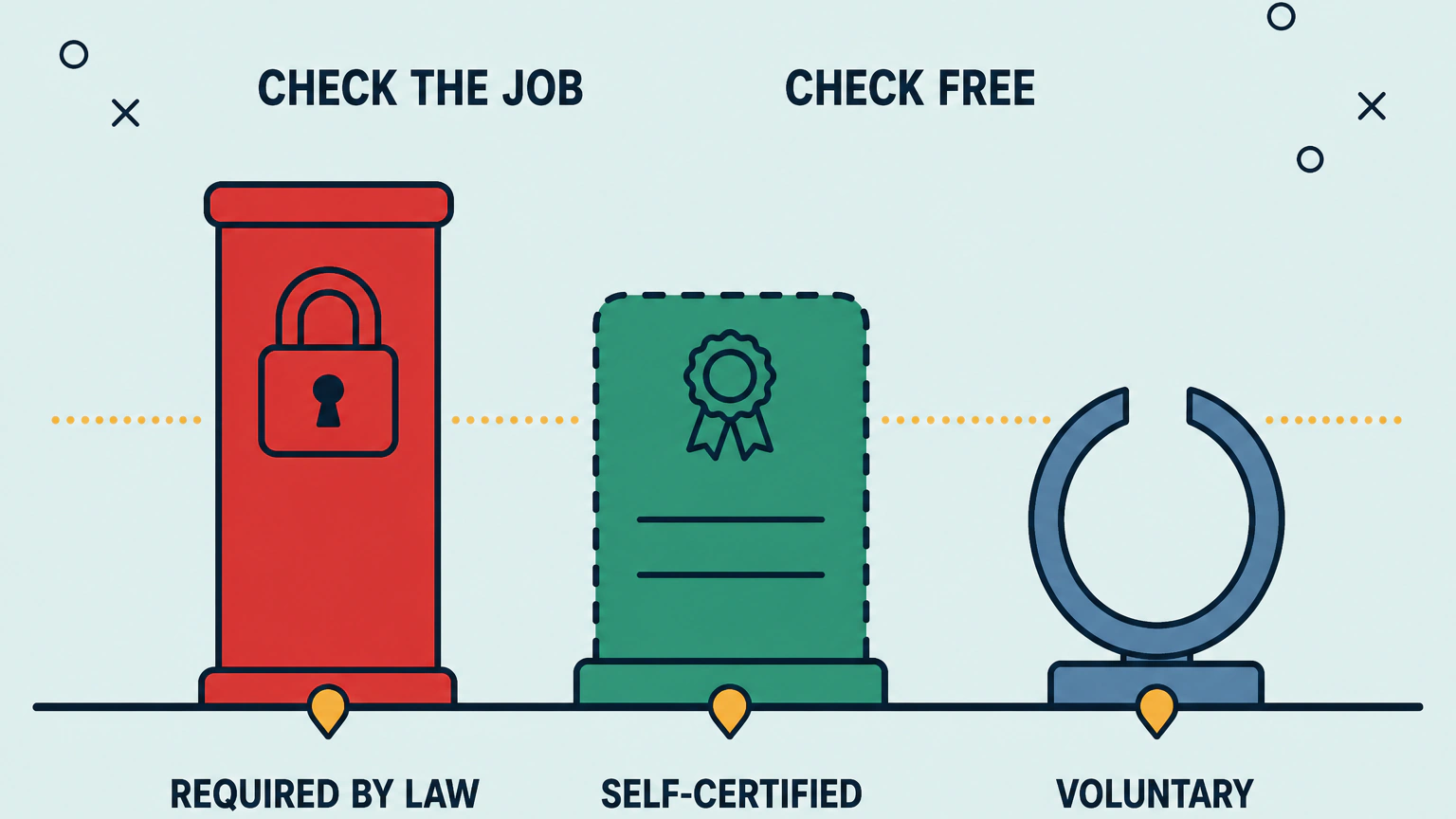
Nobody commits an offence by lacking any of it. These are voluntary schemes, which doesn't make them worthless, but a logo is not a legal status.
What TrustMark actually guarantees
TrustMark calls itself the Government Endorsed Quality Scheme, and the businesses on its register are vetted and monitored by its scheme providers rather than by TrustMark itself. It expects every one of them to carry at least two years of financial protection. That cover runs to prepayments such as deposits, workmanship after completion, rectification of defects and non-compliance with building regulations, and major damage or injury through public liability insurance. Its primary authority partner is Buckinghamshire and Surrey Trading Standards, and it's a member of the Dispute Resolution Ombudsman.
Complaints go to the business first, then its scheme provider, then the ombudsman. TrustMark isn't the body that investigates your dispute.
Trade associations, and reading a logo properly
Membership of a trade body is voluntary and entry criteria vary enormously, so the logo tells you far less than the number behind it. Three steps, always the same: ask which association, ask for the membership number, search that association's own directory yourself. Treat an unverifiable logo as no membership at all.
What a directory's "vetted" badge does and does not mean
We'll be straight about our own layer, because it's this one. Platform vetting, ours included, is a filter that narrows a field. It isn't a legal check, it doesn't notify your council, and it doesn't produce the certificate a solicitor will want in five years. Read how Industry Oversight checks the businesses it lists and judge it yourself, then run the register check for your job anyway. Our own cost profiles put the national average for a general building job at £32,109 across 828 profiles, which is a lot of money to hand over on the strength of a badge.
Five checks that apply to every trade, licence or not
- Search the company name at Companies House and check it matches the name on the quotation.
- Ask for the public liability insurance certificate and check the policy dates cover the whole job, not just today.
- Ask which scheme or register they belong to, get the number, and search that register yourself rather than trusting a logo.
- Get a written quotation that lists what is included, what is excluded and when each payment falls due.
- Agree in writing which certificate you will receive at the end, and the date you should have it by.
Companies House, in two minutes
The free search gives you three things: whether the legal name matches the name on the quotation, when the company was actually incorporated (against those claimed twenty years of trading), and whether its accounts are overdue. The same service searches disqualified directors. Companies House prints its own caveat, and it's a fair one: it doesn't check the accuracy of what companies file. A sole trader won't appear at all, which is normal rather than sinister.
Public liability insurance, and why the certificate date matters
No law generally requires a builder to hold public liability insurance, which surprises most people. The compulsory cover is employers' liability: most businesses with employees must hold at least £5 million from an authorised insurer and can be fined £2,500 for every day they do not. Ask for the public liability certificate and, where the builder has employees, the employers' liability certificate. Check the policy dates run past your finish date and that the insured name matches the business you're paying.
Get it in writing: quotation, staged payments, and no cash
A verbal estimate is not a quotation. Get the price in writing with inclusions, exclusions and payments tied to milestones rather than dates, keep the deposit modest, and pay by transfer or card so there's a trail. When something changes mid-job, and it will, get the revised price in writing first.
Red flags that mean stop
Each of these has a matching move, and none of them needs you to be an expert.
Red flag: They can't or won't show a Gas Safe ID card before gas work starts. Don't let the work begin, and report it to Gas Safe Register on 0800 408 5500.
Red flag: They display a scheme logo but won't give you a registration number. Ask once, then treat a refusal exactly as you'd treat no membership.
Red flag: They want a large cash deposit before anything has been ordered. Move to a staged, written payment schedule with a traceable payment method.
Red flag: A competent-person installer says the compliance certificate will follow "at some point". Agree the eight-week deadline in writing on the day the work completes.
Red flag: They pressure you to decide today, or say building control approval is unnecessary for notifiable work. Ring your council's building control team, or building standards in Scotland, before committing.
What to do if the work is already done and you have no certificate
Most people meet this during a sale, when a buyer's solicitor asks for a certificate nobody has. Retrospective approval may be available, but the route depends on the nation and the work.
The route depends on where the property is. In England and Wales, ask local authority building control about regularisation; only work carried out after 11 November 1985 can be approved this way, and alterations may be required. In Scotland, completed work that should have had a warrant requires a late completion certificate submission, assessed against the building regulations in force when you submit it. In Northern Ireland, ask the district council's Building Control service about its regularisation application.
Ring building control before you commission anyone to put it right, because they'll tell you what evidence they need. Then keep every certificate you do hold, boiler to windows, in one folder, so the next sale is an email rather than an excavation. If the remedial work needs a new firm, our list of builders in your area is a place to start.
We write as an editorial team, not as your council's building control officer, so treat this as general information rather than legal advice. The rules differ across the four nations and they change, and on your own job the last word belongs to your local building control or building standards team.
Frequently asked questions
Do builders have to be registered in the UK?
No. There's no licence or register for general building work, so anyone can trade as a builder tomorrow morning. But specialist work can carry separate legal checks: gas work requires Gas Safe registration, work on heat-pump equipment containing F-gas can require certification, and higher-risk asbestos work in Great Britain requires an HSE licence.
Who regulates builders in the UK?
Nobody regulates builders as a profession. Different bodies regulate different pieces of the work: the Health and Safety Executive in Great Britain and HSENI in Northern Ireland stand behind gas registration, your council's building control (building standards in Scotland) enforces the building regulations, and Trading Standards handles unfair trading. There's no single licensing body above the trade.
How do I check if a builder is Gas Safe registered?
Ask for the ID card, then check the register rather than the card alone. Gas Safe Register's Check an Engineer service takes the licence number from the card and returns the engineer's photograph and qualifications, so you can confirm the person on your doorstep matches the record. If you'd rather not use the website, ring 0800 408 5500.
What does a Gas Safe ID card look like?
The front carries a photograph, a registration number and an expiry date, and the reverse lists the categories of work the engineer is qualified to do, such as cookers, boilers and gas fires. That's HSE's own description. The categories matter as much as the expiry date, because an in-date card proves registration and nothing more.
What if my installer is not on any scheme?
It isn't automatically a red flag, but it changes the paperwork. If the job needs approval and the installer can't self-certify, someone must apply to building control before work starts. Ring the relevant building control or building standards team and include any application fee in the quotation.
Do I need a building regulations certificate for a new boiler?
Yes. A new gas boiler is notifiable work, so you should end up with a Building Regulations compliance certificate as well as the engineer's own record of the job. A registered installer notifies your council and the certificate follows within eight weeks. If nobody notifies anyone, the installation is unauthorised.
What insurance should a builder have in the UK?
Public liability insurance is the one to ask for, though no law generally forces a builder to carry it. The compulsory cover is employers' liability: most businesses with employees must hold at least £5 million from an authorised insurer and can be fined £2,500 for every day they do not. Ask for the public liability certificate and, where the builder has employees, the employers' liability certificate. Read the dates on both.
Why does the certificate matter when I sell my house?
Because you may need it when you sell. GOV.UK says a competent person scheme certificate "will also show up in solicitors' searches if you come to sell your home". If the paperwork is missing, the available route depends on the nation, the work and when it was done.