

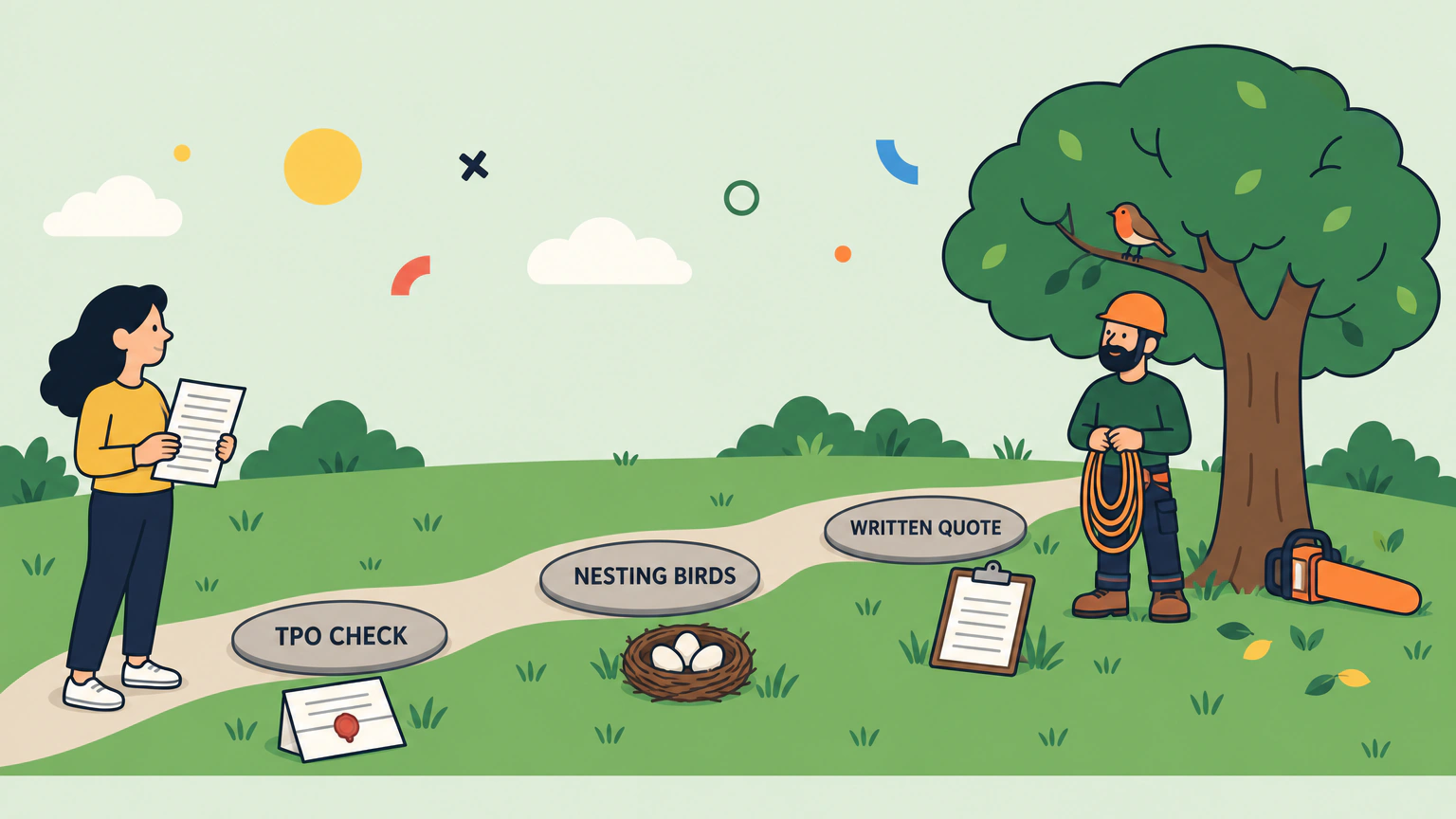
Most UK price guides put felling a small garden tree at £150 to £550, and a big one anywhere from about £650 to £3,500 or more, with stump grinding on top at roughly £50 to £400 a stump. Before anyone quotes, find out whether the tree has a preservation order or stands in a conservation area, and whether birds are nesting in it, because either can stop the job or push it back by weeks. So: the price first, then the council, the birds and who to hire.
On this page
What a tree surgeon costs in the UK
Tree surgeons price the job, not the hour. What moves the figure is the tree's height, how easily the crew can reach it and what happens to the wood. Guides to tree removal cost disagree more than they look, because each sizes trees its own way and only some include VAT. Here's the tree felling cost from four of them.
| Price guide | Small tree felled | Medium tree felled | Large tree felled | Stump removal or grinding | VAT |
|---|---|---|---|---|---|
| MyJobQuote, October 2026 | £150 to £350 (under 25 ft) | £400 to £700 (25 to 50 ft) | £650 to £1,200 (50 to 75 ft) | £60 to £400 | Not stated |
| Checkatrade, October 2026 table | £240 to £340 (up to 25 ft) | £670 to £960 (up to 40 ft) | £1,190 to £1,720 (up to 50 ft) | £160 to £220 small, £500 to £710 large | Not included |
| WhatsTheDamage, July 2026 | £150 to £400 (up to 5 m) | £400 to £900 (5 to 15 m) | £900 to £3,000 (over 15 m) | £100 to £400 | Not stated |
| Fantastic Services, 2026, outside London | £250 to £550 (up to about 5 m) | £550 to £1,200 (about 5 to 12 m) | £1,200 to £3,500 or more (12 m and over) | £50 to £250 (outside London and the South East) | Included where it applies |
Each guide sizes trees its own way, shown in brackets. Checkatrade's figures leave out VAT, so add 20% before comparing them.
Your tree hasn't read any of these guides, so use them to test a quote rather than to predict one. MyJobQuote puts a qualified tree surgeon working alone at £200 to £350 a day, about £25 to £45 an hour, and a full crew, with one or two labourers, at £400 to £700 a day. London adds about £50 to £100 a day. Several trees in one visit work out cheaper per tree, because the crew sets up, travels and clears up once.
Waste is often in the price. Where it's charged separately, MyJobQuote says to expect £90 to £500, and if the quote leaves the logs with you, check what a skip costs. For a tree near the house foundations, Checkatrade advises hiring an arborist, and MyJobQuote puts a tree survey at £300 to £600. If the tree hangs over a road or pavement, or the kit has to park there, Checkatrade notes you'll need permission to close it.
Storm work costs more. Fantastic Services prices an emergency call-out at £250 to £1,200 or more outside London and the South East, and WhatsTheDamage at £250 to £800. A limb you know is cracked is cheaper to deal with in October than in a January storm. If one has already come through the tiles, start with what to do if the roof is leaking. Then get two or three written quotes from tree removal companies near you.
What our own cost profiles show
We publish cost profiles on our own category pages, and two of our three tree categories carry one right now.
| Category on our site | Fair price range | Lowest and highest jobs | Cost profiles |
|---|---|---|---|
| Tree removal and stump grinding | £537 to £1,607 | £216 to £2,946 | 776 |
| Tree trimming and pruning | £251 to £1,051 | £94 to £1,970 | 707 |
| Arborists | Not published right now | Not published right now | Not published right now |
Each figure is the price of a whole job, not a rate per tree or per hour. Our category pages price to a location, so treat these as one snapshot.
Our fair price range for tree removal and stump grinding, £537 to £1,607, lands between the guides' medium and large trees. Our pruning range, £251 to £1,051, overlaps the guides' crown reduction prices: MyJobQuote's £400 to £900, and WhatsTheDamage's £150 to £1,500 depending on size. If a reduction would solve the problem, ask tree pruning and crown reduction specialists to price that instead.
Stumps are priced on their own line
Felling usually leaves the stump unless you ask for it to go, so get it priced separately. Tree stump removal cost depends on whose figures you read. MyJobQuote puts grinding at £60 to £400. WhatsTheDamage says £100 to £400 to grind, or £150 to £600 to dig it out. Its £100 to £200 add-on price covers a typical 300 to 500 mm stump booked with felling. Fantastic Services quotes £50 to £250 outside London and the South East, and Checkatrade's table runs from £160 to £220 for small stumps to £500 to £710 for large ones, before VAT.
Is it worth it? MyJobQuote notes that some species resprout from their roots, and that growth carrying on underground can affect drains or foundations. Taking out the roots is a separate job. Then again, some homeowners keep the stump as a garden feature and save the money, MyJobQuote adds. If yours is going, have it ground on the same visit by the firm doing the felling.
Does your tree need the council's permission first?
Most garden trees don't. Two things change that: a tree preservation order on the tree itself, or a conservation area around it. Where both apply, Planning Portal is blunt: "A TPO overrides the conservation area". To find out where your tree stands, it says to ask the council. In England a confirmed order goes in the local land charges register, and in Scotland in the Register of Sasines or the Land Register of Scotland.
In England, applying for consent or giving notice is free. GOV.UK's guidance says the applicant is usually the owner or "an arboricultural contractor or other person acting as the applicant's agent". So a tree surgeon can do the paperwork, and any charge is for their time. A garden tree needs no felling licence in England or Wales.
A preservation order means written consent first
An order bans cutting down, topping, lopping or uprooting a tree, or wilfully damaging or destroying it, without the council's consent, in all four nations. So a crown reduction or a hard prune needs consent as much as a felling does. In England, if the council hasn't decided within eight weeks, you can appeal to the Planning Inspectorate, though the council can still decide while no appeal is in. Consent can come with conditions, including planting a replacement.
For a neighbour's protected tree hanging over your garden, Planning Portal says to contact the council before you prune. And where your case rests on the tree's condition or the damage it's doing, England's rules want evidence of the damage or of the tree's health and safety. That's work for an arborist who can survey the tree.
In a conservation area, tell the council before you start
For a tree in a conservation area with no order of its own, you give the council six weeks' written notice of the work, saying which tree. The council uses those weeks to decide whether the tree deserves an order. If it doesn't make one, you can go ahead once the six weeks are up, and the notice stays good for two years. The council can also say yes sooner.
Small trees are exempt. That means a trunk 75 mm (about three inches) across or less, measured over the bark 1.5 m above the ground. The limit rises to 100 mm when you're thinning trees to help others grow, though Scotland allows that only in a woodland. In England, Wales and Northern Ireland, a tree with several stems counts as over the limit if any one stem is.
Dead and dangerous trees follow different rules in each nation
This is where the nations part company, and none of the four price guides we read covers the Scottish or Northern Irish rules.
In England, a dead tree needs no consent, but you must give the council five working days' written notice. A dying or diseased tree still needs consent. Work urgently needed to remove an immediate risk of serious harm can go ahead, with notice as soon as you can, and only as far as removes the risk. In England and Wales, you must replace a dead protected tree felled outside a woodland.
In Wales, the law says no order applies to trees that are "dying or dead or have become dangerous", and the replanting duty still applies.
Scotland has no blanket exemption for a dead tree as such. Work urgently needed for safety, to stop a nuisance or to obey another law goes ahead without consent, with written notice as soon as you can. Even the RSPB's planning guide for Scotland repeats England's five-day rule, so ring the council first.
In Northern Ireland, no order applies to trees that are "dead or have become dangerous".
Our advice, wherever you live: before a protected tree comes down on any of these grounds, take photos and get a tree surgeon's written opinion, because you may have to prove later that it was dead or dangerous. GOV.UK's guidance suggests asking a qualified arboriculturist before you rely on an exception.
| Situation | England | Wales | Scotland | Northern Ireland |
|---|---|---|---|---|
| A protected tree that's dead | No consent needed. Give the council five working days' written notice | No consent needed if it's dying or dead | Not exempt just because it's dead. Ask the council first | No consent needed |
| A protected tree that's dangerous | Only the work needed to remove an immediate risk of serious harm. Tell the council as soon as you can | No consent needed once it has become dangerous | Urgent safety work needs no consent. Tell the council in writing as soon as you can | No consent needed |
| Most a lower court can fine you for felling a protected tree | No upper limit | No upper limit | £20,000 | £100,000 |
In all four nations a tree with a preservation order needs the council's consent before other work, and a higher court can fine any amount.
What happens if a protected tree comes down without permission
In England and Wales the fine has had no upper limit since 12 March 2015, in the magistrates' court as well as the Crown Court. GOV.UK's guidance, last revised in 2014, still says up to £20,000 in the magistrates' court, and so does Checkatrade. The law changed in 2015, and neither has caught up.
The court also weighs any money the felling made, or was likely to make, such as a cleared building plot. In England it's an offence to cause or permit the work, so whoever booked the tree surgeon is exposed, not just the person holding the saw. Lesser breaches, such as lopping a protected tree in a way that won't kill it, carry a fine of up to £2,500.
Outside woodland, owners in England and Wales must plant another tree of a suitable size and species in the same place, on top of any fine. That duty passes to the next owner of the land. Ask landscapers who can plant a replacement to source one. Scotland and Northern Ireland cap the lower-court fine at £20,000 and £100,000, and their higher courts can fine any amount.
We're not your council's tree officer, and a protected tree is the one place where asking first is always cheaper. Ring them before anyone cuts.
Nesting birds decide when the work can happen
Winter is tree season for a reason, and the reason has feathers.
In England and Wales it's an offence to intentionally take, damage or destroy the nest of any wild bird "while that nest is in use or being built". Scotland and Northern Ireland add recklessness and stopping a bird using its nest, and Scotland also covers anything that "otherwise interferes with" one. GOV.UK's guidance for England lists "trimming or cutting trees" among the activities that can harm birds, says to time work around the breeding season, and puts the penalty at "an unlimited fine and up to 6 months in prison for each offence".
The months are advice. The RSPB says tree and hedge cutting "should be avoided between March and August, as this is the main breeding season for nesting birds". It also says you can legally cut year-round "as long as no active nests are moved or damaged", and warns that some birds start in January or February or breed late into September. Checkatrade now points to winter, when demand for tree surgeons can be lower.
GOV.UK's tree guidance flags bats too, where there's evidence they may be present, so ask about roosts in an old tree with holes or cavities.
So book for autumn or winter, ask the tree surgeon to check for nests before the first cut, and accept that a nest stops the job whatever the month.
How to choose a tree surgeon you can trust
There's no licence to check. The Arboricultural Association calls tree work "an industry not regulated by government", so the words on the side of the van prove nothing. Check four things instead.
Chainsaw competence first. HSE says that before using a chainsaw "on or in a tree", a worker should have "a relevant certificate of competence or national competence award". The Royal Borough of Windsor and Maidenhead's guide to choosing a contractor adds that NPTC is the most usual certificate, and that most holders carry a photo card listing the units they've passed. Ask to see it.
Membership comes next. The association's ARB Approved Contractor scheme, which it started to set the standard for tree work, has held ISO 9001 (UKAS) accreditation since 2012, and its website will find you one. For insurance, the same council guide wants proof of at least £2 million public liability cover, or £10 million for work on or next to a road.
Last, the standard. BS 3998:2010, "Tree work. Recommendations", is still current. The council guide says the written quote should name it and include taking away all the arisings (the cut wood and brash). It also warns you off door knockers and anyone who uses the words "lopping" and "topping".
What a fair written quote for tree work shows
- Exactly which trees, and what will be done to each one.
- That the work will follow BS 3998:2010, the British Standard for tree work.
- Whether the stump is ground out or left at ground level.
- Who takes away the logs, branches and chippings, and whether that's in the price.
- Whether VAT is included.
- Who has checked for a preservation order, a conservation area and nesting birds.
Red flags when a tree surgeon knocks on your door
- They turned up uninvited. The council guide's advice is to avoid door knockers.
- They offer to "lop and top" the tree, the very words that council guide tells you to steer clear of.
- Nobody has asked whether the tree has a preservation order or stands in a conservation area.
- The quote is a price and nothing else, with no mention of BS 3998 or the waste.
- They can't show a chainsaw certificate or proof of insurance.
Is VAT in the price?
Checkatrade's figures leave VAT out, Fantastic Services' include it where it applies, and the other two guides don't say. A VAT-registered tree surgeon adds 20%. A business must register once its taxable turnover goes over £90,000 in 12 months, so a small sole trader may charge none at all. That alone can put two honest quotes for the same tree a fifth apart. Checkatrade's £410 to £590 to fell a tree up to 30 ft, for example, becomes £492 to £708 with VAT. So before you put two quotes side by side, ask each firm one question: is that with VAT?
Tree surgeon questions, answered
How do I know if my tree has a TPO?
Ask your council. Its tree officer or planning team can tell you, and its website may have a map or register of orders to search first. In England a confirmed order is also recorded in the local land charges register. If your home is in a conservation area, the tree is protected even without an order, unless its trunk is 75 mm across or less at 1.5 m up.
How long does a TPO application take?
In England the council has eight weeks. If it hasn't decided by then, you can appeal to the Planning Inspectorate, though the council can still decide as long as no appeal is in. Applying costs nothing in England. For a tree in a conservation area you give six weeks' notice instead, and after that you can go ahead unless the council protects the tree with an order.
Do I need permission to cut down a tree in my garden?
Usually not. You need the council's consent first if the tree has a preservation order, and six weeks' notice if it's in a conservation area and its trunk is more than 75 mm across at 1.5 m up. A garden tree doesn't need a felling licence in England or Wales. Nesting birds can still hold the job up, whatever the council says.
Can I cut back my neighbour's overhanging branches?
Yes, as far as the boundary. GOV.UK says you can trim branches or roots that cross into your property, but only up to the boundary, and going further could land you in court. So know where your boundary actually runs, and offer the cuttings back rather than lobbing them over the fence. If the tree has a preservation order or stands in a conservation area, you may need the council's permission even for the branches on your side.
Do tree surgeons charge VAT?
Only if they're VAT-registered. A business has to register once its taxable turnover goes over £90,000 in 12 months, so a small sole trader may not charge it, while a registered firm adds 20%. Price guides differ too: Checkatrade's figures leave VAT out. Ask whether a quote includes it before you compare two.
Is it better to have a tree cut down in winter?
For the birds, yes. The RSPB advises against tree and hedge cutting from March to August, the main breeding season, but the law protects an active nest whenever it's in use, so a nest in December still stops the work. It may suit your wallet too: WhatsTheDamage reckons booking between November and February can save 10 to 20 per cent.