

On this page
- The short answer, and the rule that does not exist
- The quick check on your own record
- What a T mark looks like, and when it counts for nothing
- When the record does not settle it
- Your fence is flat after a gale. Whose bill is it?
- If the fence is yours and you cannot get to it
- Before you order a new one
- Frequently asked questions
The short answer, and the rule that does not exist
So the neighbour is wrong, and so is the bloke in the pub. There's no left-hand rule, right-hand rule or rule about odd and even house numbers. In England and Wales, HM Land Registry says the way a fence is built doesn't settle who owns or maintains it.
Start with the wording. The deeds may name the owner, impose a maintenance duty, or say nothing. A maintenance covenant doesn't by itself prove ownership. If the deeds are silent, the record hasn't settled the question.
That's a common practical problem. Most of what follows is about what to do inside it.
Nothing about the posts, the rails or the left hand side tells you anything
HM Land Registry has put the folklore to bed in writing. Its boundaries practice guide names the exact belief: "the posts and arris rails of a fence are on the owner's side". Then it answers: "There is, however, no legal foundation for such beliefs."
Posts and rails may show how the fence was built. They don't create a legal rule about ownership or maintenance.
So when next door says "everyone knows it's the left one", they may well be right. They just aren't citing anything.
The quick check on your own record
"Check your deeds" is familiar advice, but the documents live in different places and carry different fees. You're not hunting for an exact line on a map. A title plan normally shows general boundaries rather than the precise line of a fence. Look for a register clause or older deed that records ownership or imposes a maintenance duty. Those are separate questions.
Where you look depends on which of the four nations you're in. The route and the law can differ, so the table is a starting point rather than a UK-wide rule.
| Where you live | What the record is called | Can you check it online? | What it costs | What it will not tell you |
|---|---|---|---|---|
| England | HM Land Registry title register and title plan | Yes, download it | Property summary free; register or plan £7; official copy £11 by post | Where the exact legal boundary runs, or who owns the fence, unless a deed said so |
| Wales | Same as England, HM Land Registry | Yes, download it | Same as England | Same as England |
| Scotland | Title deeds, via the Land Register; check first whether the property is on it | Yes, search ScotLIS by postcode or title number and buy the documents | £3 plus VAT for a search through the Registers of Scotland online system, one title sheet included | Anything the deeds themselves are silent about |
| Northern Ireland | Land Registry folio, kept by Land & Property Services; unregistered land sits in the Registry of Deeds | No. Email, telephone or attend an LPS office | £5 to inspect a folio, map or instrument; £7 for an uncertified copy | Anything the folio or the deed does not record |
Read the last column first. It says what the record won't do, and for many readers that ends the search.
England and Wales, for seven pounds
Go to GOV.UK's "Search for land and property information" service and find your address. The property summary is free, so start there and check you've got the right title. Then buy the two documents that matter: a title register at £7, a title plan at £7, both downloadable on the spot.
The plan shows where. The register carries the words, and the words decide this. Under section 60 of the Land Registration Act 2002, what that plan shows is a general boundary, and a general boundary "does not determine the exact line of the boundary".
For proof of ownership in a court case you need an official copy instead, and those can't be downloaded. HM Land Registry posts them out at £11 per document.
Scotland and Northern Ireland, where the route is different
Scotland starts with the same practical step, but its property law is different. mygov.scot says: "If you own your home, you can find your home's boundaries by checking your title deeds". Registers of Scotland runs the search through ScotLIS, using a postcode or title number. Check whether the property is on the land register, because some older titles remain in the Sasine Register. Scotland's fee order prices an online search, including one title sheet, at £3 plus VAT.
Northern Ireland uses a different system. Land & Property Services keeps the Land Registry, and the records are folios, not title numbers. nidirect says plainly that "It is not possible to do an online search at present". So it's email, telephone or an appointment at an LPS office, at £5 to inspect a folio, map or instrument and £7 for an uncertified copy. Unregistered land goes to the Registry of Deeds instead, searchable from 1 January 1990, with PRONI holding everything older.
What a T mark looks like, and when it counts for nothing
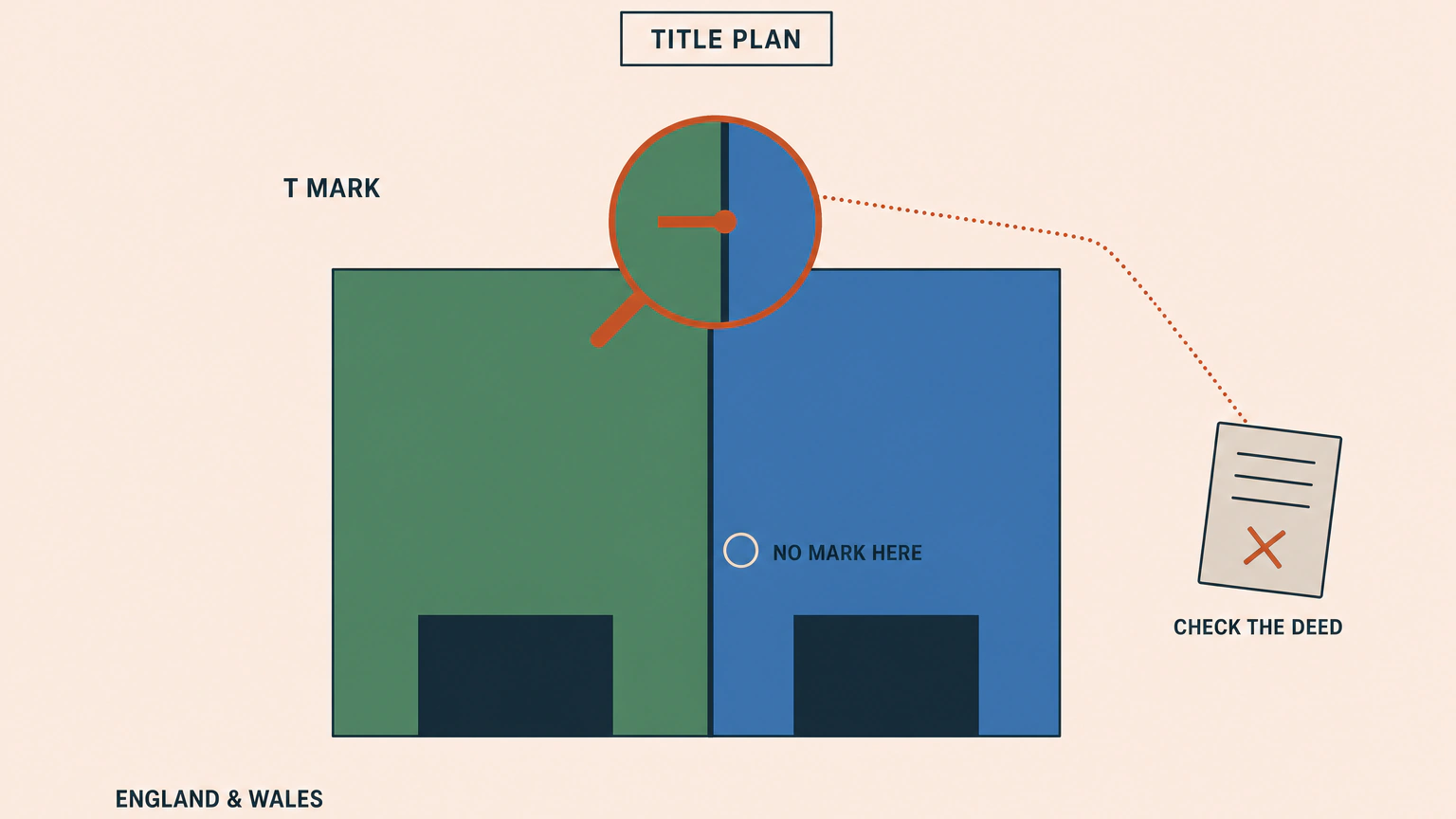
On an England or Wales deed plan, a T mark is a small capital T drawn against a boundary. Its crossbar sits on the line and its stem runs into one of the plots.
In the practice guide's words: "An entry referring to a 'T' mark is normally a statement concerning the ownership of a boundary structure or the liability to maintain and repair it."
Read that twice, because the word doing the work is entry. The registry reproduces T marks on a title plan only where the deed refers to them expressly. Where the deed says nothing, the guide is blunt. "'T' marks on deed plans which are not referred to in the text of a deed have no special force or meaning in law". The registry normally ignores them. The guide never says which way the stem points, either.
So a T mark directs you to the deed wording. It isn't a substitute for it. The clause may record ownership, maintenance responsibility or both. Don't assume that one proves the other.
When the record does not settle it
If the search finds nothing in the register or deeds, it hasn't failed. It has shown that the record doesn't settle ownership or maintenance.
HM Land Registry's guidance meets it head on. "Where the ownership or responsibility for maintenance of a boundary cannot be determined, that boundary feature is generally best regarded as a party boundary. Any alterations or replacement of the boundary should only be done with the agreement of the adjoining owners."
In a garden that cuts both ways, and both halves are worth having. A neighbour cannot turn half an unagreed quote into a debt merely because the fence sits on the boundary. Nor should either owner replace a party boundary feature alone. A deed, agreement, safety hazard or another legal duty can change the result.
We're not your solicitor, and this is general information about boundary records rather than legal advice. The rules differ across the four nations, and a real dispute about where the boundary runs is a job for a solicitor or a chartered land surveyor, not another fencing quote.
What you can do when your neighbour will not repair it
HomeOwners Alliance puts it plainly: there is "very little you can do to force your neighbour to repair or replace it" unless the fence is causing a safety hazard.
So treat it as a practical problem rather than a legal one. The aim isn't to win. It's to get a fence standing again without buying yourself ten years of frost over the hedge.
- Get your own title register and plan first, and read the words, not just the picture, because a mark on a plan that no clause mentions decides nothing.
- Put it in writing, keep a copy, and stick to what happened rather than how you feel about it, because a calm letter is also the evidence if this ever escalates.
- If talking has stopped working, ask about mediation before anyone mentions solicitors. It is usually quicker and cheaper, and you still have to live next door afterwards.
- Photograph the fence as it stands now, dated, so that a later argument about whether it was already rotten has an answer that is not two memories.
- If you want it gone and they do not, build your own fence wholly inside your own boundary instead, and leave theirs standing where it is.
That option can avoid the boundary dispute, but local planning controls still apply. If the fencer you hire takes a deposit and vanishes, that's a separate fight with its own route: getting your money back.
Your fence is flat after a gale. Whose bill is it?
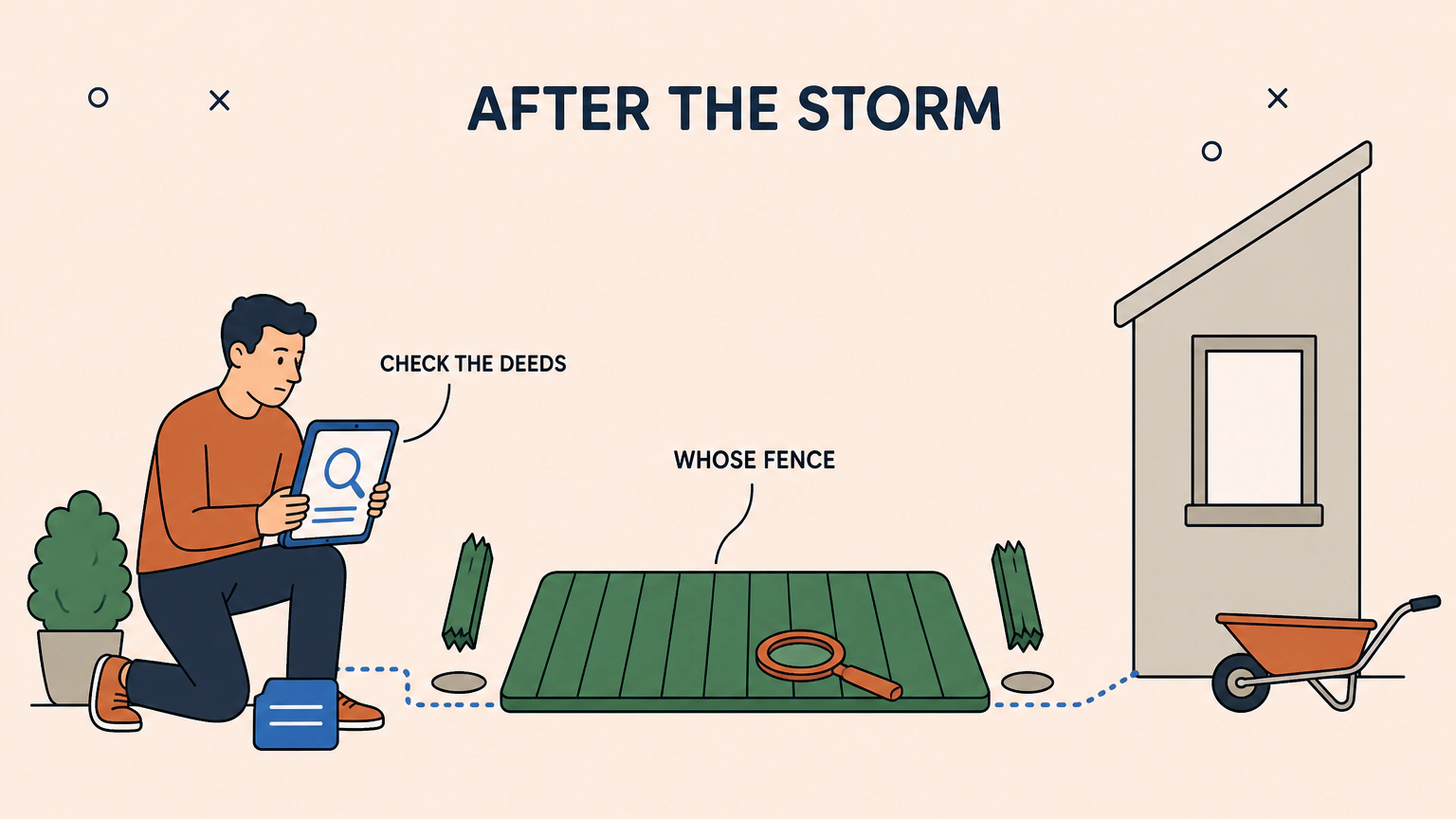
This is the version most people arrive with. The gale came through on Tuesday, there's a panel in the flowerbed, and somebody has to sort it before the dog finds the gap.
Start by checking whether the fence is yours or whether a deed makes you responsible for it. Then read the policy wording. Ownership, maintenance and insurance cover are separate questions, and an exclusion may decide the claim.
Your buildings policy probably excludes exactly this
Storm damage to fences is commonly excluded from British buildings insurance.
Lemonade UK is unusually direct. Its cover page says that "fences, gates, and hedges are specifically excluded from cover for storm damage, flooding, falling objects like trees or branches, and vehicle collisions. This applies regardless of how severe the storm or event was." Intelligent Insurance says: "Storm damage to gates, hedges and fences is excluded". HomeOwners Alliance calls the exclusion usual rather than universal. These are examples, not a market survey.
Lemonade says its policy treats solid boundary walls differently from fences. If you're weighing a low wall against more panels, bricklayers and masonry contractors are the trade for that.
Now go and read your own policy. Buildings section, exclusions, search for fences and gates.
The first hour, before anyone touches anything
Make it safe first if it's genuinely dangerous, then photograph everything before you tidy. Wide shots of the whole run, both sides, the broken post bases, and the panels that survived.
Pre-existing wear can affect whether the insurer treats the storm as the main cause. Photograph the whole fence before tidying, because a swept lawn shows very little.
The first hour after it comes down.
- A fallen panel with nails or a snapped concrete post is the actual hazard here, so make the area safe before you photograph anything, and keep children and pets out of the garden until you have.
- Photographs taken after you have tidied up are worth very little, so shoot the whole run, both sides, the broken post bases and the neighbouring panels that survived, before you move a thing.
- Ripping out a boundary you have not established is yours can turn a storm into a dispute, so check the record before the skip arrives, not after.
- A verbal "I'll sort it" from next door is not a plan, so agree in writing who is paying and when the work happens before either of you rings a fencer.
If the fence is yours and you cannot get to it
Some fences can only be repaired from the wrong side. If yours backs onto next door's garden and they won't let you through, England and Wales give you a backstop: the Access to Neighbouring Land Act 1992.
You apply to the court for an access order. The court makes one "if, and only if" it is satisfied of two things. First, that the works are reasonably necessary to preserve your land. Second, that they can't be carried out, or would be substantially more difficult, without going onto your neighbour's. The Act names "the maintenance, repair or renewal of any part of a building or other structure" on your own land as basic preservation work.
Two honest limits. The court must refuse where entry would cause your neighbour disturbance or hardship to an unreasonable degree. And the Act "extends to England and Wales only", so a Scottish or Northern Irish reader needs local advice instead.
Ask in writing first, and keep the reply. This is a backstop, not an opening move.
Before you order a new one
You've either established whose fence it is, or found that the record does not settle it. Either way, somebody may be about to buy timber. Two things matter before the quotes land: England's normal height rules, and how far apart fencing prices sit.
How high a fence can normally be in England
In England, putting up or altering a gate, fence, wall or other enclosure is normally permitted development. The limit is one metre next to a highway used by vehicles and two metres elsewhere. When altering an existing enclosure, the permitted maximum is its former height or the normal limit, whichever is higher. Class A does not cover work within a listed building's curtilage or an enclosure surrounding one. A planning condition or article 4 direction can also remove the right.
That's the English order. Wales, Scotland and Northern Ireland each run their own permitted development order, all amended since 2015, so check the one that covers you.
Then get quotes, plural. Our own fence cost profiles, 673 of them, put the average job at £3,612, with a minimum of £593 and a maximum of £10,501. A spread that wide is the argument for never taking the first number. Fencing contractors near you is the place to start, and it's worth reading how to check a tradesperson is registered before you pay a deposit.
If the boundary itself is genuinely in dispute, rather than simply unrecorded, that isn't a fencing job. That's a chartered land surveyor, and paying one before the posts go in beats moving them afterwards.
Frequently asked questions
Is it true that you always own the fence on the left?
No. HM Land Registry says beliefs of that kind have "no legal foundation" in England and Wales. Scottish and Northern Irish guidance also sends you to the title record, not to a left-or-right rule. A deed may record ownership or maintenance, but those are separate questions. If the record is silent, other evidence or local law may matter.
How do I find out who owns a fence?
In England and Wales, buy your title register and title plan from HM Land Registry for £7 each, then read the register for any clause naming a boundary. In Scotland, check your title deeds through Registers of Scotland's ScotLIS service. In Northern Ireland, Land & Property Services holds the folio and there's no online search, so you contact them by email, phone or appointment.
What does a T mark on a title plan actually mean?
In HM Land Registry's words, an entry referring to one is normally a statement about who owns a boundary structure, or who is liable to maintain and repair it. The catch is the word entry. T marks on a deed plan that the deed's text never refers to have "no special force or meaning in law", and the registry normally ignores them. Find the clause, not the symbol.
Can my neighbour make me pay half for a new fence?
Not merely because the fence separates the gardens. A deed or agreement may put the bill on you, and a safety hazard or another legal duty can change the answer. In England and Wales, where ownership or maintenance cannot be determined, HM Land Registry recommends treating the feature as a party boundary. Agree replacement before either neighbour acts.
Will my home insurance pay for a fence blown down in a storm?
Probably not, but read your policy. Fence and gate storm exclusions are common, and two insurers' published cover pages exclude them. Lemonade also lists falling objects and vehicle collisions, and treats solid boundary walls differently. Check your own buildings wording before you assume the result.
Can I paint my side of my neighbour's fence?
Ask first. If the fence is theirs, both sides of it are theirs too, and painting it without permission is a change to somebody else's property. Get the answer in writing, even a text message, so nobody's memory has to do the work later.