

On this page
What a skip costs, and what actually moves the price
Three things set the number on your quote: the size of the box, where you live, and the tax on whatever ends up in landfill.
The bands you will be quoted
Nobody publishes an official list of skip sizes and prices. These are all price-guide figures, and each one is a spread, not a quote. Costwise puts a 2 to 3 yard mini skip at £70 to £130 for a week, a 4 to 5 yard midi at £110 to £190, and a 6 to 8 yard builders' skip at £200 to £320. BestBuilders runs higher, at £280 to £480 for that same builders' skip. MyJobQuote's 6 yard skip price is £120 to £300, and its 8 yard skip price £160 to £370.
Those ranges don't agree, and that's normal. The same size of skip can cost twice as much in one part of the country as in another. The Waste Group puts a mini skip at £65 to £110 in the north and £135 to £175 in London. So a quote at the bottom of a band isn't a mistake, and one at the top isn't automatically a rip-off. Whether a quote is fair depends on what's in it: delivery, collection, the hire period, the weight allowance, and whether VAT is included.
Why the same skip costs more in London than in Leeds
Your postcode moves skip hire cost as well. Costwise's guide figure for a typical week is £260 in London and £210 in Leeds. MyJobQuote reckons a London borough can add £50 to £350 over the same job in the north. Costwise puts much of that gap down to gate fees and haulage. A gate fee is what the transfer station charges the skip firm to tip each load, and both cost more in and around London.
Permits widen the gap in hard cash. Haringey, in north London, wants £125 to put one skip on the road. Oldham charges a skip operator £47. And a permit doesn't last forever. Haringey allows up to 28 days, but its 2026 to 2027 fee schedule charges £125 for each 14-day period. Coventry's permit runs for up to 14 days. That's a good reason to keep a road skip on short hire, especially in London, where a skip left standing is a meter running. Once the permit's time is up it has to be renewed, and Coventry charges £53 to add another fortnight.
Landfill Tax, and the change that landed in April
Every tonne that goes into landfill carries a tax, and the skip firm passes it on to you. HMRC charges it at two rates. The standard rate covers most mixed rubbish. The lower rate covers inert waste, which in a skip mostly means soil, stone and rubble.
| Rate | From 1 April 2024 | From 1 April 2025 | From 1 April 2026 |
|---|---|---|---|
| Standard rate, per tonne | £103.70 | £126.15 | £130.75 |
| Lower rate, inert waste, per tonne | £3.30 | £4.05 | £8.65 |
On 1 April 2026 both rates rose by the same £4.60 a tonne. On the standard rate, that's a rise of under 4%. On the lower rate, it more than doubled the tax. HMRC's policy paper explains how: the standard rate follows inflation, and the lower rate rises "by the cash amount of the increase to the standard rate". So the tax on a tonne of dug-out garden soil sent to landfill has more than doubled in a year, while the tax on a tonne of old carpet and timber offcuts has barely moved.
Scotland and Wales collect their own landfill taxes. Revenue Scotland's rates match HMRC's to the penny. Wales charges the same £130.75 and £8.65 this year, but its lower rate was already £6.30 last year, so the jump there is smaller.
Which size you actually need
Price follows size. The expensive mistake, though, is running out of room halfway through the job.
Match the skip to the job, not to the price
Go one size up from your first instinct. The trap is ordering early, filling the skip before the demolition's finished and then booking another. Stockpile the waste until the messy part of the job is done, then order one skip that takes the lot.
- A single room's clear-out, one bathroom suite or a small garden tidy: a mini skip or a skip bag will usually do. Measure the drive first, because a skip bag or mini that fits there avoids a permit.
- A kitchen strip-out, including units and worktops: a midi skip. Order it for the day the fitters start, not the day they finish, so the old kitchen goes straight in.
- A general renovation with mixed waste and no heavy rubble: a builders' skip. It's the default size, and the one most quotes are written for.
- Soil, hardcore, tiles or broken concrete: go smaller than the volume suggests, and ask what weight is included before you book.
- A whole house clearance, or a loft and garage together: a maxi skip. If the road can't take a big one, book two collections of a smaller skip instead.
- Anything you're unsure about: order one size up. A second skip costs a second delivery, a second collection and, on the road, a second permit.
The weight limit is what catches people out
Skips are sold by volume, but disposal is paid by the tonne, and that's where heavy loads come unstuck. Soil, rubble, bricks and tiles use up a weight allowance long before they fill the box. BestBuilders lists an overweight or heavy rubble charge of £50 to £150, and says heavy loads can need a smaller skip. Costwise suggests grab hire for soil and rubble, where a lorry scoops the waste straight up, and says it often costs less per tonne.
Overfilling is the other problem. MyJobQuote warns that a skip piled above the top edge may not be collected until it's level, because loose items can fall out on the road. Keep the load flush with the rim, however tempting that last bin bag looks.
If most of what's coming out is soil from a dig, ask excavation and groundworks firms to quote for the digging and the spoil together before you book a skip at all.
Does it need a permit? The kerb decides
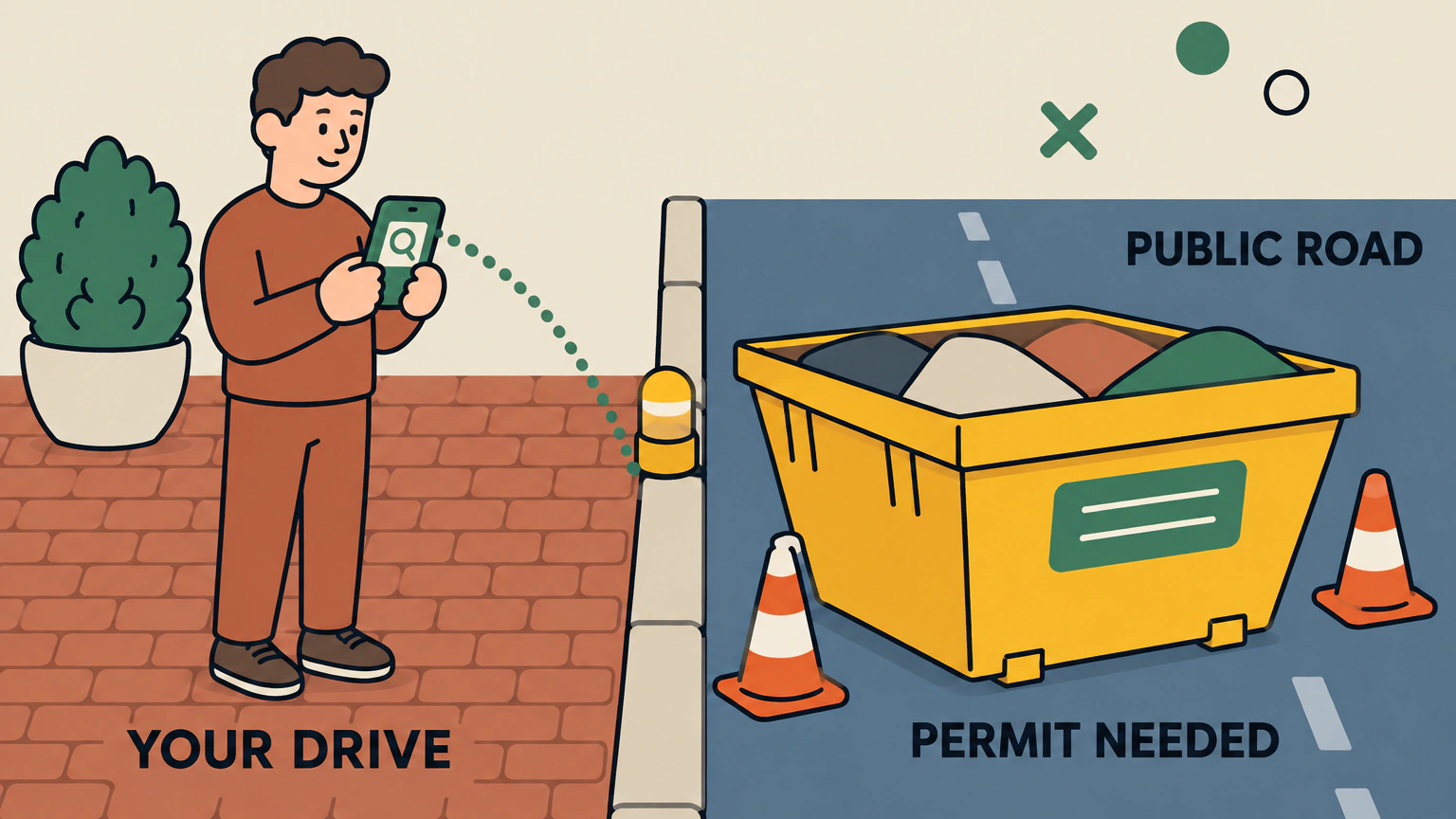
Nothing about the rubbish decides whether you need a permit. Where the skip sits does.
On your own drive there is nothing to apply for
GOV.UK is plain about it: "You don't need a skip licence if you're putting the skip entirely on private land." The word doing the work is "entirely". A skip that overhangs the pavement by half a metre is on the highway, and in England and Wales GOV.UK is just as plain that "You can't put a skip on the pavement."
So measure before you book. Ask the firm for the footprint of the skip you want, not just its size in yards. Then check there's a clear run for the lorry to set it down. The line at the front of your property is a boundary like any other, and our guide to where your boundary actually runs explains how to find it.
On the road, the law is specific about who is liable
In England and Wales, section 139 of the Highways Act 1980 says "A builders' skip shall not be deposited on a highway without the permission of the highway authority for the highway." Break that rule and the offence belongs to the owner of the skip, which normally means the hire firm. There are two catches. Hire a skip for a month or longer and the Act treats you as the owner. And where the offence is down to someone else's "act or default", that person can be charged too. GOV.UK says the skip firm gets the permit in most areas, but "In some areas you'll need to do it yourself." Ask to see it.
On the road, the owner also has to keep the skip lit at night and marked with their name and a phone number or address. It must be moved as soon as practicable once it's full. Get the lights and markings wrong, and GOV.UK says you could be fined up to £1,000. The council or a police officer can also order the skip moved, or move it and send the owner the bill.
Scotland works under section 85 of the Roads (Scotland) Act 1984, and it's stricter in one way. A skip is lawful only with written permission and the owner's name and contact details on it. The owner can pin most breaches on someone who took responsibility for the permit, but never a missing marking. GOV.UK adds that Scottish skips must be painted yellow at both ends and kept off verges. In Northern Ireland, consent comes from DfI Roads, not the council, under Article 96 of the Roads (Northern Ireland) Order 1993.
What a permit costs in the councils we checked
Every council sets its own fee, and they vary more than skip prices do. These figures come from four councils' fee pages, plus GOV.UK's guide figure for Scotland.
| Council | What the permit costs | Period it covers | Who may apply |
|---|---|---|---|
| Haringey, London | £125 for one skip, £140 for a skip plus building materials | 14 days. The fee is charged again for a 14-day extension and is not refundable | Apply to the council, at least 5 working days ahead |
| Coventry | £71 with three or more working days' notice, £79 with less | Per licence | Skip owner, £5m public liability cover required |
| Oldham | £47 per application, plus £250 operator registration | 28 days | Skip operators only, not members of the public |
| City of Edinburgh | £42 a week up to 14 yards and £126 a week for 20 or 40 yards | Weekly | Anyone |
| Scotland, GOV.UK indicative figure | £22 a week, may vary by council | Weekly | Contact your council |
Edinburgh is the cheapest of the four at £42 a week for a skip up to 14 yards. Haringey is the dearest at £125 for 14 days. One of them, Oldham, won't issue a permit to a member of the public at all. Its page says to ask your skip hire company, which applies for you. GOV.UK's Scottish figure of £22 a week sits below all four. Your council will have its own number, and GOV.UK's skip licence page finds your council from your postcode.
Skip bags are not a way round it
For a small job, a skip bag is often the better buy. HIPPO, whose name GOV.UK uses when it lists skip bags, rates its mid-size MEGABAG at 1.5 cubic yards and 1.5 tonnes. It says the bag takes a full bathroom rip-out. There's no ramp to build, and the bag is collected straight from your property. HIPPO even takes plasterboard in it, as long as it's double-wrapped.
What a bag won't do is dodge the permit. GOV.UK lists "hippobags and other skip bags" beside skips as things that need a licence on a public road. Keep it on your own land, or budget for the permit.
The check that keeps the fine off you
None of the price guides lingers on this part, and it's the one that can cost you more than the skip.
Your waste is still your problem after it leaves
Start with who the rule covers, because it surprises people. If a builder is working on your house, the waste they produce is theirs. Defra's code of practice says they're responsible for getting rid of it, and "the cost of its disposal should be included in what they charge for the work." So when you compare quotes from builders, or price a job like replacing a conservatory roof, check that taking the rubbish away is in the price.
Put your own old wardrobe in their skip, though, and the duty comes back to you. The code says so directly: "if you add your own waste to their skip, the duty of care will apply for that waste."
The duty itself is simple. When you hand your household waste to anyone, you have to take reasonable steps to make sure they're allowed to take it. All four nations have a version of this rule. The classic way to fail is the van that pulls up, spots the pile on your drive and offers to take it for a flat cash price. That load can easily end up tipped in a country lane. If it's traced back to you, GOV.UK warns you might have to pay a fixed penalty, or face prosecution.
Defra's guidance to councils in England carries a line worth knowing: "Individuals should not be penalised for minor breaches which do not lead to waste being inappropriately disposed of." It names the case of someone who used an authorised carrier but never checked. That's reassuring. It's also no reason to skip it, because checking is what protects you when a firm isn't authorised. Penalties and permit rules are set locally and they change, so your own council and regulator have the final word for your address.
How to check a carrier's licence in ninety seconds
The legal term is a waste carrier registration, though most people call it a licence. A waste carrier licence check is free and online. A firm that carries other people's waste, like a skip company, needs the upper tier.
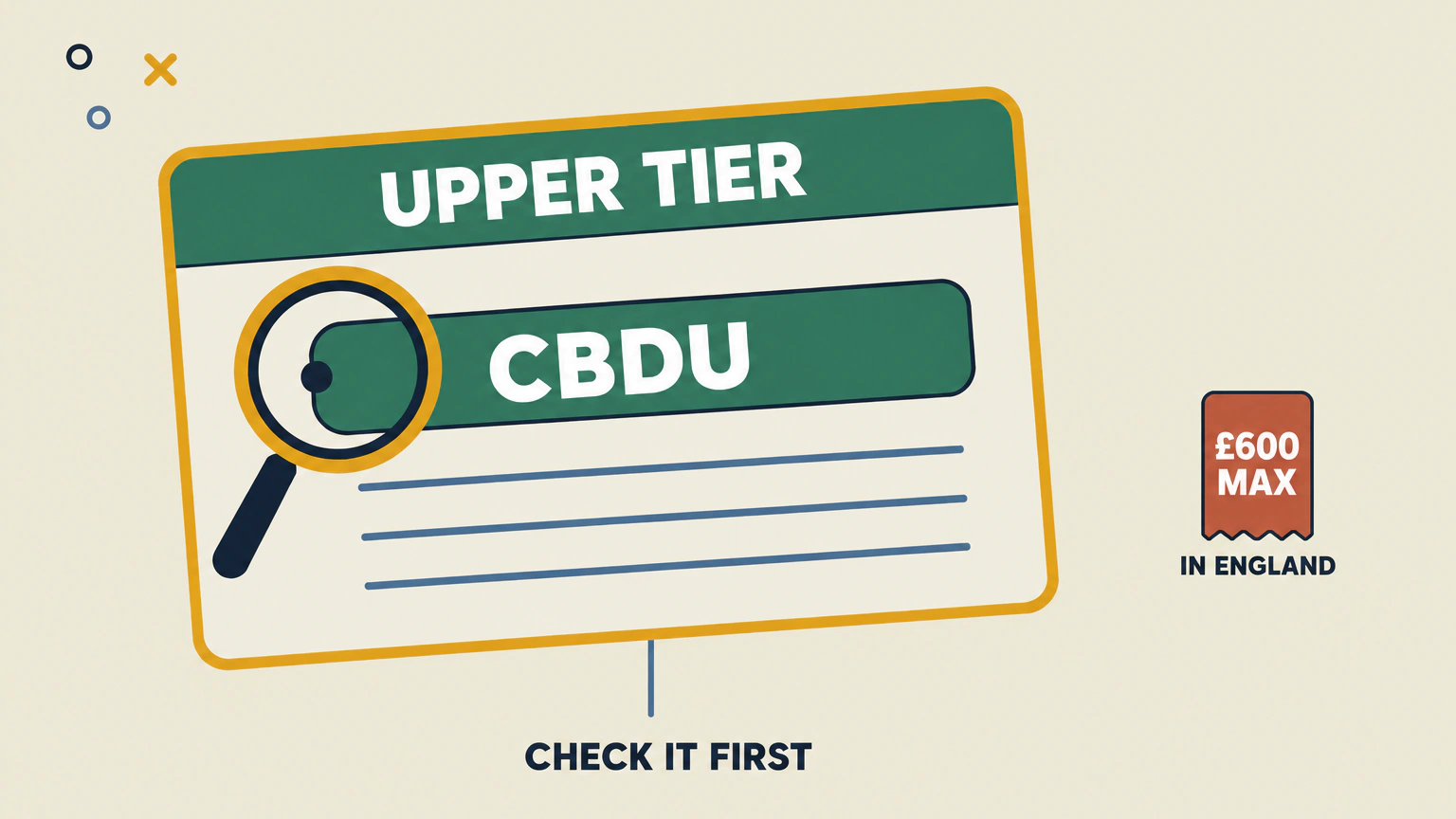
- Ask for the registration number before you book, not on the day. In England and Wales, Defra's code says to expect a number starting with the letters CBDU.
- Check it's an upper tier registration. That's the tier a business carrying somebody else's waste has to hold. A number starting CBDL is lower tier and isn't enough for a skip firm.
- Check the right register for where you live. That's the Environment Agency in England, Natural Resources Wales in Wales, SEPA in Scotland and NIEA in Northern Ireland, whose list DAERA publishes.
- Check the business name on the register matches the name on the quote and on the lorry. A number that returns a result isn't enough if it belongs to somebody else.
- Keep the quote, the number and the collection date. Then you can show who took the waste if anyone ever asks.
One result that looks like a warning isn't. A registration with the Environment Agency, NRW or SEPA is valid in all three countries, so a firm near a border can sit on a neighbour's register. The Environment Agency says as much: carriers registered in Scotland or Wales "are also authorised to operate in England". It's the same habit as knowing how to check a trade register before a builder starts. If the number doesn't check out, walk away and look at our vetted waste and rubbish removal firms instead. Here's how we vet the firms we list.
Where the four nations part company
| Where the job is | Skip on the road | Your own duty on household waste | Who you check the carrier with | Fixed penalty route |
|---|---|---|---|---|
| England | Highways Act 1980 section 139 | Section 34(2A) applies to you | Environment Agency public register | Yes, £150 to £600, £200 by default |
| Wales | Highways Act 1980 section 139 | Section 34(2A) applies to you | Natural Resources Wales public register | Yes, £300, or £150 if paid within 10 days (section 34ZB) |
| Scotland | Roads (Scotland) Act 1984 section 85 | Scotland's own section 34(2) sets a similar duty | SEPA | No current fixed penalty. Scotland has enacted a £200 route, but it is not fully in force |
| Northern Ireland | Roads (Northern Ireland) Order 1993 Article 96, consent from DfI Roads | Article 5(2A) of the Waste and Contaminated Land (Northern Ireland) Order 1997 sets the same duty | NIEA, Registration of Carriers | No, section 34ZA is England only |
Wherever you live, the duty to check who takes your household waste is yours. What changes is the road law, the register and the penalty. Only England and Wales currently let an authority issue a fixed penalty for this householder duty, and they do it differently. In England your council sets an amount between £150 and £600, or £200 if it hasn't picked one. Wales charges a flat £300, cut to £150 if you pay within 10 days. In Scotland, SEPA now calls registered carriers "transporters", and it tells you to ask for the registration number and expiry date before you hire anyone.
What you cannot put in a skip
Every firm has its own list, so ask for it when you book. The skip firms' own guides agree on the broad shape.
Banned because it's hazardous. Asbestos, paint, oils and solvents, gas bottles, batteries and chemicals. Costwise and BestBuilders both say these can't go in a standard skip at all. If you think something might be asbestos, don't break it up or bag it. Ask your council what to do before anyone touches it. For paint, batteries and gas bottles, your council's recycling centre is the place to try first, so check its website for what it takes.
Allowed at a price, or sent separately. Fridges and freezers, mattresses, tyres and other electricals. BestBuilders lists surcharges of £10 to £30 for each fridge or mattress, and £5 to £25 a tyre, while MyJobQuote says electrical items are usually refused or charged separately. GOV.UK notes that your council may run special collections for large items like fridges. And when you buy a new appliance, you can give the old one to the shop, as long as the new one does the same job.
Allowed only if kept apart. Plasterboard is the one that catches renovators out. Costwise and The Waste Group both say it can't go in with general waste. The Waste Group explains why: mixed into landfill, it can give off hydrogen sulphide gas. Stack it on its own and tell the firm when you book. Expect a separate container or a charge, which BestBuilders puts at £15 to £60.
Loading it so you only need one
Loading a skip in the order the rubbish comes out is how people end up paying for a second one. A little planning buys a surprising amount of space.
Pro tip: Sort your waste into piles before the skip arrives. Sorted material loads faster, packs tighter and shows you whether you ordered the right size while there's still time to change it. Then load it in order: flat items on their edges down each side, soft garden waste and bags low in the middle where they'll crush down, and rubble layered over the top so nothing light blows out.
Check whether the skip has a drop-front door before you plan the job. With one, you can wheel a barrow straight in. Without one, every item goes over the side, which changes what one person can realistically load in a day.
Then don't leave it open to the street for long. Neighbours and passers-by will happily fill a skip they didn't pay for, and every bag they add comes out of your weight allowance. Haringey's licence conditions tell skip users to cover it when it's unattended, to stop exactly that.
If you've never filled one, it's worth fifteen minutes watching a handyman fill an eight-yard skip from empty to full. You'll see which things go on edge, how far the garden waste squashes down and what a properly full skip looks like.
Before you book: five questions to ask
Red flag: four signs to walk away.
- Cash only, no paperwork, no registration number. Ask for the number and check it. A genuine operator gives it without hesitating.
- A van at your door offering to take your rubbish for a flat cash price. This is a classic route to a lane, and your duty to use an authorised carrier does not disappear when the van leaves. Say no and book a registered firm.
- A quote well below every other quote on the same street. Ask what weight is included and what the tip charge is, because that's usually where the difference hides.
- A promise that the skip can go on the road with no permit. Ask which council issued it and when it expires. The permit is a real document with real conditions.
If none of those apply, these five questions will get you quotes you can actually compare.
- Who's getting the permit, and when does it run out? On the road, you want the firm's answer in writing, plus the end date.
- What's your waste carrier registration number? Check it on the right register before you pay a deposit.
- How long is the hire period? Costwise and The Waste Group both put a standard hire at one to two weeks.
- What weight is included, and what do you charge over it? This matters most for soil and rubble.
- What happens if I need the skip for longer? Ask about the daily or weekly rate and who pays to renew the permit.
Two jobs come before any of those calls, and neither costs a penny. Measure the drive, and have the carrier register open on your phone when the quotes come in.
Common questions about skip hire
How much does it cost to hire a skip in the UK?
Usually about £150 to £400 for a week, depending on the size and where you live. Costwise puts a mini skip at £70 to £130 and a builders' skip at £200 to £320, while BestBuilders has the builders' skip at £280 to £480. London sits at the top end. Add a permit if the skip goes on the road, and check the quote includes VAT and a weight allowance.
Do I need a permit for a skip on my driveway?
No, as long as the whole skip sits on your own land. GOV.UK says you don't need a licence if the skip is "entirely on private land". The moment any part of it overhangs the pavement or the road, you need a permit. Measure the drive before you book, and ask the firm for the skip's footprint, not just its size in yards.
What size skip do I need for a bathroom or a garden clearance?
For one bathroom, a mini or midi skip is usually enough, and so is a mid-size skip bag: HIPPO says its 1.5 cubic yard MEGABAG takes a full bathroom rip-out. A small garden tidy suits a mini skip. A bigger clearance with soil or paving needs more thought, because you'll hit the weight limit before you run out of space. If you're unsure, go one size up.
Does the skip hire price include the council permit?
Often not, so ask. BestBuilders says its regional prices exclude the permit, which the council charges separately. Costwise says the firm normally arranges it and adds it to your bill. In some areas, like Oldham, only the firm can apply. For skips up to 14 yards, the four councils whose fee pages we opened charge £42 to £125 for a first permit.
Can I be fined if the skip firm dumps my waste?
Yes, if the firm wasn't authorised to take it and you didn't check. In England, a council can issue a fixed penalty of £150 to £600, or £200 if it hasn't set an amount. In Wales it's £300, or £150 if you pay within 10 days. Defra's guidance says people who use an authorised firm shouldn't be penalised just for not checking. The check is still your best protection.
How long can I keep a skip?
Most hires run one to two weeks, according to Costwise and The Waste Group, and keeping it longer usually costs extra. On the road, the permit sets its own limit. Coventry's lasts up to 14 days, and Haringey's and Oldham's up to 28. After that, the firm needs a new one. In England and Wales, the law also expects a road skip to go as soon as practicable once it's full.
Can I share a skip with my neighbour?
Yes, but agree the rules first, including who pays if the load goes over the weight allowance, since the firm bills whoever booked it. Each household that adds its own rubbish is handing its waste to the skip firm, so share the registration number too. Defra's guidance to councils says the duty sits with the person arranging the transfer of waste from their own home.