

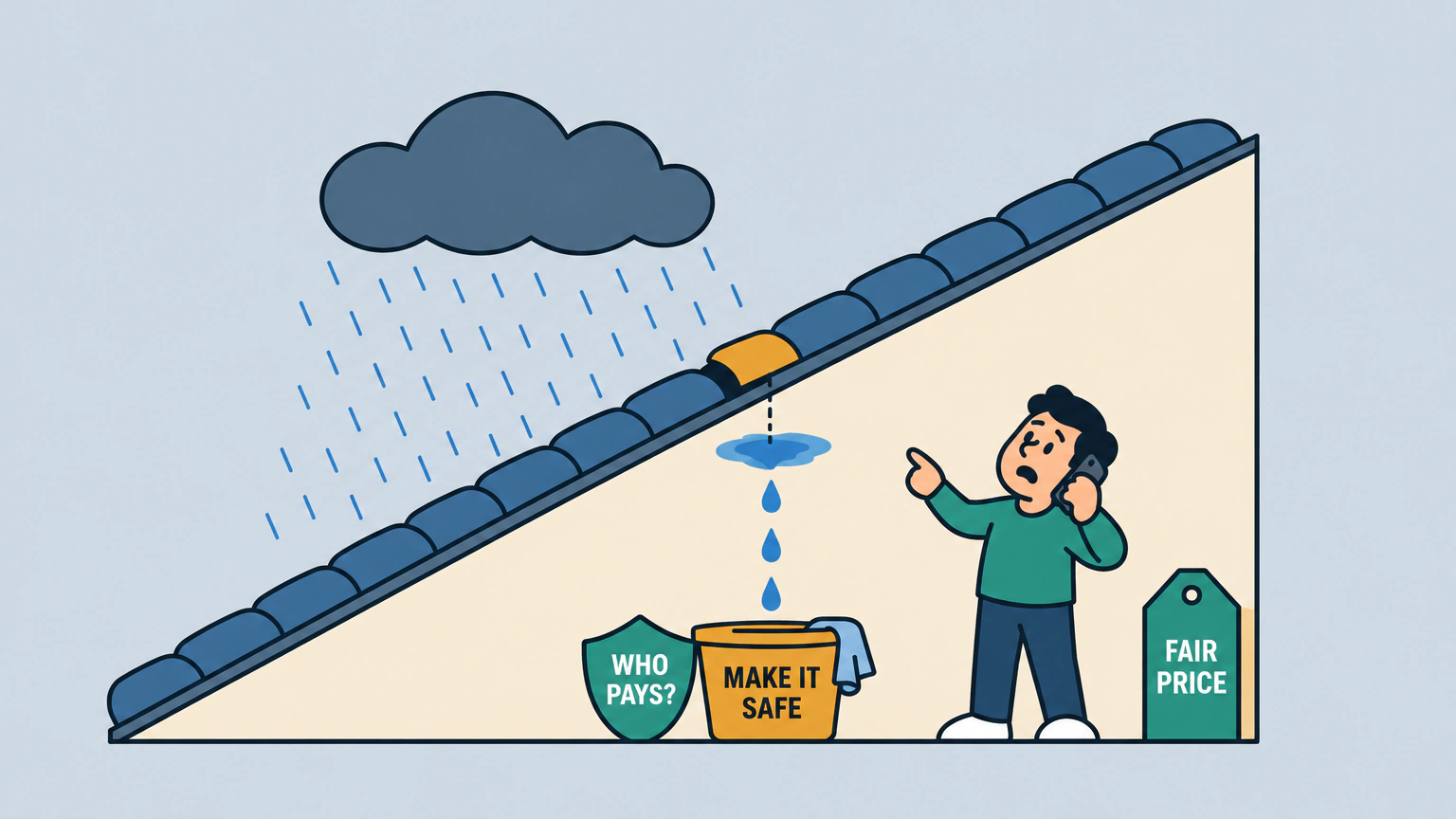
Most roof leak repairs in the UK cost £220 to £550, MyJobQuote's average is £375, and an emergency call-out in a storm adds £100 to £300. Catch the water, switch off wet circuits at the consumer unit if you safely can, and photograph everything. Then get the make-safe and the permanent repair quoted separately, because your cancellation rights and your insurance claim both turn on what you asked for and what you can show.
So take it in order: tonight, then the price, then who pays.
On this page
- Water coming through the ceiling? Do these things first
- Is it really the roof? Rule out condensation and gutters
- What a roof leak repair costs in the UK
- Get it made safe now, and fixed properly later
- Will your buildings insurance pay for the leak?
- Renting or living in a flat? The roof is usually someone else's job
- Repair or replace? Don't let one leak sell you a new roof
- Roof leak questions, answered
Water coming through the ceiling? Do these things first
The roof can wait. Water near electrics can't. Electrical Safety First says to switch off at the consumer unit "only if it is safe to do so", and to keep away from exposed wiring because it "may still be live". Any sign of water inside the consumer unit itself means calling a registered electrician. Photos and the date matter later, because the Financial Ombudsman Service decides storm claims on photos, expert reports and weather records. Stay off the roof. Checkatrade says climbing up is high-risk and can make the damage worse. And keep clear of a sagging ceiling: in one of the ombudsman's cases, a kitchen ceiling collapsed under water that had pooled above it (a leaking pipe that time, not a roof).
- Put a bucket under the drip and move furniture, rugs and anything electrical out of the way.
- If water is near a light, a socket or the consumer unit, switch off at the consumer unit (the fuse box), but only if you can reach it safely.
- Keep everyone out from under a ceiling that's sagging with water.
- Photograph the stain, the drip and anything damaged, inside and, from the ground, outside.
- Write down the date and time, and check whether the Met Office named a storm that day.
- Stay off the roof and off ladders, especially in wind and rain.
- Tell your insurer as soon as you can. Leaving it is one thing an insurer can hold against you.
If carpets or ceilings are soaked through, water-damage restoration firms can dry them out properly.
Is it really the roof? Rule out condensation and gutters
Here's where you might save the whole bill. BRE, the building research body that investigates dripping roofs, says the drips are "often caused by a build-up of condensation in the cold roof voids, rather than by leaks which may initially be suspected". They "sometimes coincide with periods of bad weather", which is why everyone blames the roof. Condensation is likelier, BRE adds, where there's loft insulation that's blocked the eaves, above a bathroom or kitchen, and where spotlights pierce the ceiling.
Condensation forms when moist air meets cold surfaces in the loft. Tell the roofer when the drips come, and ask whether it could be condensation before anyone prices tiles. Our guide on how to tell what's really causing damp covers the rest.
Then there are the gutters. Checkatrade lists blocked or broken gutters, overflowing at the roof edge, among the common causes of a leaking roof. Our own cost profiles for gutter cleaning, 563 of them, average £204 and run from £99 to £457, against £375 for MyJobQuote's average leak repair. If yours are full of leaves, ring gutter cleaners near you first.
What a roof leak repair costs in the UK
MyJobQuote's average is £375, with most jobs landing between £220 and £550, based on quotes UK tradespeople gave homeowners on its platform. Materials are only about 20 to 30% of the bill. Labour is the rest, so the hours on the roof drive the price.
| What's causing the leak | Typical price for the job (MyJobQuote) | Time on the roof (MyJobQuote) | Checkatrade's unit rate, before VAT and access |
|---|---|---|---|
| Slipped or broken tiles | £150 to £300 | 2 to 4 hours | £90 to £160 per m² of plain tile |
| Broken or lifted flashing | £200 to £500 | Half a day to a day | £50 to £70 per metre, £80 to £120 if stepped |
| Ridge tiles | £250 to £600 | 1 day | £50 to £70 per metre for a dry ridge |
| Valley | £400 to £800 | 1 to 2 days | £30 to £40 per metre for a GRP valley |
| Hole in a flat roof | £200 to £600 | 1 day for a small patch | £100 to £180 per m², by material |
| Chimney | £300 to £800 | 1 to 2 days | No rate given |
| Emergency storm work | £300 to £1,200 or more, call-out included | Varies | No rate given |
MyJobQuote's prices come from quotes made on its platform, updated September 2026. Checkatrade's rates date from June 2026, leave out VAT, scaffolding and removing the old covering, and assume a repair of up to 3 m².
MyJobQuote prices the extras too. An emergency call-out in a storm or at antisocial hours adds £100 to £300. Scaffolding, where it's needed, usually runs £300 to £800 for a house, and a temporary weatherproofing visit is £100 to £300. Checkatrade's what-to-do page puts a typical emergency call-out fee higher, at around £350. One is a surcharge on the job and the other a fee, so they aren't measuring quite the same thing. Either way, ask what the fee covers before anyone sets off.
Checkatrade calls its own figures "ballpark averages", and they still leave VAT, access and waste to add. So a per-metre price is where a quote starts, not where it ends. And if talk drifts towards a new roof, MyJobQuote puts the average replacement at £5,250.
Get it made safe now, and fixed properly later
What the emergency visit should and shouldn't include
The make-safe is a tarpaulin over the damage or the loose tiles secured, priced as a job of its own. Before anyone drives out, agree the call-out price in a text or an email. Where no price is fixed, the Consumer Rights Act says you pay "a reasonable price for the service, and no more", and a written figure ends that argument before it starts. What the roofer tells you counts too. The Act makes anything said or written to you about the service part of the contract if you take it into account, so a promise like "that'll hold till spring" belongs in writing.
A patch needs the right product and preparation. Self-adhesive flashing tape needs a dry, sound surface, and some products are designed to replace lead flashing. Ask how the roofer will repair cracked tiles and secure loose lead, rather than just cover the leak.
Photograph the damage before it's covered up. Then ask for a separate written quote for the rest of the job, and take your time over it. You don't have to agree the permanent work tonight.
Your cancellation rights, and the job they don't cover
Agree work at your home and it's an off-premises contract. You then have 14 days after the day you agree it to cancel a service, without giving a reason, on anything over £42.
Then comes the exception. There's no cancellation right for "contracts where the consumer has specifically requested a visit from the trader for the purpose of carrying out urgent repairs or maintenance". Citizens Advice's example is a plumber called out to mend a burst pipe. The emergency roofer you rang at midnight fits it exactly.
Here's the part nobody explains. The same regulation says that exception doesn't stop the right applying to "services in addition to the urgent repairs or maintenance requested", sold on the same visit. So extra work beyond the urgent repair, such as a new valley or a re-roof, can still qualify for cancellation.
For that extra work to start within the 14 days, you must ask on a "durable medium", such as paper or email. Cancel after work starts and you pay for what's been done, in proportion. You pay nothing if they omitted the cancellation or payment information, or didn't get that request. Once the service is complete, you lose the cancellation right if you requested the early start and acknowledged that consequence before work began. If they never gave you cancellation information, the 14 days can run on for up to 12 months more.
Red flags at the door after a storm
- They knocked on your door. The urgent-repair exception to your cancellation rights only covers a visit you asked for.
- Nothing in writing about cancelling. Without it, your 14 days can stretch past a year.
- A patch sold as permanent without explaining the product, preparation or repair.
- A whole new roof proposed before anyone has lifted a tile to look underneath.
- A price per metre with no line for VAT or scaffolding.
And if a trader has already taken a deposit and gone quiet, we've set out the routes to getting your money back separately.
Will your buildings insurance pay for the leak?
You're on hold to the claims line, and the music isn't helping. Buildings policies usually cover storm damage, the Financial Ombudsman Service says, and many exclude wear and tear and damage that happens gradually. Policies don't always define a storm, so the ombudsman uses its own definition: "violent winds, usually with rain, hail or snow". Rain, hail or snow on its own can count too, when a lot falls in a short time and it's extreme. And it expects your insurer to check every part of the policy, contents included, not just the storm section. If the answer's still no, here's the ombudsman's test.
The three questions the ombudsman asks
When a storm claim's been refused, the ombudsman asks three questions. They make a good checklist for your own claim:
- "Do we agree that there was a storm on the date the damage happened?"
- "Is the damage consistent with what we generally see as storm damage?"
- "Were storm conditions the main cause of the damage, or did other factors mean the damage might have happened anyway?"

To answer them it looks at weather reports, sometimes from more than one weather station, and at the Met Office's lists of UK storms. It's unlikely to be persuaded if you just say the damage was caused by a storm "some time in the past", or that you "experienced bad weather over time". Evidence of several storms over a period, one of which did the damage, can work. If you were away, or the damage wasn't obvious at once, it'll check further back in the records.
When the insurer blames wear and tear
The rule that matters here is short. "The insurer has to prove that the exclusion applies", the ombudsman says, for example with an inspection report. Its guidance to insurers goes further: a report resting on an aerial photo may not persuade it unless the photo clearly shows deterioration and the report explains it. And the storm can still have done the damage even if the roof wasn't perfect beforehand. The ombudsman weighs up which was the main cause. There's a limit. If a flat roof was already in a bad condition, you knew about it, and the storm "just highlighted an existing problem", you're unlikely to win.
Two of its cases show how this plays out. In the first, an insurer turned down a couple's roof claim, saying the nails holding the slates had worn out. Its evidence was notes of a phone call saying a contractor had seen rusty nails, plus photos too unclear to show them. A second contractor's report found the storm had done the damage, and the ombudsman told the insurer to reconsider the claim and pay any settlement due. It added that it might have decided differently if tiles had come off before the storm because of those nails.
In the second, an insurer refused because the wind hadn't reached force 10 on the Beaufort scale, 55 to 63 mph. The policy didn't define storm damage or mention wind speed at all. Local reports showed "significant wind and rain" in the policyholder's postcode that day, and the ombudsman upheld the complaint.
Why you shouldn't sit on a stain
Many policies exclude damage that happens gradually, and the ombudsman's line on it cuts both ways. For damage from an insured event, it's likely to say the insurer should pay if you couldn't reasonably have spotted the gradual damage and claimed promptly. That approach doesn't usually apply to wear and tear or accidental damage cover. One of its cases shows the other side. A couple with water damage in a rarely used spare bedroom lost, because there were clear signs of long-term damage on the wall and they'd known about problems with the heating for months without looking into it. That was a heating leak, not a roof, but the lesson carries over. A brown mark you've been watching since last winter is your insurer's best argument, so report a leak when you first see it.
If your claim is turned down
Ask for the reasons in writing, and for the inspection report the insurer relied on. Then make a formal complaint to the insurer, which has up to eight weeks to send you a final response. If it misses that, or you're unhappy with the answer, take it to the Financial Ombudsman Service, within six months of the date on any final response. It's free, and you don't need to pay a claims company to do it for you. If the storm section really doesn't fit, accidental damage cover, where you have it, may still pick the claim up. And if the ombudsman finds against your insurer, it can tell the insurer to deal with the claim, add interest and pay you compensation.
What helps a storm claim
- Dated photos and video of the damage, inside and out.
- The roofer's written report on the cause, with photos of the damaged area.
- The date it happened and the local weather that day, including any named storm.
- Invoices for past roof work, which show the roof's condition before the storm.
We're not your insurer or your solicitor. Your own policy wording decides the detail, so read it before you argue a claim.
Renting or living in a flat? The roof is usually someone else's job
The water's coming through a rented ceiling. The bucket's still your job tonight, but the roof very likely isn't. GOV.UK's guidance for private renters in England says your landlord is "always responsible" for repairs to "the property's structure and exterior", and that you "cannot be forced to do repairs that are your landlord's responsibility". You should carry on paying rent while you wait. Contact the landlord straight away if the fault could harm your health, and put it in writing, so there's a record of when they knew.
| Your home | Who has to fix the roof | Your first step | After storm damage |
|---|---|---|---|
| Renting privately, England | Your landlord must keep "the structure and exterior" in repair (Landlord and Tenant Act 1985, s.11) | Contact your landlord, straight away if the leak could harm your health (GOV.UK) | No duty to "rebuild or reinstate" after damage "by tempest" (s.11(2)(b)) |
| Council or housing association, England | The same s.11 duty. Emergency hazards such as "major leaks" must be investigated within 24 hours. Safety work shares that deadline unless the landlord arranges suitable temporary accommodation at no cost to you (SI 2025/1042, regs. 5 and 16). | Report it. The 24 hours start once the landlord has reasonable grounds to believe there's an emergency hazard | The s.11 carve-out applies to the repair duty |
| Renting, Wales | Your landlord must keep "the structure and exterior" in repair (Renting Homes (Wales) Act 2016, s.92) | Tell your landlord. The duty starts once it's aware and must be met "within a reasonable time" (s.97) | No duty to rebuild after "fire, storm, flood or other inevitable accident" (s.95) |
| Renting privately, Scotland | The home must be "wind and water tight", with its "structure and exterior" in a reasonable state of repair (Housing (Scotland) Act 2006, s.13) | Tell your landlord. Repairs must be done within a reasonable time. Damp or mould investigations normally must finish within 10 working days, starting the day after the landlord learns of the problem. Delays beyond the landlord's control require notice and reasonable steps to limit damp or mould (s.14). | No duty to rebuild after "fire or by storm, flood or other inevitable accident" (s.16) |
| Renting privately, Northern Ireland | The default duty covers "the structure and exterior", unless express tenancy terms say otherwise (Private Tenancies (Northern Ireland) Order 2006, arts. 6 and 7). | Tell your landlord. There's no duty until it actually knows (art. 11) | No duty to rebuild after damage "by tempest" (art. 10) |
| Leasehold flat, England and Wales | Your lease says whether you or your landlord repairs the roof | Read the repairs clause in your lease, then tell your landlord | The landlord usually insures the building through your service charge (GOV.UK) |
Scotland's repairing standard doesn't apply to a Scottish secure tenancy or a short Scottish secure tenancy.
Those storm clauses limit the statutory repair duties. They don't override any stronger repair promise in your tenancy or lease. So after a storm, ask your landlord whether they're claiming on their buildings insurance. Your belongings are yours to insure, because their policy covers the building, not the contents.
Council and housing association tenants in England get more. GOV.UK's Awaab's Law guidance gives "major leaks" as an example of an emergency hazard. If your landlord can't make your home safe within 24 hours, it must offer to find you somewhere else to stay. In England, if repairs still aren't done, the council's environmental health team must act if it thinks the problem could harm you. Leaseholders also have a right to be consulted before planned work that would cost them more than £250.
Repair or replace? Don't let one leak sell you a new roof
That £5,250 replacement average is fourteen times MyJobQuote's average leak repair, so a roofer who jumps from one drip to a new roof owes you some proof. Ask them to lift a couple of tiles away from the leak and show you the battens. Dry battens alone don't settle whether the whole roof needs replacing. If it's the conservatory leaking, see our guide to conservatory roof replacement costs.
In England, Planning Portal says a repair or re-cover normally needs no building control application if it affects less than 25% of the building's whole envelope and less than 50% of the roof. Go past either limit, or use a new covering at least 15% heavier, and it needs approval. A full re-roof usually does.
Look the roofer up before you book. Members of the NFRC, the National Federation of Roofing Contractors, pass an inspection before they join and are inspected again every three years. TrustMark, the government-endorsed scheme, runs its own tradesperson search. Our guide on how to check who you're hiring goes further. Then get a second quote on the same written basis from roofers near you. And if the final bill comes in higher, here's whether they can charge more than they quoted.
What a fair written quote shows
- What's causing the leak, in plain words.
- The make-safe and the permanent repair, priced separately.
- VAT, scaffolding and taking away waste, each on its own line.
- Any guarantee, in writing, with how long it lasts.
- Before-and-after photos of the repaired area.
If it leaks again after the repair
The Consumer Rights Act says the roofer must do the job with "reasonable care and skill". If a repair fails because they didn't, you can make them do it again "within a reasonable time and without significant inconvenience" to you, at their cost, labour and materials included. If a proper repair is impossible, or they don't manage it in a reasonable time, you can ask for money off the price, up to the whole of it, refunded within 14 days of them agreeing you're owed it. Any guarantee or promise they gave you, and that you relied on, counts as part of the deal.
So before you ring anyone else, tell the original roofer in writing, with your photos.
Roof leak questions, answered
How much does it cost to fix a leaking roof in the UK?
Most jobs land between £220 and £550, and MyJobQuote's average is £375. Slipped or broken tiles sit at the cheap end, from £150. Chimneys run £300 to £800 and valleys £400 to £800. An emergency call-out adds £100 to £300, and scaffolding, if it's needed, usually costs £300 to £800 for a house.
Will my buildings insurance cover a leaking roof?
It usually covers damage a storm caused, not a roof that's simply worn out. If your insurer says no, the Financial Ombudsman Service asks three things: was there a storm that day, does the damage look like storm damage, and was the storm the main cause. If the insurer blames wear and tear, it's the insurer that has to prove it.
How long does a landlord have to fix a leaking roof?
The law rarely names a deadline. In Wales and Scotland the landlord must do the work within a reasonable time once it knows about the problem. In English social housing, emergency hazards need investigation within 24 hours. Safety work shares that deadline unless the landlord arranges suitable temporary accommodation at no cost to you. Report the leak in writing, so there's no argument about when they knew.
Can I cancel an emergency roofer once they've started?
The urgent repair you requested is outside the 14-day cancellation right. Extra work can qualify, and you normally pay for work done at your request. You lose the right after full completion if you requested an early start and acknowledged that consequence before work began. An uninvited doorstep visit doesn't qualify for the urgent-repair exception.
How do I know if it's condensation and not a leak?
Often you can't tell from below, which is why it's worth asking. BRE, which investigates dripping roofs, says the cause often turns out to be condensation in the loft, even when the drips arrive in bad weather. It's likelier where insulation covers the eaves vents, above a bathroom or kitchen, or where spotlights pierce the ceiling.
How long does a roof leak repair take?
A few broken tiles take two to four hours, MyJobQuote says. Flashing takes half a day to a day, a ridge about a day, and a valley or chimney one to two days. A flat roof with damage underneath can run to two or three days.