

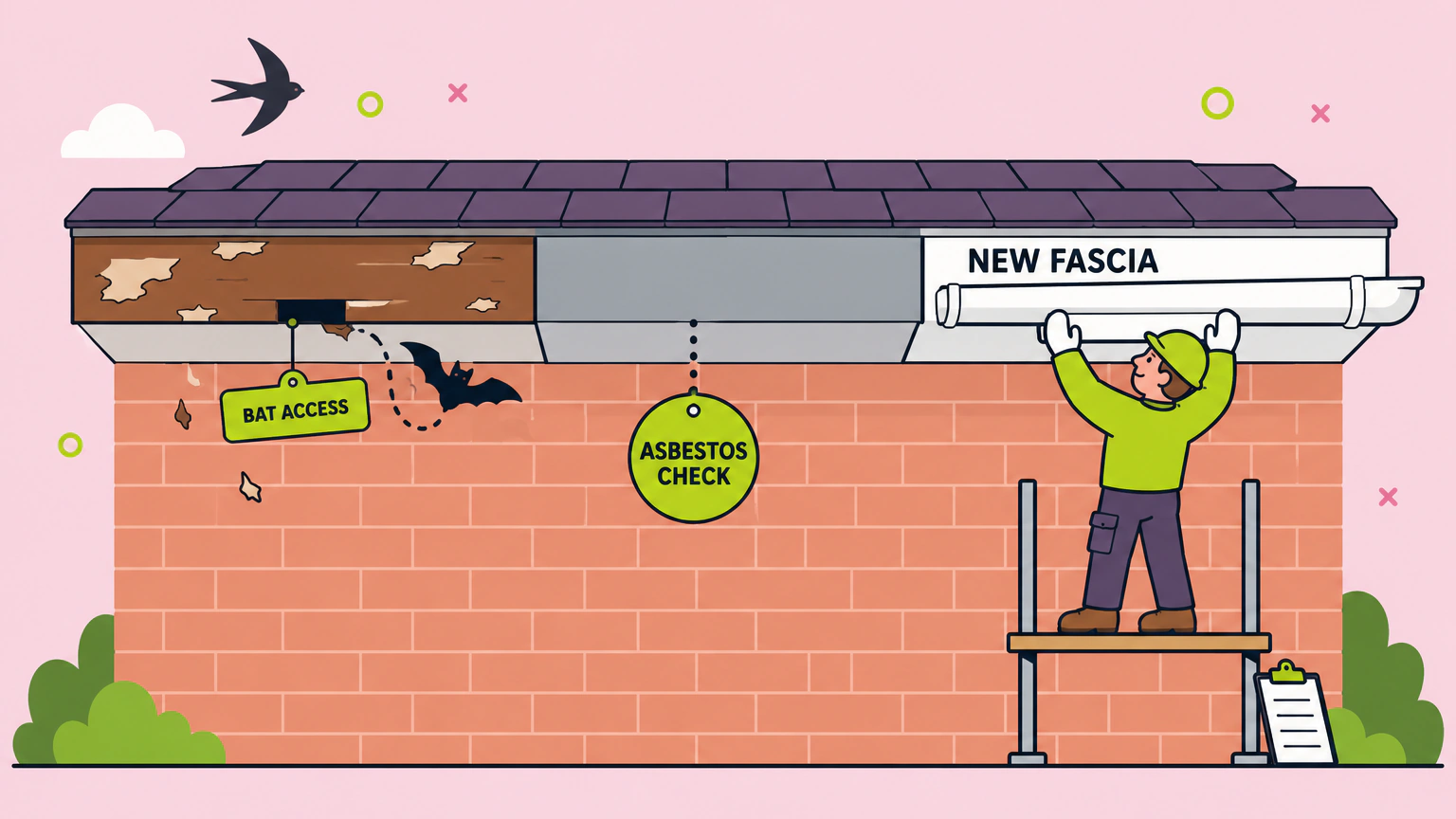
Replacing the fascias and soffits on a typical semi in uPVC costs roughly £1,200 to £3,400 before scaffolding, depending on whose price guide you read. Per metre, fitted, it's about £60 to £185. Before the old boards come down, check three things: whether a pre-2000 soffit is asbestos, whether bats or swifts use the eaves, and whether the timber is sound enough to cap.
Don't stop at the price. Each of those three checks can change who does the job, when it happens, or what it costs.
On this page
What fascia and soffit replacement costs
The four UK price guides don't agree, and the gap isn't a typo. They price different house sizes, with different ideas of what's included. Expert Roofer puts a semi at £1,200 to £2,800. BestBuilders puts the same job at £2,200 to £3,400. No other guide here prices a metre higher than Checkatrade.
The boards themselves are cheap. The Federation of Master Builders prices uPVC fascia board at £9.60 a metre and soffit board at £10.45 in its table, though its own text says soffit starts at "around £13.50 per metre". Either way, the bulk of your bill is labour, access and taking the old boards away. Most guides also price the job with new gutters, because the gutters have to come off to get at the boards.
Use the guides as a sense check, not a price list. Ask roofers near you and specialist roofline and cladding firms for a per-metre rate as well as a total, then hold each quote against these four. And ask whether VAT is in, because three of the four guides don't say.
What four UK price guides say
| Price guide | Fascias and soffits, per metre fitted | Semi-detached: fascias and soffits | Semi-detached: with new gutters | Scaffolding |
|---|---|---|---|---|
| Checkatrade (table updated September 2026) | £115 to £185, average £150 | £2,750 average, scaffolding not included | Not given | £300 to £600 per side, per week |
| MyJobQuote (updated October 2026) | Not given | Not given | £2,200 to £3,400 for a 3-bed semi in uPVC | About £500 for one wall, about £1,000 for the whole house |
| BestBuilders (2026 guide) | £90 to £150 | £2,200 to £3,400 | £2,700 to £4,000 | £900 to £1,500 for the whole house |
| Expert Roofer (prices updated July 2026) | £60 to £120 | £1,200 to £2,800 | £1,800 to £3,600 | £800 to £1,500 on top |
Only BestBuilders says whether its prices include VAT: its price chart says they do, at 20%.
Capping over the old boards is cheaper, but only over sound wood
Capping means fixing new uPVC boards over the old timber instead of taking it off, and Expert Roofer notes it's also sold as "over-cladding". It's cheaper than replacement, but the prices disagree even more. Expert Roofer says £40 to £70 a metre, BestBuilders £60 to £100 and Checkatrade £85. By the house, MyJobQuote puts capping a 4-bed semi at £1,150 (and a 3-bed semi at £800). Checkatrade prices a large semi at £3,250, nearly three times as much.
The bigger question is what's underneath. Over sound, dry timber, Expert Roofer calls capping "a legitimate budget option". Its red flag is blunt: "never cap over rotten timber." The uPVC skin hides the rot while it keeps spreading into the rafter feet, the ends of the roof timbers that the fascia is fixed to. BestBuilders only backs capping when the wood is "firm, dry and rot-free", which it says you confirm with a screwdriver test. It also warns that a capping guarantee is often shorter, or leaves out the timber altogether.
So ask the installer to show you the timber, or photograph it, once the gutter is off and before a single cap goes on. If rotten rafter ends turn up at that point, it's worth knowing when the price goes up mid-job and when it shouldn't.
Ask for the scaffolding as its own line
Scaffolding is the cost most likely to hide inside a total. Expert Roofer explains that fascia work happens at gutter height on every side of the house, so a whole-house job usually needs scaffold, typically £800 to £1,500 on top of the boards. A single rotten run above a garage can often be done from an access tower for much less.
Even one guide can't settle on a figure. MyJobQuote's gutter guide says about £1,000 for a full house, while its capping guide says typical scaffolding costs are "around £4,500". Checkatrade prices it per side, per week, at £300 to £600. A separate line is the only way to compare like with like.
If the scaffold has to stand on the pavement or the road, it needs a licence from the highway authority in England and Wales (Highways Act 1980, section 169). The Federation of Master Builders puts typical council fees at around £200 per 28 days. And if the gutters need replacing too, doing them in the same job means you pay for access once.
Which board is which
Quotes for this job use a handful of board names, and Planning Portal gives the plainest definitions. The fascia is the board fixed to the ends of the rafters at the eaves, where the gutter is attached. The soffit is the board on the underside of the overhang, closing the gap between the fascia and the wall. Planning Portal says the soffit is "where the ventilation holes are generally provided". Fascia boards also run up the gable ends to cover the rafters there, and that sloping board is the bargeboard. Checkatrade prices a replacement bargeboard at £300 to £950 each.
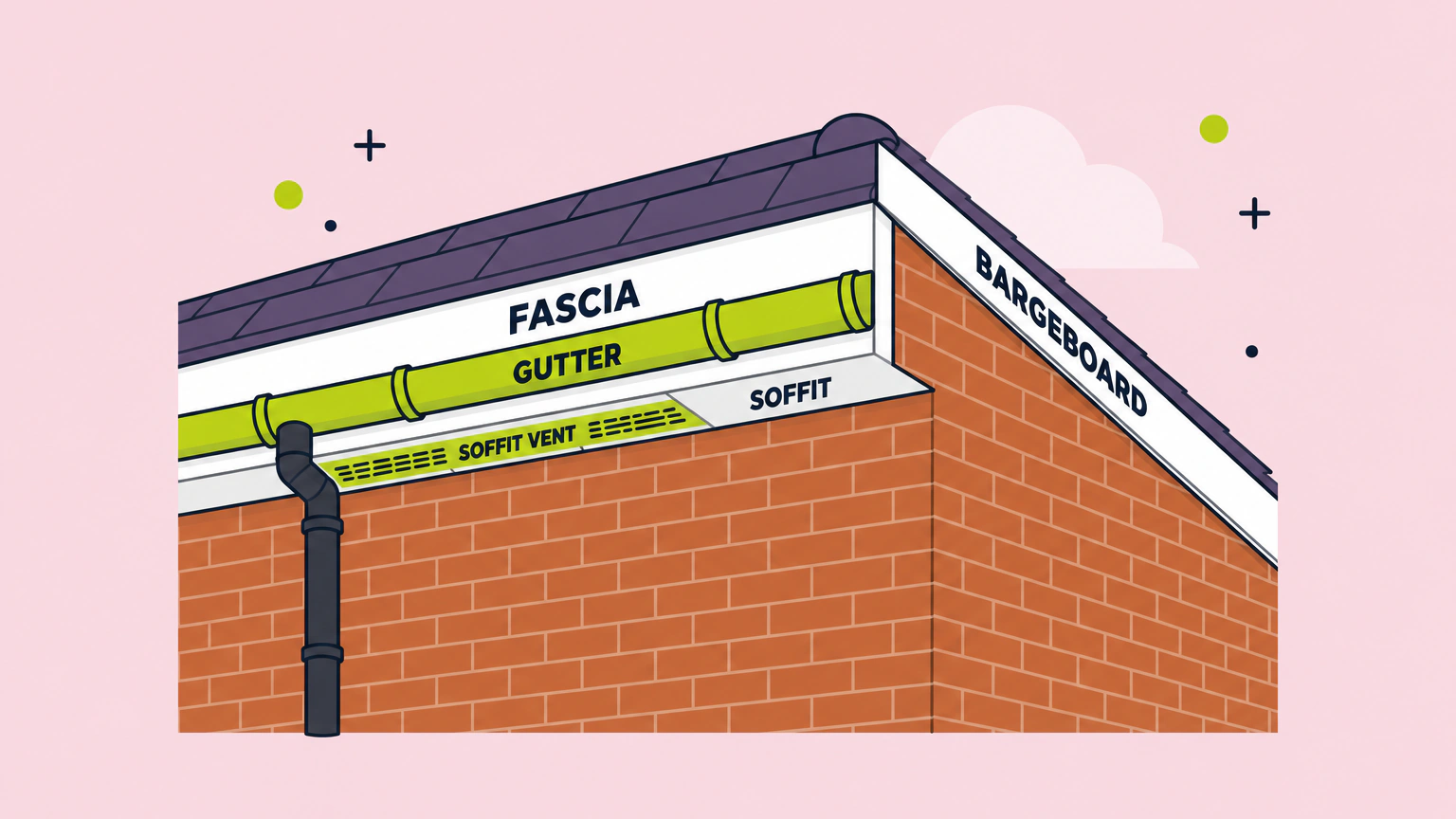
If you've followed all that, you now know more board names than most quotes bother to use.
Check the old soffits for asbestos first
Asbestos is the check that can change the whole job, so it comes before anything else. The Health and Safety Executive (HSE) says asbestos "may be part of any commercial or domestic building which was built or refurbished before the year 2000". Its list of places where asbestos insulating board was used includes "external soffits". HSE also says it's difficult to tell that board apart from non-asbestos boards. Asbestos cement, it adds, is "a hard, grey material". Once painted, either can look like any other board.
We're not asbestos surveyors or ecologists. If there's any doubt about the boards or what lives behind them, pay for the check before you pay for the scaffold.
Insulating board or cement: the difference decides who takes it down
HSE says asbestos insulating board, often shortened to AIB, "should only be removed by a contractor licensed by HSE". It lists most work to remove AIB as higher-risk work for a licensed contractor. Some short, minor maintenance tasks on it can be done by trained workers without a licence.
Asbestos cement is a different case. HSE says tasks on it "should be carried out by non-licensed workers who are trained to recognise and work safely with asbestos". It adds that this work generally wouldn't need to be notified to the regulator beforehand.
You can't tell the two apart by looking. HSE says a sample sent for analysis can confirm whether a board is asbestos cement. Where that's inconclusive, a competent asbestos analyst can run a water absorption test to show whether it's cement, millboard or insulating board.
In Northern Ireland the same rules sit under the Control of Asbestos Regulations (Northern Ireland) 2012. HSENI, the regulator there, says contractors working in your home have a legal duty to protect you from the health risks their work creates, asbestos included.
Whatever the board turns out to be, ask for any asbestos removal and disposal as its own priced line, including any access the specialist needs. The board's type changes who does the job and what it costs.
Whose job the asbestos check is
The law puts the check on the firm doing the work, not on you. Under regulation 5 of the Control of Asbestos Regulations 2012, a firm mustn't start maintenance work that could expose its workers to asbestos until it has worked out whether asbestos is there, what kind, in which material and what state it's in. If there's any doubt, it has to assume asbestos is present and work to the rules for it.
HSE says owner-occupiers aren't legally responsible for risks to contractors from asbestos. It still asks you to tell anyone working on your home about any asbestos you know of before they start. It also says not to repair or remove asbestos yourself without training. And asbestos waste has to be disposed of as hazardous waste, never mixed with household rubbish.
So put the question to the roofer plainly. "How will you check the soffits, and if it's asbestos, who takes it down and where does it go?"
Red flag: A quote for a house built before 2000 that never mentions asbestos. HSE lists external soffits among the places asbestos insulating board was used. Ask how the boards will be checked before anyone cuts, drills or caps them.
Bats, swifts and house martins at the eaves
Even if the boards pass the asbestos check, something may be living behind them. The Bat Conservation Trust (BCT) says bats "often roost behind cladding, soffits or fascias, or use these features to access their roosts elsewhere". A roost is any place a wild bat uses for shelter or protection, and even one bat counts. BCT says roosts are protected all year round, whether bats are there at the time or not. Damaging or destroying a roost can be an offence even if you didn't know it was there. GOV.UK's guidance for England lists damaging or destroying a breeding or resting place, and blocking access to resting places, among the offences. The penalty can be up to six months in prison, an unlimited fine, or both.
If bats might be roosting behind the boards
BCT's advice for fascias and soffits starts simply: replacing like for like is best if you have bats. If you're swapping timber for uPVC, it says to roughen the underside of the new boards near the bats' way in, so they can grip. Sandpaper does it, or a strip of bitumen felt, though BCT says not to use non-bitumen roofing membrane.
Timing matters as much as materials. BCT says people are commonly advised to do their work in April, or between mid-September and the end of October, when bats are least likely to be present.
In England, the advice can be free. The National Bat Helpline runs the service on Natural England's behalf, and you may be offered a volunteer roost visit. Have your contractor's quote or specification ready when you get in touch. Natural England then sends written advice with dates for the work, and BCT says not to start until you've received it. That advice is only valid until the last date it gives. GOV.UK adds that the helpline can't advise on building works that need planning permission, which a like-for-like roofline usually doesn't.
Outside England, the route is different in each nation.
Who to ask about bats before work starts
| Nation | The law protecting bat roosts | Who to ask before work starts | Phone or email |
|---|---|---|---|
| England | Conservation of Habitats and Species Regulations 2017, reg 43 | National Bat Helpline, run by the Bat Conservation Trust for Natural England | 0345 1300 228 |
| Wales | Conservation of Habitats and Species Regulations 2017, reg 43 | Natural Resources Wales species team | [email protected], or 0300 065 3000 in an emergency |
| Scotland | Conservation (Natural Habitats, &c.) Regulations 1994, reg 39 | NatureScot Bats in Houses helpline | 01463 725 165 |
| Northern Ireland | Conservation (Natural Habitats, etc.) Regulations (Northern Ireland) 1995, reg 34 | CEDaR, the records centre the Bat Conservation Trust names | 028 9039 5264 |
The National Bat Helpline answers on weekdays from 9.30am to 4.30pm. Outside England, ask whether advice or a visit is free.
Swifts and house martins come back to the same gap
RSPB says swifts nest in holes and gaps in buildings, often under roof tiles and eaves. They pair for life and come back to the same site every year. In RSPB's words, "as more old buildings are renovated and gaps in soffits closed up, Swift nest sites are fast disappearing". That's part of why swifts were added to the UK red list in 2021. They usually arrive from late April, mostly in May, and start leaving from late July.
House martins build mud nests under the eaves and often reuse them. RSPB's advice is short: "don't knock it down!"
Across the UK, a wild bird's nest is protected while it's in use or being built. In Scotland and Northern Ireland the law goes further, and stopping a wild bird from using its nest is an offence too. Our tree surgeon guide sets out the nesting-bird rules in full.
Scaffolding wrapped round the eaves can block a swift's way in. So if swifts use a gap, ask the roofer to leave it open, or book the work for the months they're away.
Ventilation, planning and listed homes
Planning Portal's guidance for England says replacing fascia or soffit boards "will not normally need building regulations approval". The catch is ventilation. Check that the new boards don't cut the airflow to the roof space, because that can cause condensation and damp on the timbers. And "if the existing system has vents installed a similar system will need to be maintained".
Edge Building Products, a roofline supplier, is blunter in its fitting guide. Roof spaces must be ventilated, it says, because condensation "encourages rot and mould growth". Its fitting sequence has the fitter cut back rotted roofing felt at the eaves, then lay a damp-proof strip or an eaves protector under the old felt so that it runs into the gutter. Edge also notes that eaves trays may be needed to keep air moving past the insulation, so if you're insulating the loft too, tell both installers.
Planning is usually simpler. Planning Portal says replacing or painting fascias "generally does not require planning permission". If you live in a listed building, a conservation area, a national park or an area of outstanding natural beauty, check with the council first.
In England and Wales, altering a listed building in a way that affects its character without listed building consent is a criminal offence. So swapping painted timber for uPVC on a listed house is a question for the council before the quote, not after. Planning Portal's pages cover England, so in Wales, Scotland and Northern Ireland, check with your own council.
What a fair roofline quote should list
A fair quote names each part of the job, so you can compare it with the next one line by line. If you agreed to the work at your kitchen table after a sales visit, you usually have at least 14 days to cancel, and our guide on what to do about a doorstep roofer covers the rest.
- Full replacement or capping, said in those words.
- Fascias, soffits, gutters, downpipes and bargeboards, each listed with the metres measured.
- Scaffolding or a tower as its own line, and who applies for any pavement licence.
- Vented soffits or an over-fascia vent wherever the old roofline had vents.
- A price for rotten rafter ends if they turn up once the boards are off.
- How the soffits will be checked for asbestos in a house built before 2000, and who removes any that's found.
- Whether there are bats or nesting birds at the eaves, and when the work will happen around them.
- Whether VAT is included in the price.
- The workmanship guarantee in writing, and whether it covers the timber behind a cap.
Then book the asbestos check, and the bat advice if you need it, before you agree a scaffold date. Not after.
Fascia and soffit questions, answered
How long does it take to replace fascias and soffits?
Usually between one and five days, depending on the size of the house. The Federation of Master Builders puts a terraced house at one to two days, a semi at two to three and a detached house at three to five. It can take longer if scaffolding is needed, the gutters are replaced at the same time, or hidden damage turns up once the old boards come off.
Do I need new gutters when I replace fascias and soffits?
Not always, but it's usually sensible. The gutters come off anyway, and Expert Roofer says refitting a 20-year-old gutter system onto brand new boards rarely makes sense. Doing both in one visit means paying for access once. MyJobQuote prices uPVC gutters at £40 to £50 a metre fitted. If your boards are sound and only the gutter has failed, look at gutter repair instead.
Can you replace fascias without scaffolding?
Sometimes. Expert Roofer says a single run, such as one above a garage, can often be done from an access tower for much less. A whole house usually needs scaffolding on every side, because the work happens at gutter height all the way round. Expert Roofer's advice is to make sure the quote states which access method is priced in.
Do soffits need to be vented?
If the old ones were vented, then yes in practice. Planning Portal (England) says replacement shouldn't reduce the ventilation to the roof space, and that where vents are installed a similar system needs to be kept. Edge Building Products says ventilation stops warm air condensing on cold surfaces, and that condensation encourages rot and mould. Ask for vented soffits or an over-fascia vent where the old roofline had vents.
Can you cover asbestos soffits instead of removing them?
Sometimes, but not as a casual cap-over. HSE says asbestos in good condition is often best left where it is. Slightly damaged asbestos can sometimes be sealed or enclosed, it adds, but only by people with the necessary training. Fixing new boards over the old ones can disturb the asbestos. HSE says the risk assessment decides whether the work needs a licensed contractor. Ask about the installer's asbestos training first.
Do I need planning permission to replace fascias and soffits?
Usually not. Planning Portal says replacing or painting fascias generally doesn't need planning permission in England. If you live in a listed building, a conservation area, a national park or an area of outstanding natural beauty, check with the council first. A listed home may also need listed building consent, and in England and Wales working without it can be a criminal offence.
When is the best time of year to replace fascias and soffits?
Autumn and winter avoid swifts, which RSPB says start leaving from late July and come back from late April. If bats use the eaves, BCT says the usually advised windows are April, or mid-September to the end of October. So get the bat advice first, and let it set the date before you book the scaffold.