

On this page
- What "unsatisfactory" actually means on an EICR
- Table 1: what each EICR code means and what it obliges you to do
- If you let the property in England, the 28 day clock has already started
- The penalty figure most guides still get wrong
- If you own the home you live in, there is no clock and no duty
- If you rent your home, this is what your landlord owes you
- Scotland, Wales and Northern Ireland run different rules
- If you think the codes are wrong
- What this is likely to cost
- Frequently asked questions
What "unsatisfactory" actually means on an EICR
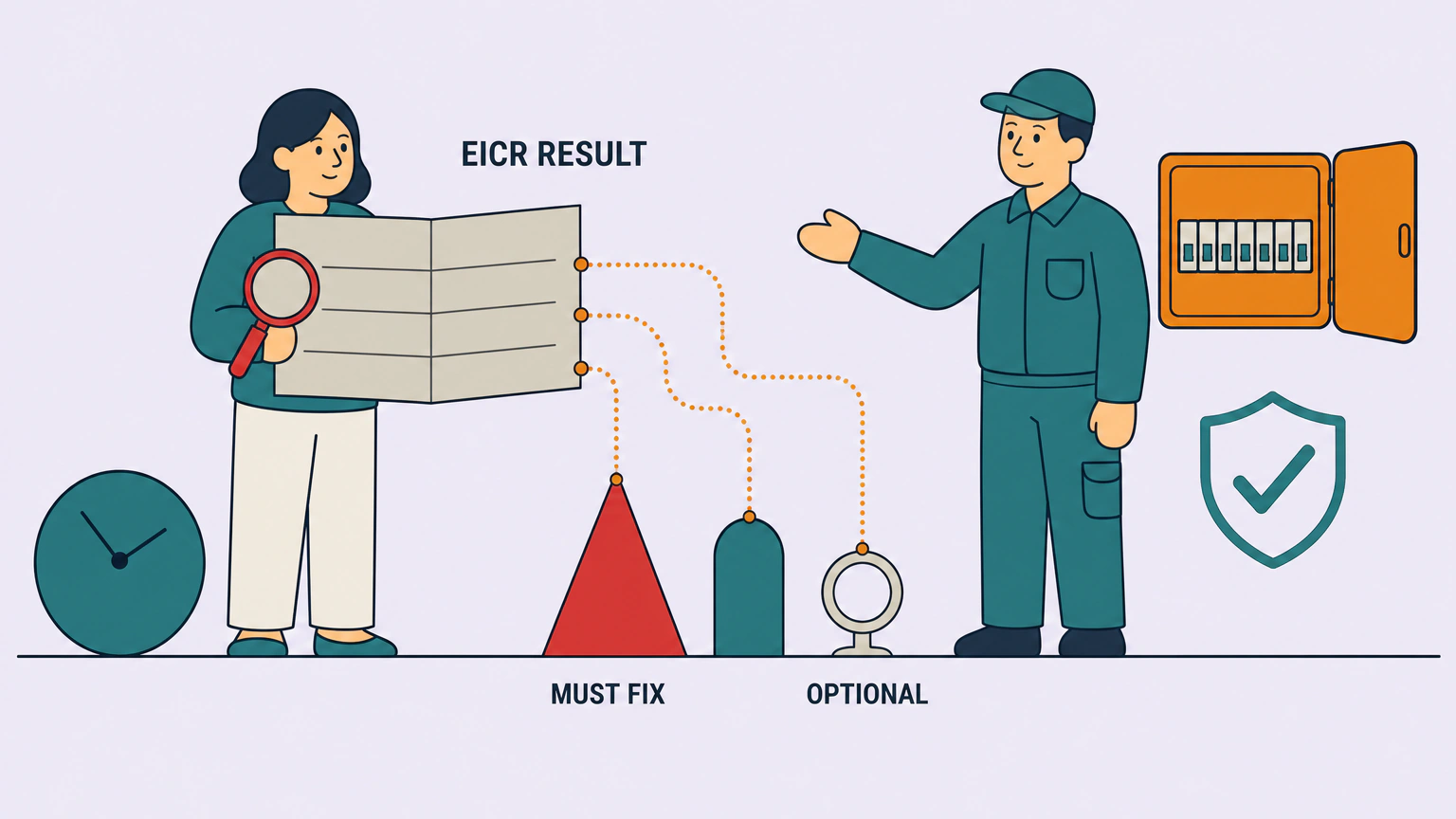
The word is not a verdict on your house. An Electrical Installation Condition Report inspects the fixed wiring: cables, sockets, light fittings and the consumer unit, sometimes still called the fuse box. The result follows mechanically from the codes the inspector recorded.
The four classification codes, and which ones fail a report
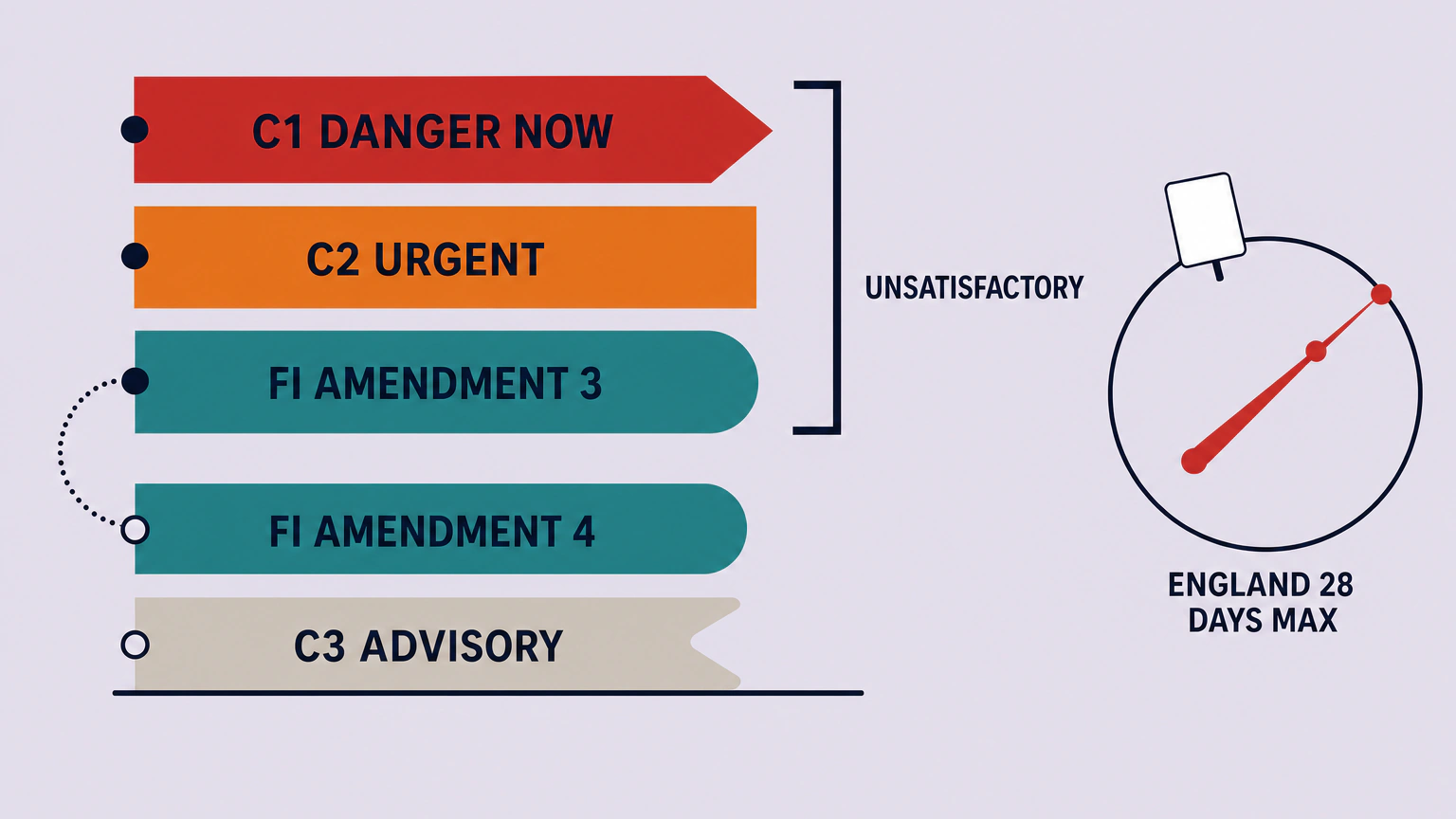
The government's guidance for landlords sets out four. C1 means danger present and a risk of injury. C2 means potentially dangerous. C3 means improvement recommended. Under Amendment 3, FI means further investigation is required without delay; Amendment 4 changes it to further investigation is advised.
Where a C1 or C2 appears, that guidance is explicit: remedial work will be required, and the report will state the installation is unsatisfactory for continued use. An FI has that effect on an Amendment 3 report. On an Amendment 4 report, FI is advisory and does not make the report unsatisfactory. A C3 alone leaves the report satisfactory.
Why C3 items appear on your quote even though nothing requires them
A C3 is not a fault. It records a departure from the current edition of the wiring regulations, BS 7671, so wiring that was compliant when installed can pick up C3 observations because the standard moved on.
Quoting for C3 items is legitimate, and so is declining them: the guidance says landlords do not have to make the improvement, only that it would improve safety. Quotes often put everything in one column under one total, so ask for every line to be marked with its code before you agree to anything.
"Unsatisfactory for continued use" does not mean you have to move out
The phrase describes the installation's certification status, not the habitability of the building. An inspector who finds a C1 may make it safe before leaving, which the guidance anticipates. The Regulations do not themselves require a tenant to leave while remedial work happens; whether it is safe to remain is a site-specific question for the qualified person.
This is a condition report, not a registration check
If your real question is whether the electrician who wrote the report is properly registered, that's a different check. Our guide to which register applies to electrical work covers the registers and the certificates for new installation work.
Table 1: what each EICR code means and what it obliges you to do
| Code | What it means | Does it fail the report? | What you must do |
|---|---|---|---|
| C1 | Danger present. Risk of injury. | Yes | Act immediately. The inspector may make it safe before leaving. In a let property in England, within 28 days or sooner if the report says so. |
| C2 | Potentially dangerous. | Yes | Remedial work required. In a let property in England, within 28 days or the shorter period the report specifies. |
| FI | Amendment 3: further investigation required without delay. Amendment 4: further investigation advised. | Amendment 3: yes. Amendment 4: no. | Follow the report. If it requires further investigation and that identifies more work, the same duty and a fresh clock apply. |
| C3 | Improvement recommended. | No | Nothing is required. Worth doing on safety grounds, but declining it breaches no duty and does not fail the report. |
If you let the property in England, the 28 day clock has already started
The deadline does not begin when the report reaches your inbox. Under regulation 3(4) of the Electrical Safety Standards in the Private Rented Sector and Social Rented Sector (England) Regulations 2020, the 28 days start with the date of the inspection and testing, so the day the electrician attended is day one.
What the Regulations require, step by step
Regulation 3(1) requires you to meet the electrical safety standards throughout the tenancy, to have every installation inspected and tested by a qualified person at regular intervals, and to have it inspected and tested before the tenancy commences.
Regular intervals means at least every five years, or by the earlier date the most recent report requires. Where the report calls for further investigative or remedial work, regulation 3(4) gives you 28 days from the inspection date, or the shorter period the report specifies. Regulation 3(6) then matters: if an FI investigation turns up further work, you repeat the cycle for it, with a fresh clock.
Who has to receive a copy, and by when
Five distribution duties sit in regulation 3(3), and missing one is a breach in its own right. The file is often held by letting agents and property managers rather than the landlord.
- Each existing tenant, within 28 days of the inspection and test.
- The local housing authority, within 7 days of a written request from it.
- Any new tenant, before that tenant occupies the premises.
- Any prospective tenant, within 28 days of a written request from them.
- The person carrying out the next inspection, plus your own retained copy.
Prospective tenant is now defined: anyone who asks for information about the property to decide whether to rent it, asks to view it, or makes an offer.
Three duties that only arrived in November 2025
S.I. 2025/1043 amended the Regulations on 1 November 2025 and renamed them to include the social rented sector.
First, the pre-tenancy inspection duty widened: the original wording covered the first inspection for a new tenancy, and regulation 3(1)(c) now requires the installation to have been inspected before every specified tenancy commences. The current guidance says a still-valid report can satisfy that duty, so a fresh inspection is not required at every re-let. Second, regulation 3(2A) added a defence, that you are not in breach if you can show you took all reasonable steps, and regulation 3(2B) confirms a tenant blocking access does not oblige you to bring legal proceedings to get in. Third, social landlords are covered. Their tenancies granted before 1 December 2025 came into scope on 1 May 2026, and regulation 3E requires those installations inspected and tested before 1 November 2026.
What you send back once the work is done
Regulation 3(5) requires written confirmation from a qualified person that the work has been carried out, with the report that required it. Both go to each existing tenant and to the local housing authority within 28 days of completion. A fresh full EICR is not always needed: the guidance accepts a satisfactory EICR, an Electrical Installation Certificate, a Minor Electrical Installation Works Certificate or other appropriate certification.
The penalty figure most guides still get wrong
Regulation 11 lets a local housing authority impose a financial penalty where it is satisfied beyond reasonable doubt that a landlord has breached a duty under regulation 3. The maximum is £40,000, substituted for the old £30,000 by S.I. 2025/1043 from 1 November 2025.
Two details take the edge off it. The authority may impose more than one penalty where a failure continues, so the ceiling is not a cap on an ongoing breach. For a report that does not indicate urgent remedial action, regulation 4 requires the authority to serve a remedial notice giving you 28 days from service to put the work right, with 21 days to make written representations.
Red flag: guidance published before November 2025 still gives £30,000 as the maximum penalty, and some pages currently competing for this search do the same. The figure in the Regulations today is £40,000, and a local housing authority may impose more than one penalty where a failure continues. Check the date on anything you read about this.
If you own the home you live in, there is no clock and no duty
The 2020 Regulations apply to specified tenancies. If nobody rents your home from you, none of those duties touch you, and the report is a list of recommendations rather than legal instructions.
Safety first: tenure changes the deadline, not the danger. A C1 means a risk of injury is present right now, and it is worth acting on whether or not any law is telling you to.
What the recommended intervals actually are
Electrical Safety First, the electrical safety charity, recommends periodic inspection and testing at least every ten years for an owner-occupied home, every five years or at each change of occupancy for a tenanted one, and at least every five years for a business. Those are recommendations, not statutory intervals. The five-year figure becomes a legal requirement only once the property is let, and then it comes from the Regulations.
How to read a remedial quote when nothing compels you to accept it
Sort the quote by code and act in that order. Deal with a C1 immediately whatever your tenure. Treat a C2 as urgent, because potentially dangerous is a real hazard even with no deadline attached. Resolve an FI before assuming the installation is fine. Treat C3 items as a budgeting question for another year.
Before you agree to any remedial work:
- Ask the electrician to mark every line on the quote with its code: C1, C2, C3 or FI.
- Check the report's own overall verdict, and whether it names a period shorter than 28 days.
- Confirm the inspection date, because that is when any deadline started, not the date the report reached you.
- Ask whether any C3 items have been priced in, and whether you can decline them.
- Ask what document you will receive when the work is finished, and who else needs a copy.
- If the quote is large, get a second inspection from an electrician who is not quoting for the work.
- Keep the report: you will need to hand it to whoever carries out the next inspection.
Pro tip: whoever inspected does not have to be whoever repairs. Getting the work quoted by a second electrician lets you compare the assessment and price before deciding.
Selling or buying: what an unsatisfactory report does to the transaction
No law requires an EICR to sell a home in England. The statutory duty to hold and act on one sits in the 2020 Regulations and belongs to landlords, so an unsatisfactory report on a home you are selling is a negotiating fact, not a legal barrier.
Buyers meet it the other way round: a survey recommends an inspection, the report comes back unsatisfactory, and the C2 items become a price conversation. Home inspectors and surveyors can tell you what their recommendation rested on, and a coded quote turns a vague worry into a number.
If you rent your home, this is what your landlord owes you
You are not a bystander here. The Regulations give you a document and a route, and that route doesn't run through your rent payments.
Asking for the report, and what to do if it does not come
Your landlord must give you a copy within 28 days of the inspection and test. If one has been carried out and nothing has arrived, ask in writing, name the property, and request the inspection date and a copy of the report under regulation 3(3)(b). If no inspection has happened at all, that is a separate breach of regulation 3(1), and the local housing authority is the body that acts on it.
When the council can step in and do the work itself
Where the council has reasonable grounds to believe a landlord is in breach and the most recent report does not indicate urgent remedial action, it must serve a remedial notice requiring the work. If the landlord does not comply, the council may arrange the work itself and recover its costs. Where the report calls for urgent remedial action it can act sooner, with your consent and 48 hours' notice.
Withholding rent is not part of this and can put your tenancy at risk. If you paid a trader for work that never happened, read our guide on what to do when a trader takes your money and stops replying.
Scotland, Wales and Northern Ireland run different rules
The 28 day rule is an English rule, from an instrument that applies in England only. Each of the other three nations creates the duty its own way, with different triggers and consequences.
| Nation | Governing instrument | How often | Deadline to fix | Copy to the tenant |
|---|---|---|---|---|
| England | Electrical Safety Standards in the Private Rented Sector and Social Rented Sector (England) Regulations 2020, regs 3 and 11 | At least every 5 years, sooner if the report requires, and before the tenancy commences | 28 days starting with the date of the inspection, or less if the report specifies | Within 28 days of the inspection |
| Wales | Renting Homes (Fitness for Human Habitation) (Wales) Regulations 2022, reg 6 | A valid report throughout each period of occupation; valid 5 years, or less if the report says | None fixed. The dwelling is treated as unfit for human habitation while the landlord is not compliant | Within 14 days of the occupation date, the inspection, or receiving written confirmation of work |
| Scotland | Housing (Scotland) Act 2006, s 13(1)(c) repairing standard, with Scottish Ministers' statutory guidance under s 13(7)(b) | Before the property is first let, then at intervals of no more than 5 years, per that guidance | None fixed. C1 and C2 items must be rectified to meet the repairing standard; FI investigated as soon as practically possible | Before the tenancy starts, and after any inspection during it |
| Northern Ireland | Electrical Safety Standards for Private Tenancies Regulations (Northern Ireland) 2024, reg 3 | At least every 5 years; before a new tenancy commences, or by 1 December 2025 for a tenancy granted before 1 April 2025 | 28 days beginning with the day of the inspection, or less if the report specifies | Within 28 days of the inspection |
Every cell comes from the instrument or guidance named in the same row. The Scottish interval sits in the statutory guidance rather than the Act, which is why the Act alone won't answer the question.
Why a single UK answer does not exist here
Four instruments, four consequences. England: a financial penalty of up to £40,000 from the local housing authority. Northern Ireland: failing to comply with regulation 3 is an offence, liable on summary conviction to a fine not exceeding level 5 on the standard scale, £5,000 there, alongside council remedial notices and cost recovery. Wales: the dwelling is treated as unfit for human habitation, which breaches a fundamental term of the occupation contract and, under Schedule 9A to the Renting Homes (Wales) Act 2016, blocks a landlord's no-fault notice under section 173. Scotland: the tenant applies to the First-tier Tribunal, which can make a Repairing Standard Enforcement Order and, on a failure to comply, a Rent Relief Order.
If you think the codes are wrong
Classification involves professional judgement, and two competent inspectors can reasonably differ at the margin, particularly between C2 and C3. That is a fair reason to seek a second opinion, and never a reason to leave a C1 or C2 alone.
Getting a second opinion, and the complaint route through the registering body
Commission a fresh inspection from an independent electrician who is not quoting for the remedial work, and say that's what you're doing. Comparing electricians in your area on that basis costs one more inspection and settles it either way.
If you believe the report is wrong rather than debatable, the registration scheme is the route. Electricians are assessed by bodies including NICEIC, NAPIT and SELECT, and each runs its own complaints process for work by its registrants. The technical reference both sides reach for is Electrical Safety First's Best Practice Guide 4 on classification codes, which the government guidance points to.
What this is likely to cost
Remedial cost depends almost entirely on which codes were raised. Adding RCD protection at the consumer unit and rewiring a house are different orders of magnitude, and no single average covers both.
What our own electrical cost profiles show
Our electrical category page aggregates quote data from 791 cost profiles. Across them the national average is £420, with a minimum of £107 and a maximum of £1,198. Treat that as our own aggregate of cost profiles rather than a market survey, covering electrical work generally rather than EICR remedials specifically.
It's still a useful anchor, because it doesn't come from anyone selling you the work. See how Industry Oversight checks the businesses it lists, then compare quotes from electricians in your area before accepting the first one.
Frequently asked questions
Does a C3 code mean my EICR has failed?
No. A C3 means improvement recommended, and the government's guidance states that further remedial work is not required for the report to be deemed satisfactory. C1 and C2 observations make a report unsatisfactory for continued use. During the transition to Amendment 4, FI does so under Amendment 3 but not under Amendment 4. If every coded item is a C3, the report has passed.
How long do I have to fix an unsatisfactory EICR?
In a let property in England, 28 days starting with the date of the inspection and testing, or the shorter period the report specifies. The clock runs from the day the electrician attended, not the day the report reached you. If you own and live in the property, no statutory deadline applies at all.
Does the 28 day deadline apply if I own the house I live in?
No. The 2020 Regulations apply to specified tenancies, meaning property let to somebody who occupies it as their only or main residence and pays rent. An owner-occupier has no inspection duty, no deadline and no penalty exposure. The report is a recommendation you can act on at your own pace.
What happens if I miss the deadline?
If the most recent report does not indicate urgent remedial action, the local housing authority must serve a remedial notice giving you 28 days from service to do the work, and you have 21 days to make written representations. If you still do not comply, the council can arrange the work and recover its costs, and it can impose a financial penalty of up to £40,000.
Do I need a completely new EICR after the remedial work is done?
Not necessarily. The Regulations require written confirmation from a qualified person that the work has been carried out, supplied with the original report. The guidance accepts a satisfactory EICR, an Electrical Installation Certificate, a Minor Electrical Installation Works Certificate or other appropriate certification as that confirmation.
Can my tenants stay in the property while the work is carried out?
Whether tenants can stay depends on the hazard and the work. Nothing in the Regulations itself requires a property to be vacated for remedial work, and an inspector may make a C1 hazard safe before leaving. Follow the qualified person's site-specific safety instructions. Urgent remedial action taken by a council needs the tenant's consent and 48 hours' notice.
Do I need an EICR to sell my house?
No law in England requires an EICR before a sale. The statutory duty to hold and act on one belongs to landlords under the 2020 Regulations. A buyer's survey may still recommend an inspection, and an unsatisfactory result then becomes a point of negotiation on price rather than a legal obstacle to completing.
This is general information about the law in your nation, not advice on your own installation. For a decision about a specific defect, ask a qualified person to look at it. Anything coded C1 should be treated as an immediate hazard whatever your tenure.