

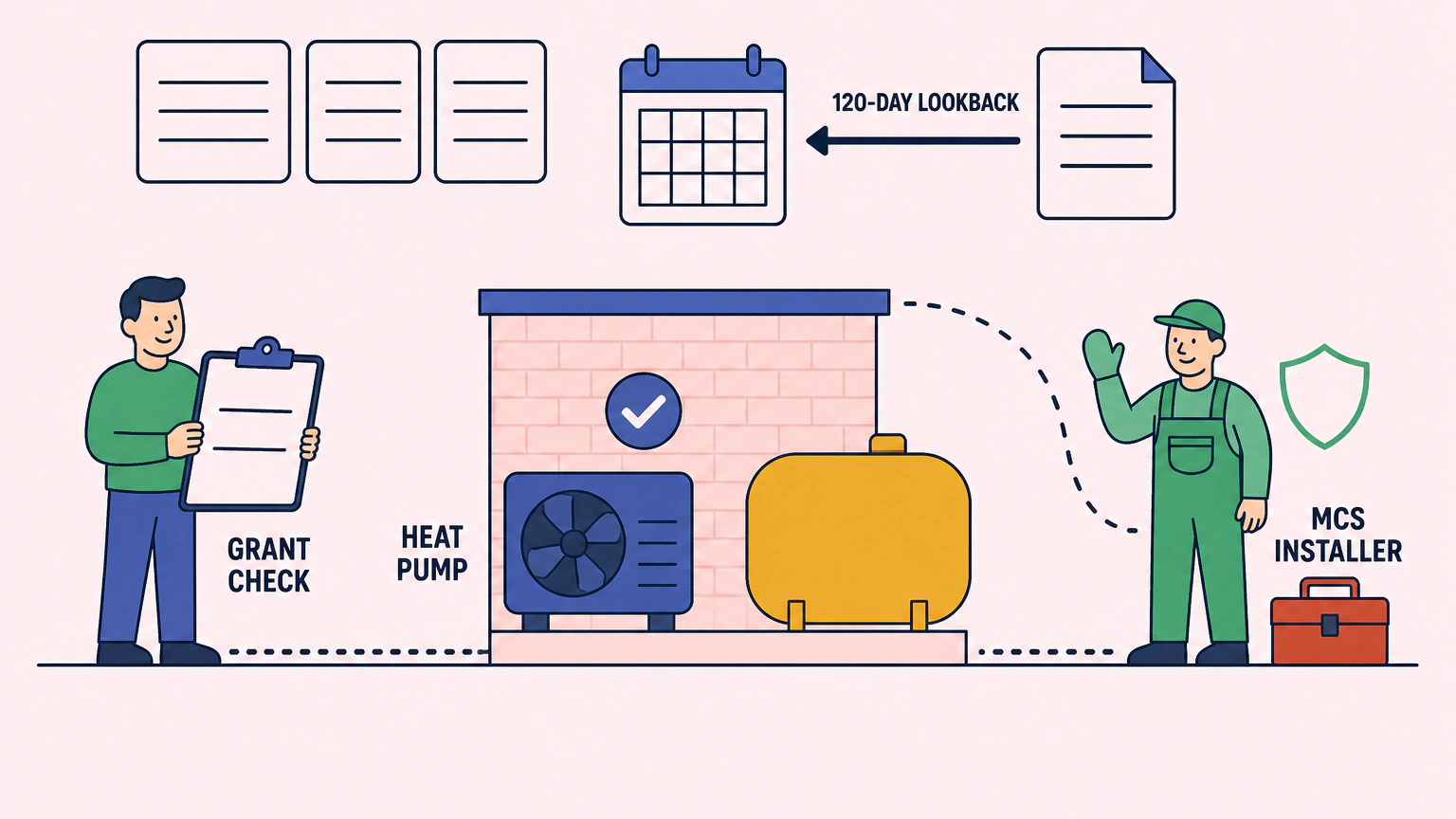
Boiler Upgrade Scheme eligibility comes down to six questions: which nation, who owns the property, what heats it now, whether there is a gas main at the address, what you're installing, and two deadlines almost nobody advertises.
Three dates to keep: the £9,000 off-gas rate runs from 21 July 2026 to 31 March 2027. The temporary 0% VAT rate for qualifying installations in residential accommodation and relevant charitable buildings ends the same day. For BUS eligibility, a system commissioned before the application must have been commissioned no more than 120 days before the grant application is properly made. Once issued, a voucher expires after three months, or after six months for a ground source heat pump.
On this page
- The short answer: what the scheme pays, and where
- Which nation you live in decides everything else
- The eligibility tests, in the order they are actually applied
- The two deadlines that cost people the grant
- What you will actually pay after the grant
- How to apply without losing the grant
- Frequently asked questions
- How we checked this
The short answer: what the scheme pays, and where
The four grant values, and the one with an expiry date
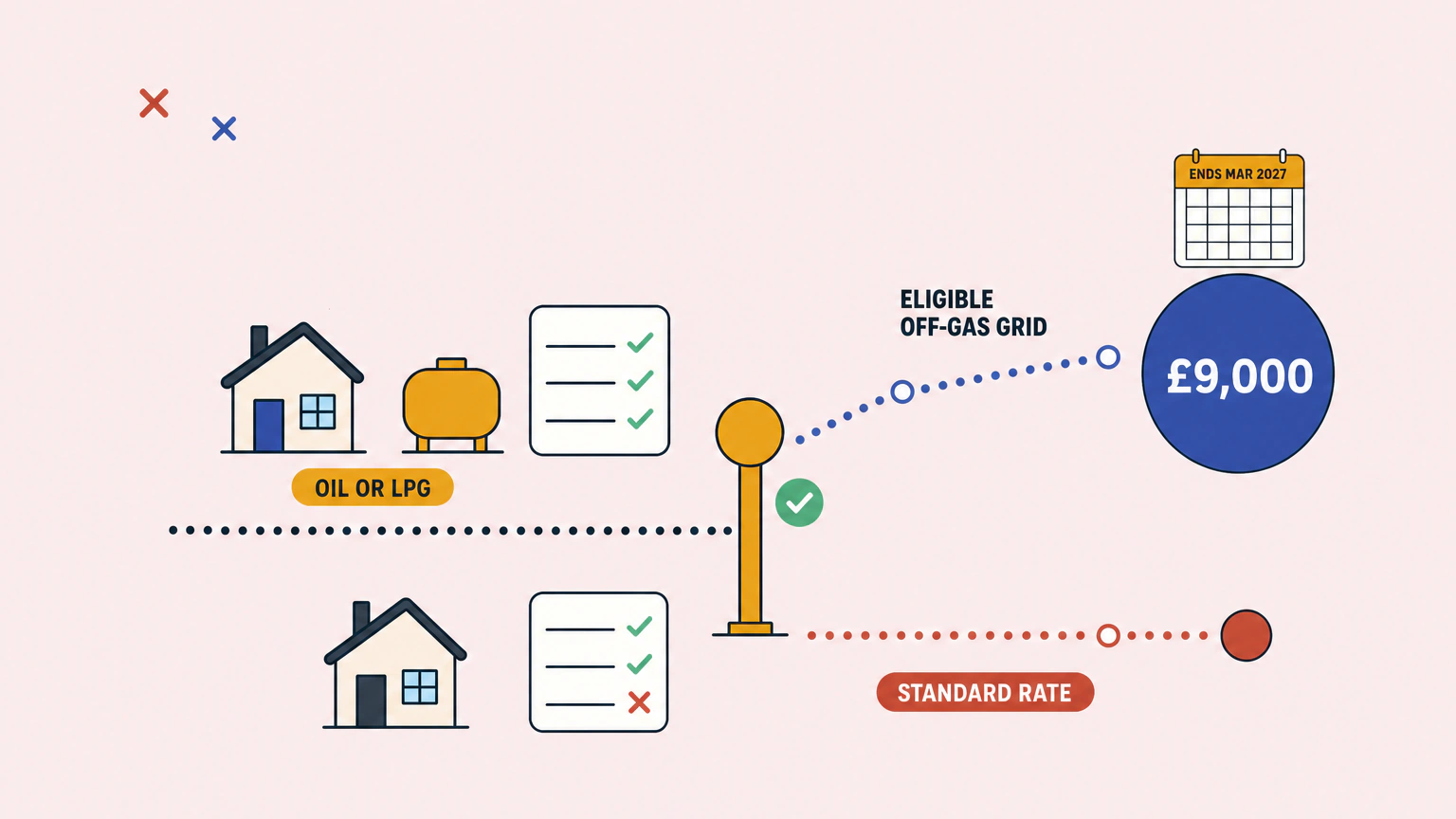
You get one grant per property, and the amount depends on what you install, not on what you earn. Three of the four values have no published end date. The fourth isn't a separate grant at all: the off-gas-grid rate is the £7,500 heat pump grant plus a £1,500 uplift, which Ofgem publishes as running from 21 July 2026 until 31 March 2027.
The Secretary of State sets and publishes those values under regulation 13 of the scheme's regulations, and they can go down as well as up. A change takes effect at least 28 days after its notice. Normally the value is the one in force when the voucher application is properly made; for an application held over because budget was exhausted, it is the value in force when the voucher is issued.
| System | Grant | Conditions attached | Ends |
|---|---|---|---|
| Air-to-water heat pump (air source) | £7,500 | England or Wales; MCS-certified installer | No end date published |
| Ground source heat pump, including water source and shared ground loops | £7,500 | As above | No end date published |
| Air-to-water or ground source, off-gas-grid rate | £9,000 | Heated by oil or LPG and an eligible off-gas-grid property as defined below | 31 March 2027 |
| Air-to-air heat pump | £2,500 | Residential properties only | No end date published |
| Biomass boiler | £5,000 | Off the gas grid, rural, emissions certificate; no self-builds | No end date published |
Why GOV.UK and Ofgem describe the off-gas rate differently
The two official sources word the same rule differently, and the difference is worth £1,500 to you. GOV.UK says you get an additional £1,500 "if both" the property is heated by oil or LPG and you have no mains gas connection. Ofgem, the administrator, publishes it as £9,000 "in eligible off-gas grid properties". Read only Ofgem's line and a home on electric storage heaters with no gas main looks like a £9,000 case. It's a £7,500 case.
The regulations explain the gap. Schedule 1A splits the off-gas-grid grant categories by the fuel being replaced: oil, LPG, coal, a fossil-fuel hybrid and electric heating each sit in their own line. The values published on GOV.UK attach the extra £1,500 only to the oil and LPG ones.
The gas half of the test is strict too. An off-gas grid property is one not attached to a heat network, not fuelled by mains gas, with no record of a gas meter point, and not a new build. Capping or clamping the meter doesn't help: a property doesn't stop being fuelled by mains gas when its supply meter point is capped or clamped. Get the grant value in writing on the quotation, with the figure stated, before you agree anything.
Heat Pump Grant Checker
These questions need JavaScript. The result below is the answer for a home in England heated by an oil boiler that matches the statutory off-gas-grid definition, replacing it with an air-to-water heat pump.
Your result
£9,000 published rate
Off-gas-grid rate - currently available for applications properly made by 31 March 2027
Your property is heated by oil and your answers match the statutory off-gas-grid definition, so the higher published rate applies to an otherwise eligible air-to-water heat-pump application.
Your installer must be MCS certified and applies to Ofgem on your behalf. Ofgem checks the eligibility conditions this checker does not establish. The grant should appear as a deduction on your quotation.
The Boiler Upgrade Scheme covers second homes, business premises and properties you let to tenants, as long as you own them.
Which nation you live in decides everything else
England and Wales — the Boiler Upgrade Scheme
The scheme is made under the Boiler Upgrade Scheme (England and Wales) Regulations 2022 and extends to those two nations only. Ofgem administers it and the Department for Energy Security and Net Zero owns the policy. Residential and non-residential buildings both count, so premises you own qualify as well as your house.
Welsh readers are covered on identical terms: Wales took 4,534 of the 87,266 grant payments made up to the end of June 2026. The Welsh Government separately runs Nest, which offers free improvements including a heat pump to households meeting its own conditions.
| Nation | Scheme | Most you can get | Who qualifies | Where to start |
|---|---|---|---|---|
| England | Boiler Upgrade Scheme | £7,500, or £9,000 for oil and LPG homes that meet the eligible off-gas-grid definition, until 31 March 2027 | Anyone who owns the property, including landlords, second homes and business premises | An MCS-certified installer, who applies to Ofgem for you |
| Wales | Boiler Upgrade Scheme, with Nest alongside | £7,500, or £9,000 on the same eligible off-gas-grid conditions | As England. Nest is separate, with its own test | An MCS-certified installer; Nest for the Welsh scheme |
| Scotland | Home Energy Scotland Grant and Loan | £7,500 grant, up to £7,500 more as an optional interest-free loan, plus £1,500 rural and island uplift | Homeowners living there as their only or main private residence, so no let property or second homes | Home Energy Scotland, before you agree a quote |
| Northern Ireland | The Boiler Upgrade Scheme does not apply; the Boiler Replacement Scheme is closed; NISEP runs separate annual schemes | Fully funded air-source heat pumps are listed for qualifying owner-occupiers in 2026/27 | Income, tenure, current-heating and property conditions apply | NI Energy Advice; the current NISEP scheme list; the Housing Executive's Affordable Warmth Scheme |
Scotland — a grant plus an interest-free loan, with a tighter ownership test
Home Energy Scotland pays up to £7,500 as a grant towards air, ground and water-to-water source heat pumps, with up to £7,500 more as an optional interest-free loan and a £1,500 uplift for rural and island homes. Like the Boiler Upgrade Scheme, it isn't means tested.
The ownership test is where it parts company with England and Wales. The property must be an existing Scottish property you own and live in as your only or main private residence, so a landlord who qualifies in Wales doesn't qualify in Scotland. Hybrid heat pumps are excluded and the system must meet all the property's heating and hot water needs. Wood-fuelled boilers are funded on the same terms, but only with written evidence of why a heat pump and high heat retention storage heaters are not suitable. Funding is first come, first served.
Northern Ireland — no Boiler Upgrade Scheme, and what exists instead
The Boiler Upgrade Scheme does not operate in Northern Ireland, and the Boiler Replacement Scheme is closed. But the 2026/27 Northern Ireland Sustainable Energy Programme lists fully funded air-source heat pump schemes for qualifying owner-occupiers, subject to income, current-heating and property conditions.
Help with energy efficiency does exist: NI Energy Advice for free advice and referrals, the Housing Executive's Affordable Warmth Scheme, and the Northern Ireland Sustainable Energy Programme. A consultation on a Warm Healthy Homes Fund, intended to replace Affordable Warmth, was still running when this page was verified.
The eligibility tests, in the order they are actually applied
Test 1 — do you own it?
You must own the property you're applying for. GOV.UK is explicit that this includes a business premises, a second home and a property you rent out to tenants, which makes this grant unusually landlord-friendly.
A tenant can't apply: if you rent, the application and the money belong to your landlord. Scotland is the mirror image, and funds only the home you live in.
Test 2 — what heats it now?
The system you're replacing has to be fossil-fuelled, which GOV.UK lists as oil, gas or LPG. An electric heating system counts too. That last category is the one people miss, and it brings storage-heater homes inside the scheme. You can't use the grant to replace heating that's already low carbon, and an address that has already had public money for a heat pump or biomass boiler can't have a second grant.
Solid fuel sits in a grey area. The regulations' own category list names a coal heating system as something a grant can replace, but wood isn't a fossil fuel, so ask your installer to confirm with Ofgem before ordering.
Test 3 — is the property itself excluded?
Some properties fail on what they are, not on what heats them.
| Situation | Eligible? | What to do instead |
|---|---|---|
| Social housing | No | Ask your landlord or housing association what funding they use |
| A new build the developer is still building | No | Ask the developer to specify a heat pump in the build |
| A finished new build you moved into with a fossil-fuel boiler | Possibly | GOV.UK says you may be able to get a grant; have your installer confirm with Ofgem |
| An address that has already had government funding for a heat pump or biomass boiler | No | The funding is spent; it is one grant per property |
| A self-build you or the original owner built | Yes, with evidence | Show proof such as the title deeds if you built it; self-builds cannot get the biomass grant |
| A hybrid gas boiler plus heat pump system | No | Choose a heat pump sized for the whole property |
| Replacing heating that is already low carbon | No | The scheme funds the switch away from fossil fuel and electric heating |
| You rent the property | No, not for you | Only the owner can apply |
Test 4 — is the equipment eligible?
Capacity is capped at 45 kilowatts thermal for a single system, 70 kilowatts thermal where a heat pump goes in alongside further heat pumps, and 300 kilowatts thermal for shared ground loops. Air-to-water and ground source units must reach a seasonal coefficient of performance of at least 2.8. That figure is the heat delivered across a year for each unit of electricity used. Hybrids that pair a gas boiler with a heat pump are excluded, and the heat pump has to be sized to meet the property's full space heating demand on its own.
Ask your installer early whether the electricity supply needs upgrading. GOV.UK says most heat pumps go in without changes to the supply, but if yours is the exception, the electricians doing that work are a cost outside the grant.
The insulation rule that no longer applies
The original 2022 regulations tied eligibility to insulation recommendations on your EPC, and households were told to fix loft and cavity insulation first. Regulation 6 was omitted on 8 May 2024, and GOV.UK now says you stay eligible if you have already had funding to make your property more energy efficient.
Second-hand advice hasn't caught up, so treat any page that makes insulation a condition of the grant as out of date. It still matters for a different reason: a heat pump in a leaky house runs at a higher flow temperature and costs more to run, so insulation installers are worth a conversation before the system is sized. It's a running-cost decision now, not a gate.
The two deadlines that cost people the grant
14 calendar days to confirm your consent
Once your installer submits the application, Ofgem contacts you to confirm two things: that you consented to the application being made for you, and that you meet the eligibility criteria. If those confirmations don't arrive within 14 calendar days, Ofgem may reject the application.
Watch for that message and check your junk folder. Confirming consent doesn't tie you to that installer contractually, but where two installers have applied for one property you can confirm only one.
The 120-day lookback and the voucher deadline
The regulations allow an installer to apply after commissioning, but the heat pump or biomass boiler must not have been commissioned more than 120 days before the grant application is properly made. Ofgem may extend that lookback only in the limited review or refusal circumstances listed in regulation 8(3).
A separate clock starts when the voucher is issued. It expires after three months for air-to-water and air-to-air heat pumps and biomass boilers, or after six months for a ground source heat pump; a ground source voucher cannot run beyond 31 March 2030. If it expires, the installer must apply again and you must confirm consent again. Agree the installation timetable before the application is made. Of 135,500 voucher applications received to the end of June 2026, 115,215 vouchers had been issued and 87,266 payments made. Most of that gap is work in progress, but applications that fall away tend to fall away on dates like these.
What you will actually pay after the grant
What the official statistics say these installations cost
DESNZ publishes what these jobs actually cost every month, and almost nobody quotes it. For the second quarter of 2026 the median reported cost was £12,908 for an air-to-water heat pump and £27,232 for a ground source heat pump, both including the grant value. At that median, an air-to-water installation leaves about £5,400 to find after a £7,500 grant, or roughly £3,900 at the off-gas rate.
Adjusted for inflation, the median air-to-water cost is 11% below the same quarter in 2023. The same statistics show that 55% of paid installations replaced gas and 17% replaced oil, and that 62% of grant-funded properties were on the gas grid. That's why the new off-gas rate is aimed at a minority.
The 0% VAT relief, which ends on the same day
Qualifying installations of heat pumps or wood-fuelled boilers in residential accommodation or relevant charitable buildings carry 0% VAT until 31 March 2027. HMRC's notice is explicit about what follows: from 1 April 2027, installations of energy-saving materials revert to the reduced rate of 5%.
Two reliefs therefore expire on one day, and on a qualifying £12,908 domestic job the VAT change alone is worth several hundred pounds. That is the practical reason to act inside this window rather than next winter.
How that compares with ordinary heating work
For a sense of where a heat pump sits against everyday heating jobs, our own numbers help. Across 942 cost profiles from heating engineers and heat pump installers on this site, our aggregate average is £7,036, spanning £2,256 to £13,514. That's our own aggregate, not a market statistic and not a heat pump price.
Set beside DESNZ's medians, it makes one point: the grant alone is worth more than the average heating job we see.
How to apply without losing the grant
Who does what, step by step
The scheme is installer-led, so the paperwork isn't yours. You get quotes, agree one, and your installer applies to Ofgem and claims the money at the end. The grant reaches you as an upfront discount shown on the quotation and the invoice.
- Confirm which UK nation the property is in, and use that nation's scheme.
- Confirm you own the property and have the authority to approve the work.
- Check what currently heats the property, and whether there is a mains gas connection at the address.
- Get quotes from more than one MCS-certified installer.
- Check the quote shows the grant as a deduction, with the grant value stated.
- Watch for Ofgem's consent contact and reply within 14 calendar days.
- Agree an installation date that leaves room before the voucher expires: three months after issue, or six months for a ground source heat pump.
Checking your installer is MCS certified — and what else that gets you
Microgeneration Certification Scheme certification is the gate to the money: without it there's no grant, whatever else is promised. The register is public and searchable, and the same discipline applies to every trade you hire, which is why it pays to know how to check a tradesperson's registration.
Certification buys more than the grant. MCS-certified installers must belong to a consumer protection scheme such as RECC or HIES, so there's somewhere to go when work goes wrong. If the money has already gone, there are further steps you can take. An installer in a competent person scheme can also self-certify that the work meets building regulations, and you should get an MCS commissioning certificate within 10 days of completion. The same scheme covers solar, so apply the identical check to solar panel installers.
What a genuine grant offer looks like, and what to do about the other kind
A real offer is dull to look at: a written quotation from an MCS-certified firm, with the grant shown as a deduction and the figure stated. Anything with more urgency deserves a second look.
Red flags on a "government grant" pitch: Nobody from the government or Ofgem cold-calls or doorsteps you to sell a heat pump. End the call, then search the MCS register yourself. A quote that mentions a grant but shows no deduction. Ask for the grant value in writing on the quotation and the invoice. Pressure to sign today for a better price. GOV.UK's own guidance says installers should never pressure you to sign or offer a cheaper deal for signing up today. An installer who is not MCS certified but offers to "sort the paperwork". Without MCS certification there is no grant, whatever the paperwork says.
Frequently asked questions
Is the Boiler Upgrade Scheme means tested?
No. The published rules turn on the property and the equipment, not on your income, savings or benefits: own the property, replace a fossil-fuel or electric heating system, use an MCS-certified installer. Home Energy Scotland says the same of its scheme. Wales' Nest scheme is different and does test household circumstances.
Is the Boiler Upgrade Scheme still available, and when does it end?
It's open now, and it isn't being scrapped. The regulations require Ofgem to refuse new voucher applications after 31 December 2029, and no ground source voucher may run beyond 31 March 2030. The part with a near deadline is the £9,000 off-gas-grid rate, which ends on 31 March 2027.
Can a landlord claim the Boiler Upgrade Scheme on a rented property?
Yes. GOV.UK says you're eligible if you own the property, expressly including a business premises, a second home and a property you rent out to tenants. The tenant can't apply. In Scotland the answer is no, because Home Energy Scotland funds only the home you live in yourself.
Is the Boiler Upgrade Scheme available in Scotland or Northern Ireland?
No to both: the Boiler Upgrade Scheme itself runs only in England and Wales. Scotland has the Home Energy Scotland Grant and Loan, worth up to £7,500 as a grant with an optional interest-free loan on top. In Northern Ireland, the 2026/27 Northern Ireland Sustainable Energy Programme includes fully funded air-source heat pump schemes for qualifying owner-occupiers.
Do I need an EPC, or insulation work done first?
Neither is a condition of the grant. The insulation requirement in regulation 6 was removed on 8 May 2024, and GOV.UK confirms you stay eligible if you have already had energy-efficiency funding. The application does ask for your EPC reference number where the property has a valid certificate, and your installer handles that.
Does the scheme cover air-to-air heat pumps?
Yes, at £2,500, in residential properties only. A 2026 amendment made them eligible from 28 April 2026 and excludes non-residential buildings, and the off-gas-grid uplift doesn't apply to them. Take-up is early: DESNZ recorded 87 air-to-air applications to the end of June 2026 and no vouchers issued yet.
Do I need planning permission for a heat pump as well?
Often not, but it isn't a question to settle from a web page. GOV.UK tells you to establish it before you start, by asking your installer or contacting your local planning authority through your council. Do that before you agree an installation date, because a refusal afterwards is expensive.
How we checked this
Every figure here was read from its primary source: GOV.UK's Boiler Upgrade Scheme guide, Ofgem's scheme and property-owner pages, the Boiler Upgrade Scheme (England and Wales) Regulations 2022 as amended in 2024 and 2026, DESNZ's Boiler Upgrade Scheme statistics for June 2026, HMRC's VAT Notice 708/6, Home Energy Scotland and nidirect.
Grant values are set and published by the Secretary of State under regulation 13, and they can change without new legislation, as they did on 21 July 2026. Any change takes effect at least 28 days after its notice.
Money disclaimer: these are the published scheme values, and Ofgem decides whether an application is eligible, not us. Confirm the grant value in writing on your own quotation before you sign anything.