

Published guide prices for a standard 7 kW home charge point start at about £800, while the upper end ranges from £1,200 to £1,500. One national supplier, Pod Point, publishes a fully installed price of £999. The government grant that knocks up to £500 off isn't open to most of the people who ask about it. If you own the house you live in and park on your own drive, you can't have it.
Where your own quote lands depends mostly on four things you can find out before anyone visits.
On this page
- What a home charge point actually costs in 2026
- Who is allowed to fit it, and what that leaves you holding
- The four things your electrician needs from you before they can price the job
- The grant, and the rule that quietly disqualifies people
- What your charger will do that you never asked it to
- Questions homeowners ask
What a home charge point actually costs in 2026
Start with the money, because that's what you came for. Ask how much to install an EV charger at home and there are two honest reference points: a range from guides that installers and comparison sites publish, and one supplier's fixed national price. Neither is your quote. Together they tell you whether a number you've been given is in the right neighbourhood.
The fitted price, and what a standard installation covers
Seven of the eight guides we checked publish a total for a standard 7 kW job before any grant. All seven start at £800. Four stop at £1,200, one at £1,400 and two at £1,500. These are published guide prices, not a national survey.
A fixed price shows you what "standard" buys. Pod Point sells its Solo 3S for £999 untethered, meaning you plug in your own cable, or £1,049 tethered, with the cable fixed to the unit. It says standard installation is included for the 90% of its customers who qualify for it. A pre-installation survey comes first, and if Pod Point can't fit the charger, you get a full refund.
A standard EV home charger installation is the job where nothing is awkward. The consumer unit (today's name for the fuse box) has room for one more circuit. The cable run is short, the wall is sound, and the supply can take the extra load without the network company hearing about it first. Change any one of those and the electric car charger installation cost moves.
The five things that push a quote above the standard price
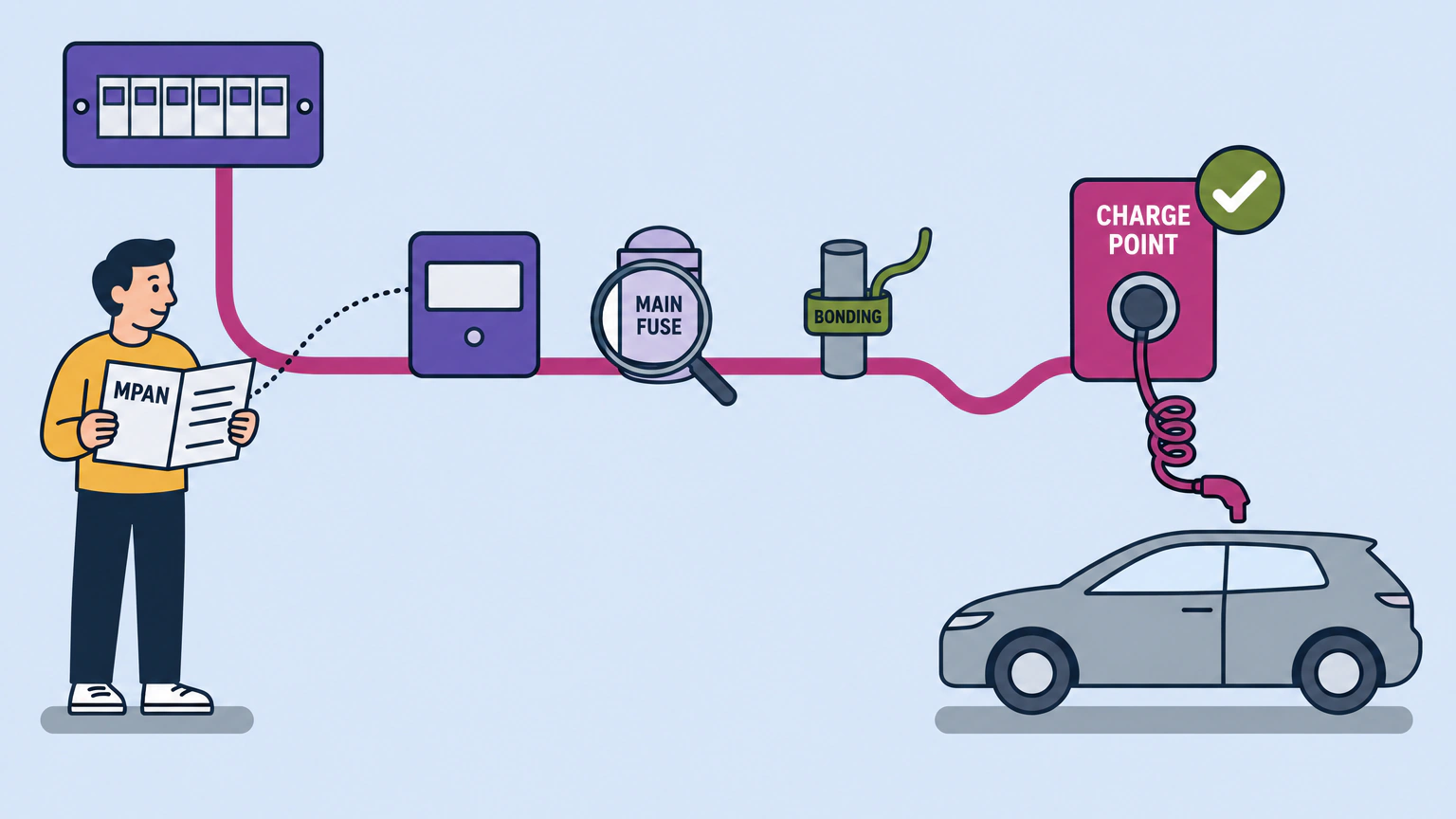
An EV charging point installation quote turns on five things, and every one of them sits between your fuse box and your parking space: the distance to the car, the consumer unit, the earth cables on your pipes, your main fuse and supply cable, and what the charger is fixed to.
That's why good installers ask for photos or a video survey before they price anything. A quote given without seeing any of this is a guess. Guesses tend to grow on the day.
What moves the price of a charge-point installation
| What varies | Why it changes the job | What to check before you ask for a quote | Likely effect on the quote |
|---|---|---|---|
| Distance from consumer unit to parking space | Every extra metre is more cable to buy, fix and hide, and more time drilling through walls or running round them | Where the car really parks, and roughly how far that is from the consumer unit | One of the largest variables |
| State of the consumer unit | The new circuit needs suitable protection and space. In England and Wales, replacing an old unit is notifiable work in its own right | Whether there's a free space, and a clear photo of the unit with its cover on | Nothing extra if there's room; a large extra if the unit has to be replaced |
| Main protective bonding | Only metal services with a path to Earth need bonding | Whether your electrician confirms bonding is required, present and correctly sized | Adds a fixed extra when required bonding is missing |
| Main fuse rating and looped supply | A small supply or a cable shared with a neighbour can mean the network operator must act before the charger goes in | The rating printed on the main fuse carrier by the meter, and whether your supply is looped | Can hold the job up until the network operator has done its part |
| Mounting surface and cable route | Brick, render, timber cladding and freestanding posts all fix differently, and a cable crossing a drive may need a trench | A photo of the wall you'd like it on, and the path a cable would take back to the consumer unit | Usually small; digging across a drive is the exception |
Who is allowed to fit it, and what that leaves you holding
Now the part that decides who you can hire. A charge point isn't an appliance you plug in. It's a new electrical circuit running to the outside of your home, and the UK's EV charger installation requirements split three ways by nation. Wherever you live, you should finish the job holding paper, not just a charger.
England and Wales: a charge point is a new circuit, and a new circuit is notifiable
In England, the Building Regulations name three kinds of electrical work in a home as notifiable, meaning building control has to hear about them. Approved Document P, the government's guidance on electrical safety in homes, quotes the list: "(a) the installation of a new circuit; (b) the replacement of a consumer unit; or (c) any addition or alteration to existing circuits in a special location." A charge point gets its own circuit, so it's caught by the first line.
There are two ways to meet the rule. The usual one is an electrician registered with a competent person scheme, who certifies their own work and tells the council for you. The other is giving building control notice before work starts and paying its fee. With a registered installer you apply for nothing yourself, and Electrical Safety First points out you won't pay building control charges either.
Wales sits alongside England because it works from the same 2010 regulations. Approved Document P is written for England, but in Wales a new circuit still needs a registered installer or a building notice. If your Welsh case is at all unusual, check with your local building control body first.
Before anyone drills a hole, make sure they're on a register. Our guide on how to check a tradesperson is registered walks through each scheme.
Scotland and Northern Ireland run different systems
Scotland doesn't use Part P. Electrical work there falls under the Building Standards system and the Building (Scotland) Regulations 2004, and the question is whether you need a building warrant, the council's permission to start. The trigger is the type of building, not the type of work, and that's the part everyone gets wrong. Work in a house needs no warrant unless, among other exceptions, the house has a storey more than 4.5 metres up or the work could weaken a wall you share with next door. Scottish Government research sums it up: houses of up to two storeys are exempt, flats are not. Where a warrant is needed, applying for it is the owner's legal duty.
Northern Ireland has no equivalent at all. Electrical Safety First says there are "currently no statutory requirements for domestic electrical installation work in Northern Ireland", and the Northern Ireland building regulations have no electrical part. That's no reason to hire whoever is cheapest. BS 7671, the UK's wiring standard, still describes a safe job.
Who has to be told, by nation
| Nation | What governs domestic electrical work | What that means for a charge point | What you should be given |
|---|---|---|---|
| England and Wales | Part P of the Building Regulations 2010 (Approved Document P is the guidance for England) | A new circuit is notifiable: a registered installer self-certifies, or building control is told before work starts | An Electrical Installation Certificate, plus a Building Regulations compliance certificate or building control's own sign-off |
| Scotland | The Building Standards system under the Building (Scotland) Regulations 2004 | No warrant for most work in a house of up to two storeys; a flat, or a house with a storey above 4.5 metres, generally needs one, and the owner applies | An Electrical Installation Certificate, plus certification from an Approved Certifier of Construction or the council's check where a warrant applied |
| Northern Ireland | No statutory requirement for domestic electrical installation work | No building control notice for the circuit, though the work should still meet BS 7671 | An Electrical Installation Certificate to BS 7671, which a registered electrician should issue |
The certificate you should end up with, and when it should arrive
You should get two documents. The first is an Electrical Installation Certificate, the electrician's record that the new circuit was tested and meets BS 7671. The second, in England and Wales, is the Building Regulations compliance certificate that comes through the installer's scheme.
The timing depends on who you ask. The Building Regulations give the installer "not more than 30 days after the completion of the work" to hand you a copy and tell the council. GOV.UK's advice to homeowners says to expect the certificate "within 8 weeks of completion". The first is the law and the second is guidance. We'd start chasing at 30 days.
It matters more than it looks. GOV.UK notes that the certificate "will also show up in solicitors' searches if you come to sell your home". A missing one becomes a buyer's question years from now.
The four things your electrician needs from you before they can price the job
Here's the homework. None of it needs tools, and none of it means taking a cover off anything. Have all four ready before you contact anyone. That turns a vague quote into a firm one, and it often saves a second visit.
Before you ask anyone for a price
- Find your MPAN. It is on your electricity bill and it identifies your supply. Take a photo so you can send it with your first enquiry.
- Read the rating off your main fuse beside the meter, and ask your installer whether your supply is looped. Photograph the printed number without touching anything, and ask the looped question in writing.
- Check whether your incoming water and gas pipes carry a main bonding conductor. Look for a green-and-yellow cable held on with a metal clamp where the water main enters and on the gas pipe beside the meter, and photograph both.
- Decide where the car will actually park, and measure roughly how far that is from your consumer unit. Pace it along the route a cable could follow, round corners and through walls, not as the crow flies.
Your MPAN, and where to find it
MPAN is short for meter point administration number, the reference that identifies your electricity supply. You'll find it printed on the bill. Your installer wants it because the distribution network operator, the company that brings power to your property, has to be told that a charge point has gone in. The MPAN is how that notice gets matched to your supply.
You don't do the telling. The Energy Saving Trust says your installer will usually register the charger with the network operator for you. Government guidance for England, Scotland and Wales sets the timing. If the job qualifies for what the industry calls "connect and notify", the installer fits the charger and sends the form within 28 days.
Your main fuse rating, and whether your supply is looped
The main fuse sits where the supply cable enters your home, beside the meter, with its rating printed on the carrier. A 7 kW charger running flat out draws about 30 amps for hours at a time, on top of the kettle, the oven and the shower. The question is whether your supply can carry the lot. A looped supply is one where your service cable is shared with a neighbour's, and you can't always tell by looking.
Either can move the network operator's part of the job from after the install to before it. SSEN, one of the regional network operators, spells the rule out. If the property's total demand, charger included, is 60 amps or less with no safety concerns, the installer fits first and notifies afterwards. If it's higher, or the property is looped, the installer applies first and waits for permission. Where the fuse, the cut-out or a shared cable can't cope, SSEN says it arranges the upgrade or unlooping before installation.
That's where a routine job can turn into a wait. If the survey also finds an old consumer unit or tired wiring, read our guide to what a rewire costs and covers before you agree anything.
Whether your main bonding is already up to standard
Main protective bonding is a green-and-yellow cable that ties metal services with a path to Earth into your home's earthing. Look where the water main comes into the house, and on the gas pipe just after the meter, for a cable held on by a metal clamp.
If required bonding is missing, or isn't correctly sized, it has to be put right as part of the job. That belongs in the quote, not in a surprise on the day. Tell the installer what you found before they price anything, because that's what makes a remote survey accurate.
The pipes matter too. A plastic incoming water service usually needs no bonding, even where the pipework inside is copper. Your electrician still has to check that the metal pipework has no other contact with Earth.
If your electrician turns up other faults in the existing wiring, our guide to what the codes on an electrical report mean explains which ones need fixing and how fast.
Where the car actually parks
Ask where the car really ends up at ten o'clock at night, not where a charger would look tidiest. Plenty of British garages hold bikes, paint tins and a chest freezer while the car lives on the drive. Fit the charger in there and you'll be feeding a lead under the door for years.
The cable run is one of the biggest variables in the price. A charger on the outside wall right behind the consumer unit is a short job. One at the far end of a drive, reached through two walls or under a path, is a longer and dearer one.
With your four answers and photos ready, you're set to contact electricians in your area. Send the lot with your first message and ask each firm to price from them.
The grant, and the rule that quietly disqualifies people
Start with who can't apply. The flats and renters grant excludes you if you live in a house you own, unless your home is a flat that's part of the house. If you own your house and have a drive, that's the end of the grant road.
The three household schemes still open are for people who rent, own a flat, let out property, or have no off-street parking at all. They run until 31 March 2027, and the government calls this their final year. Grant rules and rates can change, so check the current position on GOV.UK before you apply.
Which of the three household grants you might fit
All three pay the same way: 75% of the cost of buying and installing a socket, up to £500. That cap rose from £350 on 1 April 2026. The flats and renters grant also wants a private off-street parking space and an eligible car. You must be its registered keeper or lease it. A company car assigned to you, or one for which your employer names you as the primary user, also qualifies. An ordered car must arrive within three months. Every scheme needs a charger from the eligible model list kept by OZEV, the Office for Zero Emission Vehicles, fitted by an OZEV-authorised installer. That list changes every few weeks.
Here's how the arithmetic works. On a £600 job, 75% is £450, which is under the cap, so the grant pays £450 and you pay £150. On a £999 job, 75% would be £749.25, so the grant stops at the capped £500 and you pay £499. Once the job costs about £667 or more, the grant is simply the flat £500.
The three household grants, and who each one is for
| Grant | Who it is for | What it pays | The condition people miss |
|---|---|---|---|
| Flats and renters | People who own and live in a flat, or rent the home they live in, with a private off-street parking space | 75% of buying and installing one socket, up to £500 | A house you own and live in is excluded, unless it has been converted into flats and you live in one of them |
| Residential landlords | Landlords and property managers letting homes, including blocks of flats | 75% per socket, up to £500 each, for up to 200 sockets a year | You need a Companies House or VAT registration, and you can't live in the property |
| Households with on-street parking | Owners or renters who live in the home and have no private off-street parking | 75% of buying and installing one socket, up to £500 | You need your highways authority's consent for a permanent cross-pavement channel before you apply; cable covers or mats don't count |
The order of events that protects your claim
The order is the whole game. For the flats and renters grant, GOV.UK sets it out: get a quote from an OZEV-authorised installer, gather the documents and permissions, apply online, then wait. You'll need a dated quote, a utility bill in your name at the address, and your tenancy agreement if you rent. Add written permission from your landlord or freeholder, and the council's written permission if the building is listed. The on-street grant adds the highways authority's consent at the front.
OZEV estimates up to 10 working days to assess applications on the platform it opened in April 2026. When it approves you, it tells your installer at the same time. Only then does anyone pick up a drill.
Red flag: Don't let anyone fit the charge point before OZEV has confirmed you're eligible. GOV.UK is explicit that customers "must not have their chargepoint installed until receiving notification from OZEV that they are eligible for a grant". An installer who offers to fit it today and sort the paperwork afterwards is offering to cost you up to £500.
Afterwards the installer claims the grant on your behalf and OZEV pays them directly, so it comes off your bill rather than landing in your account. OZEV may audit your application or the installation itself, and can cancel an application if you won't let it check.
What your charger will do that you never asked it to
You plug in at seven in the evening and nothing happens. It isn't broken. In England, Scotland and Wales, the Electric Vehicles (Smart Charge Points) Regulations 2021 make home chargers sold since 30 June 2022 behave in two ways you might not expect.
The first is default charging hours. A charger has to come set up with default hours outside peak times, which the regulations define as "8am to 11am on weekdays and 4pm to 10pm on weekdays". When you set it up, you can accept those hours, remove them or set your own. You can change them later, and override them when you need a top-up in a hurry.
The second is a random delay. Each time charging would start, or its speed would change, the charger holds off for anything up to 600 seconds by default. That's ten minutes at most. It must also be able to wait up to 1,800 seconds, half an hour, if that maximum is raised remotely. You can cancel the delay.
Neither is a fault to report. Pair the charger with a tariff that has a cheap overnight rate and the default hours start earning their keep. Some EV tariffs need a smart meter, the Energy Saving Trust notes, so get one fitted before the charger, not after. If you're adding panels or a battery too, talk to solar installers about a charger that can run on what your roof generates.
Questions homeowners ask
Can I install my own EV charger?
In practice, no. In England and Wales a charge point is a new circuit, which is notifiable. Anyone unregistered would have to give building control notice first and pay for its checks, and the work should still meet BS 7671. No grant will pay for it either, because every scheme needs an OZEV-authorised installer. For almost everyone, this is a job for a registered electrician.
Do I need planning permission for an EV charge point?
Usually not, in England. A charger mounted on a wall in an area lawfully used for off-street parking is permitted development, as long as the unit and its casing are no bigger than 0.2 cubic metres. The exceptions are the grounds of a listed building and scheduled monuments. An old limit on chargers facing a road from within 2 metres was dropped in May 2025. Scotland, Wales and Northern Ireland set their own rules, so ask your council there.
Can I get the grant if I own my house?
Not if you have your own drive or garage. The flats and renters grant excludes anyone living in a house they own, unless it has been converted into flats and they live in one of them. The one route left for a house owner is the on-street parking grant. That's only for homes with no private off-street parking, and it needs the highways authority's consent for a permanent cross-pavement channel.
Why does my car wait before it starts charging?
Because the law in Great Britain tells the charger to. Home chargers sold since 30 June 2022 add a random delay, up to ten minutes by default, each time charging starts or changes speed. If you accepted the default charging hours when you set it up, it also waits for those hours, which by law sit outside 8am to 11am and 4pm to 10pm on weekdays. You can cancel the delay and change or remove those hours.
Does a 7 kW charger need a bigger main fuse?
Not necessarily. A 7 kW charger draws about 30 amps at full power, and what counts is your home's total demand with the charger added. Under SSEN's rules, if that stays at 60 amps or less with no safety concerns, the installer can fit first and notify afterwards. If it's higher, or your supply is looped, the network operator gets involved first, and SSEN says it arranges any upgrade before installation.
What should my installer give me when they finish?
An Electrical Installation Certificate showing the new circuit was tested to BS 7671. In England and Wales you should also get a Building Regulations compliance certificate. The regulations give the installer 30 days after completion to hand it over, though GOV.UK tells homeowners to expect it within eight weeks. File both somewhere safe, because the compliance certificate shows up in solicitors' searches when you sell.