

On this page
An EICR isn't really a certificate
Everyone calls it a certificate, an electrical certificate or an electrical safety certificate, including landlords, letting agents and plenty of the websites selling one. The form itself says report. GOV.UK's guidance tells landlords to get "a report", which it says is usually an Electrical Installation Condition Report. An EICR records the state of existing wiring on one day, or in the form's own words "at the date of inspection and testing". And it can come back unsatisfactory, which is why it's no pass mark. The word matters because the real certificates are different papers, issued for different jobs.
Which electrical paper is which
The names are close enough to blur, but no two of these papers do the same job.
| Paper | What it covers | When you get it |
|---|---|---|
| Electrical Installation Condition Report (EICR) | The condition of wiring that's already there | After an inspection of an existing home |
| Electrical Installation Certificate (EIC) | New wiring, such as a new build, a full rewire or a new consumer unit | When that work is finished |
| Minor Electrical Installation Works Certificate | A smaller job on an existing circuit, such as a repair | When that job is finished |
| Building Regulations compliance certificate | Notifiable work in England or Wales, under Part P. Scotland and Northern Ireland have no electrical Part P | After a registered installer finishes the work |
The costly mix-up runs the other way: an EICR can't sign off new work. The IET's model form says it's only for reporting on an existing installation, "and not for the replacement of a consumer unit". New wiring from a rewire gets an electrical installation certificate instead, and our guide to what a rewire costs covers that job and its paperwork.
What the electrician looks at, and what they can't see
The inspection covers the fixed parts of the home. GOV.UK's guidance for landlords lists the wiring, the sockets, the light fittings and the consumer unit (the fuse box), plus permanently connected equipment such as showers and extractors, and the circuits for solar panels or battery storage. The electrician is looking for overloaded circuits, shock risks, fire hazards, defective work, and missing earthing or bonding, the two protections built into the wiring to stop you getting a shock. Plug-in appliances aren't part of it.
Then comes the limit most people miss. Unless you agree otherwise before the visit, the model form records that cables hidden in trunking, under floors, in roof spaces and inside the walls "have not been inspected", and that product recalls haven't been checked. Testing can still reveal a fault on a hidden cable. Nobody has looked at it, though.
So a satisfactory report means nothing dangerous was found on that day, in the parts that were covered. That's useful, and narrower than a clean bill of health.
How much an EICR costs
The EICR certificate cost you're quoted mostly tracks size, because more rooms usually mean more circuits to test. The fee buys the inspection and the report. Any repairs it turns up are quoted separately. Nobody sets a national price, so the useful comparison is between two kinds of published figure: what the big price guides say, and what firms print on their own lists.
What the big price guides say
Three national sites publish EICR prices by home size, and they roughly agree on the middle.
| Guide | Smaller flat | 3-bed house | 4-bed house | Time it says |
|---|---|---|---|---|
| MyBuilder | £120 to £200 (1 to 2 bed) | £200 to £250 | £250 to £350 | 1 to 2 hours for a flat, 2 to 4 for a 3-bed |
| MyJobQuote | £100 to £160 (studio or 1 bed) | £150 to £250 | £250 to £350 | 1 to 2 hours for a flat, 2 to 4 for a house |
| Checkatrade | From about £100 | £250 or more | Not split out | 2 to 4 hours for a small flat, half a day for an average house |
MyJobQuote puts the average at about £180, and London at £200 to £400. Checkatrade, which files its figures under electrical safety check costs, puts the average at £200 inside a £100 to £250 range. Its £250-plus covers any house rather than a three-bed in particular. The guide says it was updated in February 2026, and the rate table underneath reads "Last updated: October 2026". One catch: that table's price column is headed "Cost + VAT", so ask whether a quote includes VAT before you compare it with anything. Use the guides for a ballpark. For the real spread, look at what firms charge.
What firms print on their own price lists
We read EICR price lists from firms and national sites across all four nations and picked one to three per place, to show how far apart real prices sit.
| Provider | 1-bed flat | 3-bed house | Notes |
|---|---|---|---|
| British Gas, national | £249 | £299 | 1 to 2 and 3 to 4 bedroom bands. VAT not stated |
| National certificate sites, one list on Belfast and Cardiff pages | £99 | £139 | Includes VAT |
| London landlord-certificate firm | £97.99 | £97.99 | One price for 1 to 3 bedrooms. VAT not stated |
| London firm | £154.80 | £202.80 | Includes VAT |
| London firm | £140 | £200 | Includes VAT. 3-bed flat or terrace |
| Manchester firm | £144 | £180 | £120 and £150 plus VAT. The lower price covers 1 to 2 bedrooms |
| Manchester firm | £160 | £160 | Includes VAT. One flat rate for any home |
| Edinburgh firm | £180 | £228 | £150 and £190 plus VAT |
| Glasgow site | £110 | £140 | Bands of 1 to 2 and 3 to 4 bedrooms. VAT not stated |
| Bridgend firm | £240 | £240 | £200 plus VAT for a standard home |
| Belfast firm | £264 | £288 | £220 and £240 plus VAT. The lower price is a 2 to 3 bed flat or terrace |
Prices as printed on each provider's own site. Where a firm adds VAT, we've added it at 20%. A spread, not a survey.
For a three-bed house, that list runs from under £100 to £299. Inside London alone, three-bed prices sit more than £100 apart. VAT moves things too. A firm that adds VAT at 20% can look dearer than one that doesn't charge it at all. A sole trader whose turnover stays under the £90,000 VAT threshold doesn't have to register. Among the local firms here that say where they stand on VAT, three-bed prices ran from £160 to £288.
Red flag: A city in the web address isn't a local electrician. We found one price table repeated on Belfast and Cardiff pages, and another on Manchester and Belfast pages. Before you book, ask who's actually coming, and which scheme they're on.
Why two similar houses get different quotes
Circuits come first. Where a firm prices by the circuit, MyJobQuote puts it at £10 to £30 each. One Belfast firm in that list includes 12 circuits and then adds £20 for each extra one. A second fuse board costs more too (one Edinburgh site adds from £60). The same Belfast firm charges £80 plus VAT for an outbuilding or garage of up to four circuits.
Older wiring takes longer to inspect, Checkatrade notes. In central London one firm adds £21.60, plus parking where there's nowhere suitable. Another London firm adds £50 for an evening or weekend visit, and the same again for a same-day one.
Then there's your own paperwork. If there are no records of earlier testing at all, Electrical Safety First's Best Practice Guide 10 says the electrician may have to inspect and test in more detail, which "will have a bearing on the cost of the work". So keep the old report, and hand it over when you book.
What the price should buy
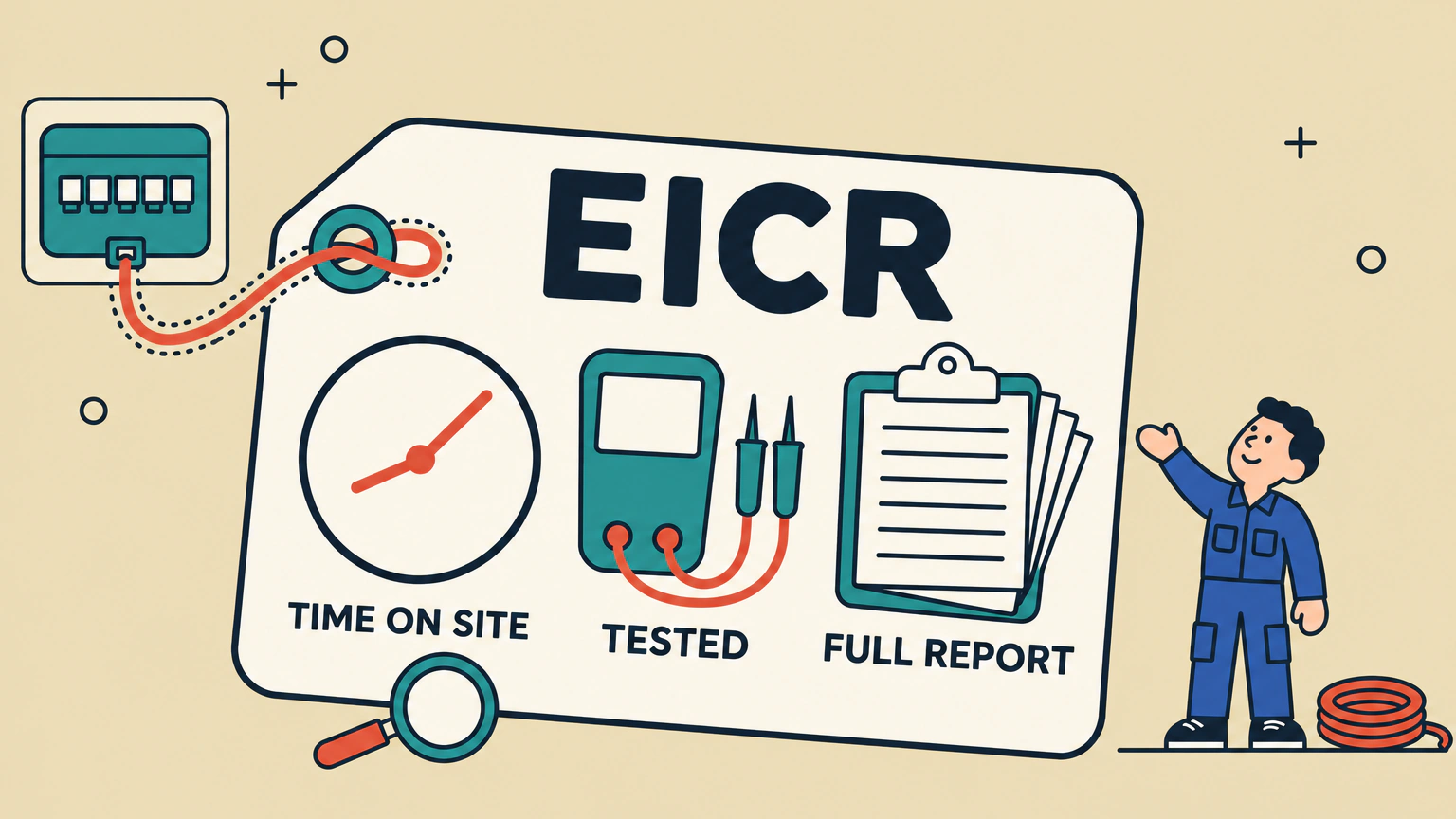
A low price doesn't prove a bad job, and plenty of careful electricians charge reasonable prices. You can't judge the workmanship from your sofa. What you can check is the time on site, the paperwork, and what was left out.
How long the electrician should be there
The guides can't agree on this one. A flat takes 1 to 2 hours on two of them and 2 to 4 hours on the third. Firms that publish their own times for EICR testing are more specific: one London firm gives 1.5 to 2 hours for a one-bed flat and 2.5 to 3.5 for a three-bed, and a Bridgend firm says two to four hours for a three-bed house. Checkatrade adds that electricians often quote a half or full day. So use the floor. Under an hour is below every published figure we found.
Now the sum. At Checkatrade's average rate of £55 an hour, £99 pays for under two hours. Take VAT out of that £99 and it's closer to an hour and a half, before travel and write-up. The trade has a name for the thin version: a drive-by report. A careful firm won't treat even a small occupied flat as a quick job. And some very cheap reports are paid for by the repair list that follows. Ask how long they'll be on site when you ring round.
The section that tells you what wasn't checked
Section D of the report, headed extent and limitations of inspection and testing, records which parts were covered, every limit, the reason for it and who agreed it. Electrical Safety First's Best Practice Guide 10 is blunt: "There should be little need to set limitations, other than the 'standard' limitations". It warns against limits set unnecessarily, "as this would result in the report having less validity". It's written for rented homes, but the logic carries. A locked room is a fair limit. A vague one isn't. A one-word limit, or a report saying it covered part of the wiring without saying which part, tells you nothing and tells the next electrician even less.
The guide also suggests a minimum for a typical rented home. On every lighting circuit, at least one switch and one lighting point should be checked inside. On every socket circuit, at least one socket or fused spur (the fused outlet that feeds a fixed appliance) should get the same. It says the report should record which items were checked and where, so different ones get looked at next time. Two tells you can spot yourself: rows of LIM (limitation) or N/V (not verified) on the schedules where readings should be, and paint seals still unbroken round every socket, which means no faceplate came off.
What you should be holding at the end
The IET's model form puts it in one line: "This Report is only valid if accompanied by the Schedule(s) of Inspections and the Schedule(s) of Circuit Details and Schedule(s) of Test Results."
- The report, with your address, the inspection date and a result of satisfactory or unsatisfactory.
- Section D filled in, showing what was covered, every limit, the reason for it and who agreed it.
- A schedule of inspections, with an outcome against each item.
- A schedule of circuit details, covering every circuit on the board.
- A schedule of test results, with readings rather than rows of LIM or N/V.
- A date for the next inspection, and a signature from the person who did the work.
- On a report dated from 15 October 2026, a line showing it was done to BS 7671 as amended in 2026.
A report done to the old edition before 15 October 2026 doesn't need redoing because the standard moved. It runs to its own next-inspection date.
Who can carry out an EICR, and how to check
Any electrician can say yes on the phone. The law's answer to who's allowed is short, the trade's answer is now stricter, and you can check both.
What the law says, and what the trade now asks for
England's Regulations say the inspection must be done by a "qualified person", meaning someone competent to do the inspection and testing and any further work it calls for. They name no qualification and no scheme. Northern Ireland's and Wales's definitions say the same.
So what counts as competent? Since 1 October 2026, the Electrotechnical Assessment Specification, the industry rulebook that certification bodies such as NICEIC assess firms against, has set a stricter bar. Everyone doing this work at a certified firm needs a relevant Level 3 inspection and testing qualification, such as the 2391-51 or 2391-52, plus at least two years' experience and ongoing training. Trainees under close supervision are the exception. It's an industry rule, not a law. NICEIC says a firm that can't show it yet agrees an action plan, and that this "will not immediately affect" its ability to keep doing the work, though it may in future.
A council can take a harder line. Pendle Borough Council in Lancashire won't accept a report from an inspector outside a relevant scheme unless a completed competence checklist and declaration come with it. If it turns a report down, the cost of a replacement is yours.
Finding someone registered for inspection
Registered doesn't automatically mean registered for this. In England and Wales, the Registered Competent Person Electrical search has a separate option, "To undertake an electrical safety report", and Electrical Safety First's register lists inspection as its own search too. Our guide on how to check a tradesperson's registration covers the registers for other trades. In Scotland, the repairing standard statutory guidance accepts members of SELECT, NICEIC and NAPIT. In Northern Ireland, the Department for Communities' guidance says to check for a competent person scheme or have the inspector sign a checklist. For anyone outside a scheme, Scotland's checklist makes a good model: £2 million of public liability insurance and £0.25 million of professional indemnity are the recommended minimums for reporting work. When you're ready to compare, start with registered electricians near you.
Do you actually need one?
The law only reaches some people, and it reaches them differently in each nation.
| Your situation | Does the law require one? | What to know |
|---|---|---|
| You own your home and live in it, anywhere in the UK | No | Electrical Safety First recommends one at least every 10 years |
| You're selling or buying in England or Wales | No | A buyer who plans to let will want a current report |
| You rent out a home | Yes, for private landlords in all four nations and social landlords in England and Wales | At least every 5 years, or sooner if the report says so |
| You run an HMO in England | Yes | Councils can also ask for it with a licence application |
| A lodger shares your home in England | No. Shared accommodation is left out of the 2020 Regulations | The 10-year recommendation for your own home still makes sense |
| You run a holiday let in Scotland | Yes, as a licence condition | At least every 5 years, with appliance testing as well |
| You run a holiday let in England | Not under the 2020 Regulations, which cover a tenant's only or main home | Your insurer may still ask for one |
| Communal areas of a block in England | Not under the 2020 Regulations | Councils can still act under other housing law, so have them checked |
For a sale, we couldn't find a rule in Scotland or Northern Ireland that requires one. Scotland's Home Report has three parts, and an EICR isn't one of them. A buyer can still ask, and in England and Wales the TA6 property information form has a question on it.
Why landlords in England should keep the report to hand
England's landlord register is called "Register your rental property", and the government's Housing Hub says it starts rolling out on 15 December 2026, region by region, beginning with the West Midlands. Landlords will upload their gas, electrical and energy certificates. The electrical item is a copy of the EICR, or an appropriate EIC, with its expiry date. The fee is £65 per property per year. If you use letting agents and property managers, they'll be able to upload some items on your behalf, though you start the registration yourself. A missing report now shows up in one more place. Social landlords in England had their own deadline: first inspections on older tenancies were due before 1 November 2026.
How to book one without overpaying
Six questions to ask before you book
Ring two or three firms and put the same questions to each. The answers tell you more than the headline price does.
- How many circuits and fuse boards does that price cover, and what's the charge for each extra one?
- Does the price include VAT, parking and travel?
- Who's coming, and is that person registered for inspection work?
- How long will they be on site, and how long will the power be off?
- Will I get the full report with all its schedules, and how soon?
- If repairs are needed, will the report say which circuit and where, so another electrician can quote?
Getting the home ready
Best Practice Guide 10 gives whoever orders the work a short list. The power has to be on, including credit on a prepayment meter, or the live tests can't be done. In a block of flats, arrange access to the intake position, where the supply comes into the building. Dig out old reports and certificates. Warn your tenants, and keep pets shut away for the visit. It's worth clearing the consumer unit and the sockets behind heavy furniture too, because anything the electrician can't reach can end up recorded as a limitation. The power will be off for parts of the visit, so plan around the freezer, the router and anyone working from home.
We can't see your wiring from here, so this is a guide to the paperwork and not advice on your installation. Leave the testing to a registered electrician, and don't open a consumer unit yourself.
If it comes back unsatisfactory
Repairs aren't part of the fee. Our guide to what the codes mean and what you have to fix covers the codes, the deadlines and the penalties. One thing is worth asking for now: observations that say which circuit and where. A vague line such as "no RCD" (the trip switch that cuts the power when current leaks to earth) leaves another electrician guessing, which quietly ties the repair to the person who wrote the report. That's where a second quote gets hard.
Frequently asked questions
How long does an EICR last?
For a rented home, until the next-inspection date printed on it, and never more than five years from the inspection. The electrician can set a shorter date if the wiring needs it. In a home you own and live in, nothing expires in law, though Electrical Safety First recommends a fresh report at least every 10 years.
Do I need an EICR if I have an EIC?
Often not, if the EIC covers the whole home. In England and Northern Ireland, an EIC for a new build or a full rewire lets a landlord skip the report for five years. Scotland accepts one issued within the last five years, as long as its own next-inspection date hasn't passed. Wales's guidance for landlords names new builds only. An EIC for one new circuit or a new consumer unit doesn't count as a whole-home check.
Does an EICR include PAT testing?
No. An EICR covers the fixed wiring and permanently connected equipment, not plug-in appliances. Private landlords in Scotland must have the appliances they provide tested as well. Social landlords in England must have the equipment they provide checked at least every five years. Northern Ireland's guidance recommends portable appliance testing as good practice.
Is a visual inspection the same as an EICR?
No. British Gas describes a visual inspection report as a basic check with no circuit testing, suitable only if the installation was tested recently. Rented homes have to be inspected and tested, so a visual report won't meet the rule. It's still useful between full reports, and GOV.UK recommends at least a visual check before a new tenancy in England.
Can I check an EICR online?
Not the report itself. England's landlord register will hold copies, but the government hasn't yet said what the public will be able to see. What you can check online today is the firm. In England and Wales, search its name on Registered Competent Person Electrical, and if a report looks wrong, ring the scheme named on it.
Does a landlord need a new EICR for every tenant?
No. In England, a report under five years old that calls for no further work carries over, and the new tenant gets a copy. Scotland's guidance says the same. Electrical Safety First still recommends a fresh inspection at each change of occupancy, which is advice rather than law.
Do I have to use the same electrician for the repairs?
No. In England the rule is that a qualified person does the work and confirms it in writing, and nothing says that person has to be the one who inspected. If the repair list looks long, get a second quote from registered electricians near you.