

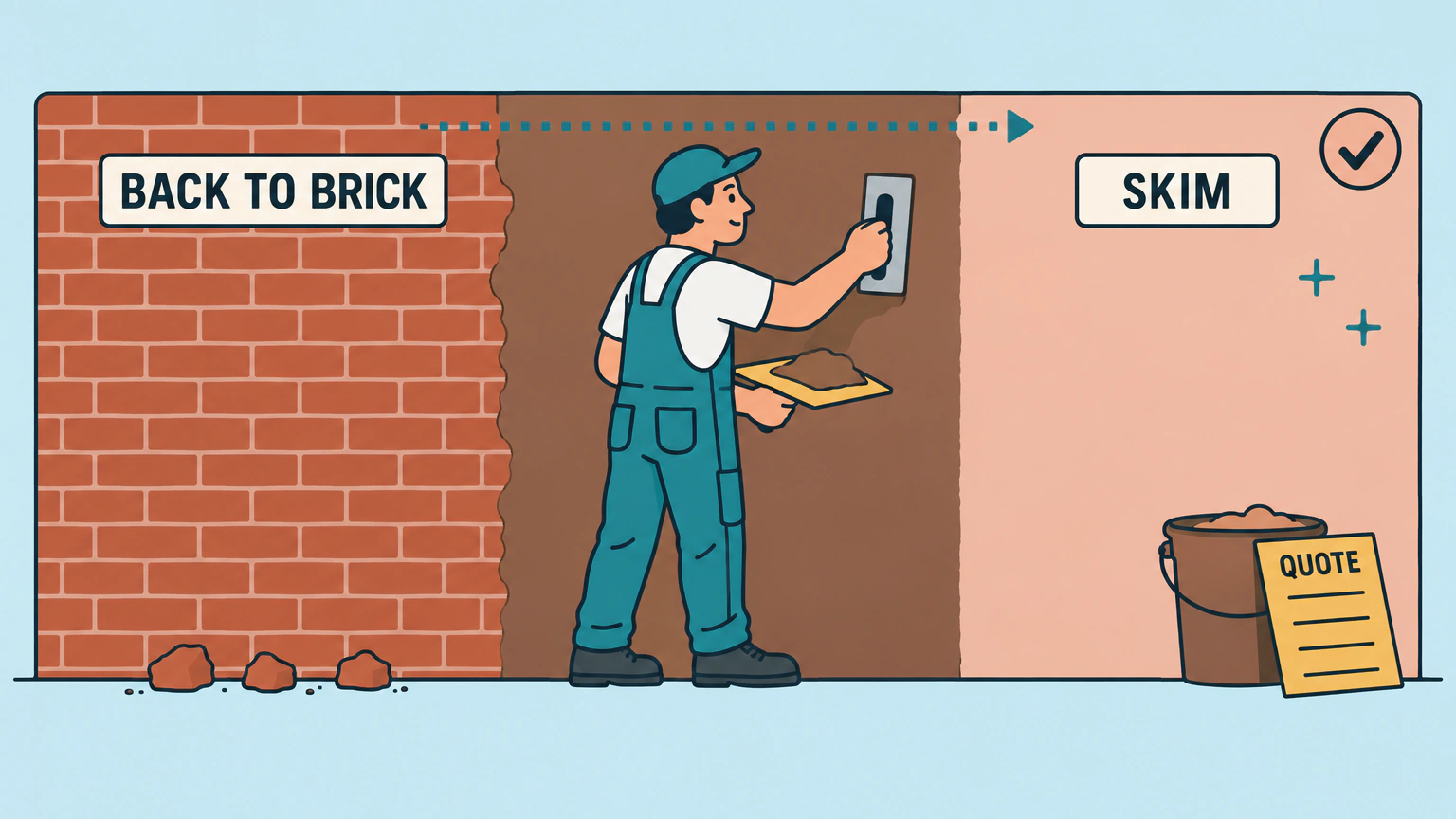
On MyJobQuote's 2026 guide prices, skimming the walls of an average room costs about £425 to £600, or £600 to £850 with the ceiling. A full replaster from bare brick runs at roughly twice the skim rate: £30 to £40 per square metre against £15 to £25. Which job you need depends on whether the old plaster is still stuck to the wall. And if more than half of an outside wall goes back to brick in England, Wales or Northern Ireland, the Building Regulations expect that wall to be insulated while it's open.
On this page
What it costs to plaster a room
A skim, a full replaster, and why the price guides disagree
Start with the two jobs, because they're priced differently. A skim is a thin finishing coat, about 2 mm, laid over plaster or plasterboard that's still sound. A full replaster takes the wall back to brick or block and builds it up again, with a backing coat first and a finish on top. If you want one number anyway, MyJobQuote puts the average cost to plaster a room at about £630.
What two of the big price guides publish
| Job | MyJobQuote | Checkatrade |
|---|---|---|
| Skim the walls, small room (about 2 m by 2 m) | £375 to £500 | £378 to £496 |
| Skim the walls, medium room (about 3 m by 3 m) | £425 to £600 | £430 to £550 |
| Skim the walls, large room | £550 to £750 (5 m by 4 m) | £536 to £690 (6 m by 5 m) |
| Skim walls and ceiling, medium room | £600 to £850 | No single price given |
| Plaster a medium room from scratch | No price by room size | £575 to £920 |
| Skim, per m² | £15 to £25 | £24 |
| Full replaster, per m² | £30 to £40 | Not given |
| Plasterer's day rate | £180 to £250, and £300 to £350 in London and the South East | £300 |
MyJobQuote's are its 2026 guide prices. Checkatrade's are from its 2025 guides, and its room prices include VAT.
Averaging price guides tells you nothing, because they aren't measuring the same thing. Some price the floor area and some the wall area. Some include the ceiling and some don't. Checkatrade's own two guides put plastering a small room at about £640 on one page and £1,100 on the other, and one of those small rooms is 2 m by 2 m while the other is 9 m². So when a quote looks high or low, ask one question first. What exactly was measured?
How to work out your own room by the square metre
For a rough check against MyJobQuote's guide, measure the distance round the room and multiply it by the ceiling height. Leave doors and windows in for that calculation. At a 2.4 m ceiling, this gross-area method reproduces MyJobQuote's 29 m² wall figure for a 3 m by 3 m room. If the ceiling's included, add the floor area on top.
Your room in square metres
| Room (floor size) | Wall area at 2.4 m high | Ceiling | Skim the walls at £15 to £25 per m² | Replaster the walls at £30 to £40 per m² |
|---|---|---|---|---|
| Single bedroom, 3 m by 2.5 m | 26.4 m² | 7.5 m² | £396 to £660 | £792 to £1,056 |
| Double bedroom, 4 m by 3 m | 33.6 m² | 12 m² | £504 to £840 | £1,008 to £1,344 |
| Living room, 5 m by 4 m | 43.2 m² | 20 m² | £648 to £1,080 | £1,296 to £1,728 |
Wall area is the distance round the room times the height, with doors and windows left in. Rates are MyJobQuote's 2026 figures.
There's a catch: plastering rates per m² slide with the size of the room. MyJobQuote's skim prices work out at £20 to £26 per m² in a 2 m by 2 m room, and £13 to £17 in a 5 m by 4 m one. Its timings explain why: even a small room takes the plasterer a whole day, so it's priced like one. That's also why a flat £15 to £25 a metre puts a 5 m by 4 m living room at £648 to £1,080, well above MyJobQuote's own room price of £550 to £750. Use the per-metre sum as a ceiling check on a quote, not as the quote.
Day rates, and what they leave out
MyJobQuote gives a plasterer day rate of around £180 to £250 for labour, or £300 to £350 in London and the South East. Its regional table puts the Midlands at £200 to £275 and the North of England at £180 to £250. That same table starts London at £250, though, and its skim guide says £200 to £300, so even one publisher's day rate has soft edges. Checkatrade prints a flat £300.
Most plasterers don't sell you days anyway. They quote a fixed price for the job, materials included, and two things change what that price covers.
The first is VAT. A business must register once its taxable turnover passes £90,000, but it can register voluntarily below that. Ask whether the quoted price includes VAT.
The second is the work around the plastering. MyJobQuote lists what a quote usually leaves out: stripping wallpaper, taking radiators off, moving furniture, getting rid of large amounts of waste, and decorating. That list is half the answer to how much plasterers charge.
For scale, across our 600 cost profiles for plastering and dry-lining jobs, the typical job runs £1,270 to £3,338, from £598 at the bottom to £5,965 at the top. Those are whole jobs of every size, one snapshot, so don't use them as per-room prices. MyJobQuote prices a whole three-bed semi at £3,500 to £5,500.
Skim or back to brick: which job your walls need
How to tell before the plasterer arrives
Knock along the wall with your knuckles, which is the same test MyJobQuote describes. A dull, solid sound means the plaster is still bonded to the wall behind it. A hollow one means it has "blown" and come away. Sound plaster with a tired surface takes a skim. Plaster that's loose, crumbling, bulging, badly cracked or damp comes off.
Settle three things first. If damp caused the damage, the cause gets fixed before anything's replastered, so check whether the wall really needs damp proofing before you pay for both. If the house needs rewiring, the grooves cut for new cables go in before the plasterer, not after, because making good is part of what a rewire costs and you only want to pay for plaster once. And if more plaster turns out to be blown once work starts, the price will move. Agree now how that's handled, rather than arguing later about whether you owe more than the quote.
Paint, wallpaper and what new plaster has to stick to
Wallpaper comes off first. MyJobQuote lists stripping it among the things a quote doesn't usually include, so decide now who's doing it.
Then there's whatever's under the paper. New plaster needs a clean, sound surface to grip. MyJobQuote describes the plasterer clearing dirt and debris and then priming the wall: a bonding agent on smooth, low-suction walls, a suction-control primer on dry, absorbent ones. On painted walls, the existing surface must be sound and properly prepared before a skim.
So ask what goes on the painted walls first, and get the product named. "A coat of PVA" is a vaguer answer than it sounds.
Stripping an outside wall? The insulation rule that comes with it
What the Building Regulations ask for
No price guide mentions this part, and it can change the whole job.
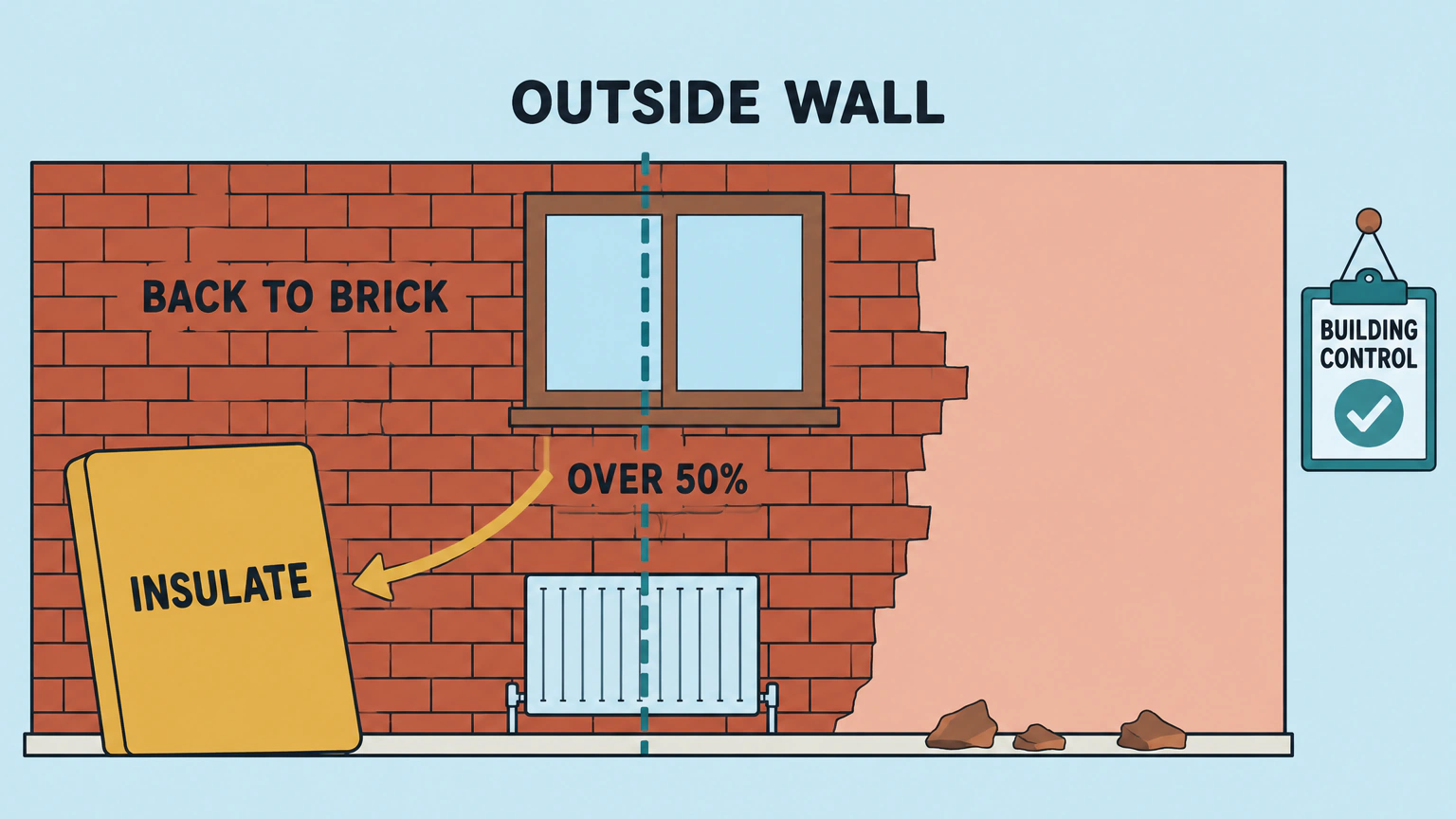
An outside wall is what the Building Regulations call a thermal element: a wall, floor or roof that separates a heated room from the outside, or from an unheated part of the building. Renovating one means adding a new layer or replacing an existing one, and decorative finishes don't count. Approved Document L, the government's official guidance on meeting the rule, lists two kinds of renovation that a plasterer does. One is dry-lining, which means fixing board to the inside face of the wall. The other is stripping it back to the bricks or blocks and rebuilding. A fresh skim over sound plaster isn't on that list.
The trigger is more than 50% of that one wall's surface. The approved document even uses plaster as its example: when it comes off the inside, the area that counts is "the area of external wall as viewed from inside the room". So a bedroom's outside wall is judged on its own, not against the whole side of the house. (A second trigger, renovating more than 25% of the house's whole outer shell, catches whole-house jobs.) Cross the line and the whole of that wall has to be improved, "in so far as that is technically, functionally and economically feasible".
A wall between two heated rooms isn't a thermal element at all. A wall to an unheated garage is.
One honest wrinkle. Planning Portal's page on external walls says "25 per cent or more". The regulation says more than 50%. When two official-looking pages disagree, ring your council's building control team before the plaster comes off. We're not building control, and on your wall theirs is the answer that counts.
What that does to your quote
The target for a wall insulated on the inside is a U-value of 0.30 W/m²K. A U-value measures how fast heat leaks through, and lower is better. Approved Document L's worked examples show how it's normally met when the inside finish is renewed: insulated plasterboard fixed to the wall, or studs fixed to it with insulation between them.
The guidance writes in three get-outs. If the full upgrade wouldn't pay for itself within 15 years, if it would take more than 5% off the room's floor area, or if it isn't technically feasible, a lesser upgrade can be acceptable. Even then, the wall generally shouldn't end up worse than 0.70. Thickness is the practical snag, because door frames, window reveals and skirtings all have to give. Where a doorway sits tight to the wall, a plasterer may suggest bonding and skimming that wall instead of boarding it, and that's a conversation to have with building control.
Older homes get some slack. Walls that need to breathe, such as stone, cob or anything built with lime mortar, should only be improved where it won't damage the fabric over time. Listed buildings and homes in conservation areas needn't comply in full where it would unacceptably alter their character or appearance.
On price, BestBuilders puts insulated plasterboard, fixed and skimmed, at £35 to £55 per m², against £25 to £40 for plain board. On a 4 m outside wall at 2.4 m high, that's 9.6 m², and the extra for insulated board comes to roughly £96 to £144.
The paperwork is a building control application. For a job this size a building notice is the simple route. It's the application meant for smaller projects, and GOV.UK says work can start two days after it's submitted. Every council sets its own fee. Blackpool charges £218.10 for renovating a thermal element in one home, Cherwell £378. On a single bedroom wall, then, the fee can come to more than the upgrade itself.
The other route is an installer registered with a competent person scheme for internal wall insulation, who certifies the work themselves. GOV.UK lists five such schemes and none for plastering, so ask your insulation installers which scheme they belong to.
Skip all of it and GOV.UK is blunt. The person doing the work "could be prosecuted and fined", and the council could make you pay to put it right. And "Without approval you will not have the certificates of compliance you may need when you want to sell your home."
How the rule changes in Wales, Northern Ireland and Scotland
Wales has the same regulation 23 and its own approved document with the same 50% test. Northern Ireland's regulation 43 repeats it, and its technical booklet explains why it measures room by room: "the marginal cost of dry lining with insulated plasterboard rather than plain plasterboard is small". Scotland sets no percentage. Its handbook says that when a wall's build-up is altered or rebuilt, "the opportunity should be taken" to improve the insulation, as far as is reasonably practicable. In Scotland, ask the council's building standards team whether your job needs a building warrant, Scotland's form of building approval.
The outside wall rule, nation by nation
| Nation | What triggers it | Wall target | Where it's written |
|---|---|---|---|
| England | More than half of the outside wall, measured from inside the room, is stripped or dry-lined | 0.30 W/m²K | Building Regulations 2010, regulation 23; Approved Document L volume 1, section 11 |
| Wales | The same test | 0.30 W/m²K | Building Regulations 2010, regulation 23; the Welsh Approved Document L volume 1, section 11 |
| Northern Ireland | The same test | 0.30 W/m²K | Building Regulations (Northern Ireland) 2012, regulation 43; Technical Booklet F1 |
| Scotland | No percentage. When a wall's build-up is altered or rebuilt, the opportunity should be taken to insulate, as far as reasonably practicable | 0.70 W/m²K or lower after the work | Domestic Technical Handbook, section 6.2 |
Artex, old ceilings and asbestos
Before anyone skims a textured ceiling
The Health and Safety Executive (HSE) says asbestos may be in any home built or refurbished before 2000, and textured decorative coatings, "commonly referred to as Artex", are on its list. "May" is the word that matters, and a lab test is how you turn it into a yes or a no.
HSE's position, in the order you'll need it:
- Work on textured coatings is low-risk and can be done by non-licensed workers, but they must be trained to work safely with asbestos.
- For small-area removal, HSE's task sheet says: "Never scrape through or sand down textured coatings or stripped surfaces."
- Stripping more than a small patch by steaming or gelling becomes work that has to be notified.
- If the coating sits on asbestos insulating board, HSE says to use a licensed contractor.
If a textured coating in a pre-2000 home could be disturbed, have a sample tested before work starts. HSE says asbestos analysts must be accredited by UKAS. HSE lists sealing sound asbestos materials as non-licensed work, but it doesn't publish a task sheet for skimming a textured coating. If the coating contains asbestos, use a worker trained to handle it and agree a method that avoids disturbing it.
If the coating is painted, the plasterer should first check that it is sound and that the preparation system will bond to it.
When the ceiling has to come down
Cracks or sagging in the old ceiling can mean it needs overboarding or replacement instead of a skim. Overboarding means fixing new plasterboard into the joists and then skimming over it. Checkatrade's 2025 guide prices overboarding and plastering a medium room's ceiling at £270 to £435. HSE lists inserting or removing screws through a textured coating as lower-risk work, but the worker still needs asbestos training.
If the old ceiling is pulled down instead, the asbestos question gets answered first. And if it's the ceiling under a cold loft and the insulation comes out with it, the same renovation rule applies overhead. Approved Document L's examples set a target of 0.16 W/m²K there, met with 250 mm of mineral fibre or cellulose quilt laid between and across the joists. Price that alongside what loft insulation costs.
How long it takes, and when you can paint
On MyJobQuote's timings, the plastering itself takes a day in a small room, one to two days in a medium room and two to three in a large one. Drying is the slow part, and it's where the sources split.
MyJobQuote's skim guide says fresh plaster is usually dry in three to seven days. Its own plastering guide allows a week or two for a skim and four weeks for new plaster. Dulux says plaster takes "up to 4 weeks to dry completely". The figures cover different jobs and conditions, so treat them as ranges rather than deadlines.
So go by colour, not the calendar. Wet plaster is brown. Dry plaster is an even pale pink with no dark patches, and you wait until the whole wall gets there. Dulux warns that emulsion on wet plaster is "likely to crack and peel off". Its mist coat is watered-down emulsion that acts as the primer, at ten parts paint to one part water.
Winter slows everything. Fresh plaster mustn't freeze before it's dry, so an empty, unheated room needs some warmth. Dulux suggests a heater or an open window to speed things along. If you'd rather hand the mist coat and the rest to someone else, painters and decorators can pick it up once the wall has turned.
What a fair plastering quote puts in writing
The government's Regulated Professions Register returns no result for plasterers, and no competent person scheme covers plastering. Registers do exist for other trades, and how to check a tradesperson's registration explains which. For plastering, the written scope is the protection you've got, and a good quote covers these eight points.
- Which walls get a skim and which go back to brick, wall by wall.
- The area the price is based on, in square metres, and whether the ceiling is in it.
- Who strips the wallpaper, takes the radiators off and puts them back.
- What goes on painted or glossy walls before the skim, by product name.
- For any outside wall being stripped or dry-lined: the insulation going on, its U-value, and who tells building control.
- For a textured ceiling in a home built or refurbished before 2000: whether a sample has been tested, and how the coating will be dealt with.
- Whether the rubble and empty bags leave with the plasterer or you need a skip.
- Whether VAT is on top, and what happens to the price if more plaster comes off than expected.
Four things that should slow you down
- A price for "the room" over the phone, with no visit. Ask for the area in square metres and for someone to look at the walls first.
- An outside wall going back to brick with no mention of insulation or building control. Ring your council's building control team yourself before the plaster comes off.
- An offer to scrape through or sand down a textured coating without checking for asbestos first. If it contains asbestos, HSE's small-area removal sheet says never to scrape through it or sand down the coating or stripped surface.
- A promise that it'll be ready to paint tomorrow. Wait for an even pale pink across the whole wall.
None of these means the plasterer is a bad one. Each means the quote isn't finished yet.
Then get two or three quotes from plasterers near you and hold each one against the list.
Frequently asked questions
How much does it cost to plaster a room and ceiling?
MyJobQuote puts skimming the walls and ceiling at £600 to £850 for a medium room and £800 to £1,100 for a large one. The ceiling adds the room's floor area to the wall area. If the old ceiling needs boarding over first, Checkatrade's 2025 guide prices that separately, at £270 to £435 for a medium room.
How long does it take to plaster a room?
A day for a small room, one to two days for a medium one and two to three for a large one, on MyJobQuote's timings. A full replaster takes longer than a skim, because the old plaster comes off first and a backing coat goes on before the finish.
How long after plastering can you paint?
When the whole wall is an even pale pink, with no dark patches. MyJobQuote's skim guide says three to seven days, its main plastering guide allows four weeks for new plaster, and Dulux says up to four weeks to dry completely. A thin skim dries fastest. Start with a mist coat of watered-down emulsion.
Can you skim over Artex?
Only if the coating is sound and firmly attached, and the plasterer has checked that skimming is suitable. In a home built or refurbished before 2000, have a sample tested before work that could disturb it. If it contains asbestos, use a worker trained to handle it. HSE's small-area removal sheet says never to scrape through it or sand down the coating or stripped surface.
How do I know if my walls need replastering?
Knock on them. A hollow sound means the plaster has come away from the wall and should come off. So should plaster that's crumbling, bulging or deeply cracked. Damp patches mean finding the cause first. Sound plaster with a rough or tired surface only needs a skim, at about half the rate per square metre.
Do plasterers need to be licensed?
We found no plasterer entry in the government's Regulated Professions Register, and no competent person scheme covers plastering. The register says a zero result can also mean a profession is listed under another name, so that search alone doesn't prove there is no licensing requirement. Check the written quote, public liability insurance and recent work you can see. Stripping or lining an outside wall is different, because building control or a registered installer may have to be involved.
Do I need to remove wallpaper before plastering?
Yes. Plaster needs a clean, sound surface to stick to, and paper isn't one. MyJobQuote lists wallpaper stripping among the things a plasterer's quote doesn't usually include, so agree who's doing it. If the plasterer takes it on, expect it as an extra.