

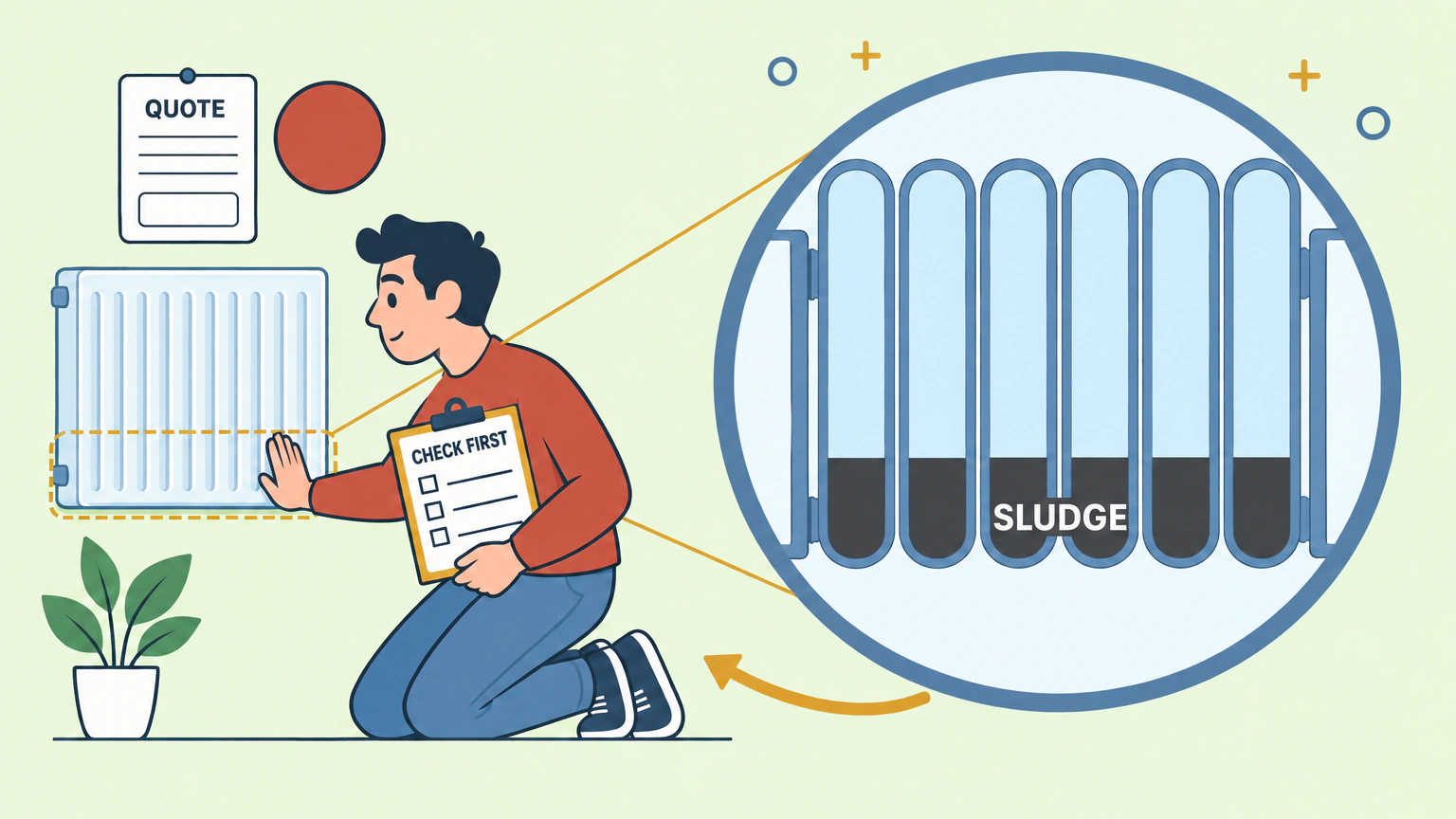
Here's the short answer. Across five UK price guides we read, the published figures for a power flush run from £300 to £850, and British Gas, which sells the job, starts a three-bed house at £755. Those are what publishers print. What you pay moves with your region, your installer and the state of your system.
Before you hand over any of it, put a hand on your radiators. The building regulations guidance and the Benchmark checklist ask for a system that's been cleaned and dosed with inhibitor. Worcester Bosch, Vaillant and Ideal won't cover sludge damage under the warranty terms we read. And not one of them says the cleaning has to be a power flush.
On this page
- What a power flush costs, and why one house gets such different prices
- What your radiators are telling you before anyone quotes
- What the rules actually ask for when a new boiler goes in
- What your boiler warranty says about sludge
- Chemical clean, power flush or filter: which one does what
- Sold a flush during a service or breakdown visit? You may be able to cancel
- Five questions to ask before you agree to a power flush
- Common questions about power flushing
What a power flush costs, and why one house gets such different prices
Five UK publishers print a price for this job, and they don't agree with each other. Here's what each one publishes, in its own words and its own size bands.
| Who publishes it | What the figure is | Flat or small home | Three-bed house | Four-bed house |
|---|---|---|---|---|
| British Gas, which sells the flush | Starting price, fixed quote after a free home visit | From £460 (one-bed flat) | From £755 | Not published |
| MyJobQuote, a quote marketplace | Guide range from quotes on its platform | £400 to £470 (one or two bed, 6 to 8 radiators) | £470 to £520 (8 to 10 radiators) | £520 to £550 (10 to 12 radiators) |
| iHeat, an online boiler seller | Guide price | £300 to £400 (up to 6 radiators) | £400 to £550 (two or three bed, 7 to 10 radiators) | £550 to £700 (11 to 15 radiators) |
| Boilers2Go, an online boiler seller | Estimate by radiator count | £350 to £450 (4 to 6 radiators) | £450 to £600 (7 to 10 radiators) | £550 to £850 (11 to 15 radiators) |
| BoilerCentral, a boiler quote site | Typical cost | £300 to £350 (one or two bed) | £350 to £450 | £450 to £600 (four or five bed) |
For a three-bed house, BoilerCentral's range opens at £350 and British Gas opens at £755. That's more than double, for the same size of house.
The two aren't quite describing the same thing, though. British Gas gives a fixed price only after a free home visit, so £755 is a starting price, not a quote for your actual house. A marketplace guide band is gathered from jobs other people booked. One is a starting point for a future quote. The other is a forecast.
The bands don't line up either. MyJobQuote calls 8 to 10 radiators a three-bed job, iHeat 7 to 10, and BoilerCentral doesn't count radiators at all. So a true like-for-like reading across five publishers isn't available, which is worth knowing before you treat any single guide as your yardstick.
The guides repeatedly point to two price drivers: how many radiators the engineer has to flush one at a time, and how badly sludged the system is. Time on site follows from both. Region, access and system type can move the price too. British Gas says the job "usually takes around 8 hours". MyJobQuote reckons most are finished within a single working day, with a mid-sized system taking about five to six hours.
What the price should cover, and what gets added on the day
A power flush price should buy the whole job. That means the machine and its chemicals, every radiator flushed individually rather than the circuit rinsed through as one loop, fresh inhibitor dosed in at the end, and a final check that the radiators heat evenly top to bottom afterwards.
What isn't in it tends to arrive on the day. MyJobQuote's own extras table prices a magnetic filter supplied and fitted at £180 to £260, replacing radiator valves at £75 to £180, fixing a leak at £100 to £150, and clearing a single badly blocked radiator at £80 to £120.
None of that is a stitch-up. Old valves do seize, and a leak found mid-job has to be fixed. They're just decisions you'd rather make sitting down with a written quote than standing in a hallway while the machine runs and the floor is under towels.
So ask for the likely extras to be priced as options up front. If they appear anyway, our guide to when a final bill can go past the quote sets out where you stand.
What your radiators are telling you before anyone quotes
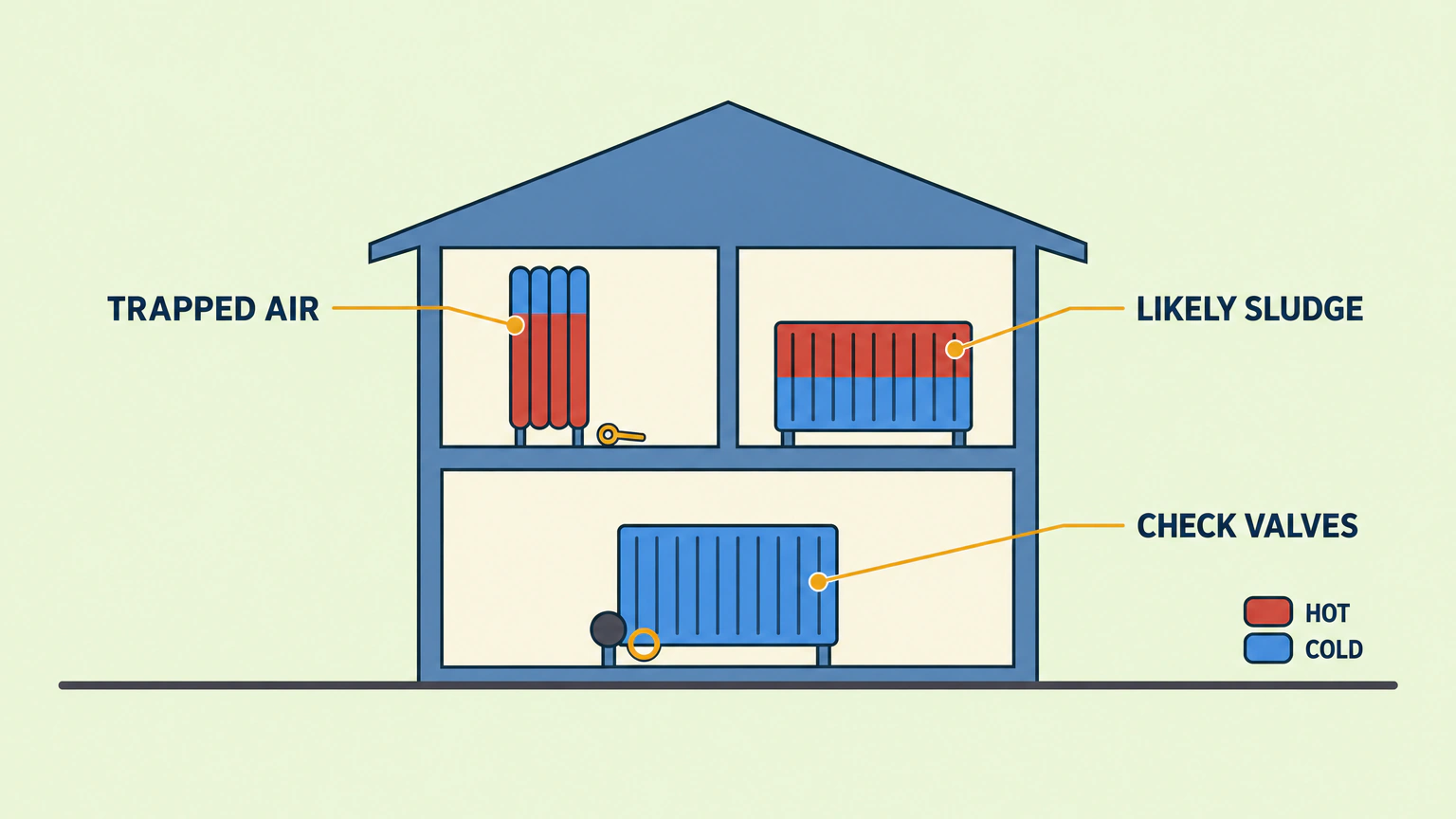
Do this tonight, before anyone quotes anything. Put the heating on, give it twenty minutes to come up to temperature, then lay a flat palm on each radiator, high first and then low. You're feeling for where the heat stops.
One refinement from the trade, worth ten extra seconds: feel the two pipes going into the radiator as well as its face. If heat is reaching that radiator at all, the pipes say so before the panel does.
Here's what each pattern usually means.
| What you feel with the heating on | What it usually means | What to do first | Is a whole-system flush the answer? |
|---|---|---|---|
| Cold at the top, warm at the bottom | Trapped air | Bleed the radiator, then top the pressure back up if you have a sealed system | No |
| Warm at the top, cold at the bottom, on one radiator | Sludge in that radiator | Have that one radiator taken off and flushed through | Usually not |
| Cold at the bottom on more than one radiator | Sludge through the system | Ask about a system clean, chemical or power flush | Often, yes |
| One radiator cold all over while the rest heat | A closed lockshield valve or a stuck valve pin | Check the lockshield is open and the thermostatic valve pin moves freely | No |
The air and sludge patterns come from Ideal Heating's own guidance page. The valve checks come from Plumberparts, a working plumbing firm whose advice pages say what its engineers find most often: a thermostatic valve pin stuck down after a summer of sitting still, a lockshield valve nobody ever opened, or a system knocked out of balance because one lockshield was opened all the way.
Two of those four patterns point somewhere far cheaper than a whole-system flush. One of them costs nothing at all.
Keep to the safe side of the line while you're testing. Bleeding a radiator and checking a valve are householder jobs. None of that involves opening the boiler, taking its cover off, or touching anything gas. That work is regulated, and it belongs to a registered engineer.
One cold radiator is usually that radiator's problem
Ideal is blunt about the single-radiator case, and it's the line that saves you the most money. When one radiator is warm at the top and cold at the bottom while the rest of the house heats normally, Ideal says it's "likely to be an issue with that individual radiator rather than a problem with your overall heating system", and that it "may just need a good clean". A power flush "may be the best solution", the same page says, when more than one radiator is cold at the bottom.
That distinction is worth several hundred pounds to you.
The cheaper route for one sludged radiator is a targeted job. Both valves closed, the radiator lifted off its brackets, carried outside and hosed through until the water runs clear, rehung, bled, and the pressure topped back up if you're on a sealed system. Plumberparts describes exactly that sequence, in that order.
Most people should get a plumber to do it rather than attempt it themselves. A full radiator is much heavier than it looks, the water inside it is black, and carrying one down a carpeted staircase is a memory you don't need. If the engineer who quoted you for a flush won't price that smaller job instead, asking why is entirely reasonable.
What the rules actually ask for when a new boiler goes in
A flush line may turn up on a new-boiler quote with a nod towards "the regulations". It's worth knowing what that paperwork actually asks for, because it asks for less than the pitch tends to imply.
The paragraph installers work to in England and Wales
In England it comes down to one paragraph, 8.8 of Approved Document L, Volume 1. It reads: "Before a new heating appliance is installed, all central heating and primary hot water circuits should be thoroughly cleaned and flushed out. A suitable chemical inhibitor should be added to the primary heating circuit to protect against scale and corrosion." It finishes by saying domestic systems "should be prepared and commissioned to BS 7593".
Now read it again for what it doesn't say. It asks for a clean system and inhibitor in the water. It names no machine, no method and no product. The word filter appears nowhere in the whole document, and neither does the phrase power flush.
Wales carries the same paragraph, word for word, in its own edition. A new English edition keeps all four points. It takes effect on 24 March 2027 outside higher-risk buildings and on 24 September 2027 for higher-risk work. Scotland and Northern Ireland run their own building standards and we haven't checked what theirs say, so don't read that paragraph as covering them.
BS 7593 is the British Standard that paragraph points at, a code of practice for preparing, commissioning and maintaining domestic central heating water. BSI describes the current edition as covering "treatment of water to overcome scale and corrosion; cleaning and flushing of systems; and the use of in-line filters". The standard is sold rather than published, so we can describe it in BSI's words and no further.
The box on the Benchmark checklist your installer has to fill in
Many new-boiler manuals include a Benchmark checklist. It's the commissioning record the installer completes and leaves with the boiler. Vaillant and Ideal's published warranty terms name that record, while Worcester's terms require annual-service details in its service record. HHIC, the industry body behind the scheme, publishes a template, and one small section of it is the part that matters here.
We opened HHIC's July 2019 template. On it, the installer ticks that the system "has been flushed, cleaned and a suitable inhibitor applied upon final fill, in accordance with BS7593 and boiler manufacturers' instructions". Then come two write-in boxes: "What system cleaner was used?" and "What inhibitor was used?", each asking for a brand and a product by name. Underneath them, the primary water system filter is recorded as "pre-existing", "Fitted" or "Not required".
Hold on to that last option. That 2019 template allows for a system that doesn't have a filter.
HHIC has revised the form more than once, so the exact wording of that tick line may read a little differently in your manual. The write-in boxes are the same on the two 2019 HHIC versions we opened. Before the installer packs up, look at that section and make sure it's filled in with real product names rather than a bare tick, then keep the booklet somewhere you'll find it again. The same scheme asks for an inhibitor check at every annual service afterwards, which is part of what a boiler service should include.
What your boiler warranty says about sludge
If you're told, "You need this for the warranty," read what the terms themselves say. They say something narrower.
| Boiler maker | Register it within | Paperwork the terms name | What the terms say about sludge | Filter in the terms |
|---|---|---|---|---|
| Worcester Bosch | 30 days (clause 4.1.3) | Annual service details in the service record (clause 4.1.6) | Excludes "Damage to the Product as a result of water quality or other external factors causing scale, sludge, blockages" (clause 4.2.7) | Extended guarantees on specific boilers need a Worcester Bosch Accredited Installer and a Greenstar System Filter |
| Vaillant | 30 days, or the guarantee falls back to 12 months (clause 5) | Benchmark logbook completed at installation (clause 3) | A failure caused by contaminated water, "e.g. blockages, or influences of flux residues, iron oxides, limescale, sludge", makes the visit chargeable (clause 15) | Extended guarantee needs Vaillant's boiler protection kit filter and a system "flushed, cleansed and inhibited in accordance with BS7593" |
| Ideal | 30 days, or the warranty runs only 12 months (condition 4) | Benchmark commissioning sheet left with the boiler (condition 2) | Excludes damage "caused by aggressive water or sludge resulting from corrosion" (condition 7d) | On Max boilers, the included system filter must be registered with the boiler (condition 4) |
Three things run through all three. Sludge damage sits outside cover, or turns the engineer's visit into a chargeable one. Registration inside 30 days is an easy condition to miss, and it costs nothing to get right. And a filter, where it appears at all, hangs off an extended guarantee or a particular boiler range rather than being demanded across the board.
Then the finding that matters. Not one of those three sets of published terms uses the words power flush. The terms differ: they require timely registration and ongoing servicing or records, while sludge-related damage is excluded or chargeable. The separate building guidance and Benchmark template require a clean, inhibited system. A power flush is one route to that. It isn't the only one, and none of these three manufacturers names it.
These are the standard published terms of three makers, read from their own pages. If you've a Baxi, a Glow-worm or anything else, read yours. And when an engineer tells you a flush is required by your warranty, ask which clause says so. A good one will happily show you.
Chemical clean, power flush or filter: which one does what
Three different jobs, at three different prices, sold often enough as though they were one.
A chemical clean
British Gas puts it plainly: "A chemical flush adds chemicals to the heating system and lets them circulate using the existing pump." No machine comes through your door. Ideal sets out the method the same way: add the cleaner, let the heating run for an hour or so, then flush it out and refill, with the cleaner left in for up to a week in severe cases.
MyJobQuote lists £150 for up to two bedrooms, £200 for three to four bedrooms and £275 for five or more. Boilers2Go puts a chemical flush at £150 to £350.
Who it suits: a newer or lightly sludged system that still heats evenly top to bottom. It ends the way a power flush ends, with fresh inhibitor in the system.
A power flush
British Gas describes "a high-flow, low-pressure pumping machine" driving chemicals through the whole system, with every radiator flushed individually. That's a full day on site.
Two questions are worth asking before anyone connects it. First, if a new boiler has just been fitted to an old system, whether it will be isolated while the radiators are flushed. Kamco's guidance says that is the scenario where the new boiler should not be included, while an existing boiler may itself need cleaning. Second, whether the engineer will recommission and test the controls afterwards. Fernox's procedure ends by resetting the controls and test-running the system.
The machine hire isn't what your money buys. A day of skilled labour is.
A magnetic filter
A filter sits on the return pipe and catches debris that's already moving. In Ideal's words, it "will collect any debris in the system, allowing easy removal without having to resort to the complexity of cleaning, removing or power flushing your radiators". MyJobQuote prices one supplied and fitted at £180 to £260.
What a filter won't do is shift sludge that's already settled in the bottom of your radiators. It catches what circulates. It can't reach what's lying still.
Fitting one is often a genuinely good idea, and some extended guarantees make it a condition. You'll also meet it sold as compulsory, which is a different claim. MyJobQuote's page says BS 7593 "requires an in-line filter to be fitted on every system after a clean". We couldn't open the paid standard to verify that statement, and BSI's public summary confirms only that the standard covers in-line filters. Ask the engineer to show you the current clause and explain how it applies to your system.
Sold a flush during a service or breakdown visit? You may be able to cancel
The engineer is at your kitchen table. The heating is still off, the quote is on the worktop, and everything about the moment says agree to it now. You don't have to. And if you already have, you may not be stuck with it.
A contract you agree with a trader inside your own home is an off-premises contract under the Consumer Contracts Regulations 2013. For a service costing more than £42, you get 14 days from the day you agree it to cancel, and you don't have to give a reason.
The obvious objection is the emergency, and the regulations meet it head on. If you called someone out for an urgent repair, that repair itself isn't cancellable, which is only fair to the engineer who came. But the exception is drawn narrowly. It doesn't stop the right applying to "services in addition to the urgent repairs or maintenance requested" that the trader sells you on the same visit. A separately sold power flush can still carry the cancellation right if it is a service in addition to the urgent repair you requested.
Two further rules do most of the work for you. The trader may not start the job inside those 14 days unless you ask them to. Where the contract was agreed in your home, that request has to be made on a durable medium, such as paper or email. Ask for an early start and then cancel partway, and you pay for the part that's been done. Ask for it, let them finish, and acknowledge that you'd lose the right, and the right is gone.
So what if they started without asking you, or nobody mentioned cancellation at all? Then you bear no cost for the service supplied during the cancellation period. And where the right to cancel was never explained to you, that 14-day window stretches by up to 12 months.
Cancellation turns on where and how your deal was struck, so check your own paperwork, or take it to Citizens Advice, before you rely on any of this.
If an old radiator starts leaking afterwards
It does happen. Fernox says homeowners should be warned when cleaning highly corroded parts may expose leaks. On an old system that's been quietly corroding for years, shifting the sludge can expose a radiator or a joint that was already near the end of its life.
The Consumer Rights Act 2015 says every contract to supply a service includes a term that the trader "must perform the service with reasonable care and skill". Where that hasn't happened, you can require repeat performance at their cost when that remedy is possible, and a clause in their terms trying to sign that liability away isn't binding on you.
None of which makes a worn-out radiator their fault. So the useful move comes before the work rather than after it. Ask what happens if a radiator or a valve starts to weep, and get the answer in writing next to the quote. If water has already come through a ceiling, water damage restoration firms are a separate call, and a quicker one.
Five questions to ask before you agree to a power flush
You don't need to understand a flushing machine to hold a quote to account. Five questions will do it. A good engineer will be happy to answer every one.
- What did you see that points to sludge? Ask which radiators were cold and where, because cold at the top or one radiator cold all over points somewhere cheaper first.
- Would a chemical clean do the job, and if not, why not? Ask for both prices so you can see what the machine is adding.
- What exactly is in the price? Check it covers every radiator, the chemicals and fresh inhibitor at the end, and whether a filter, valves or leak repairs would be extra.
- What happens if an old radiator or valve starts leaking? Get the answer in writing before anyone connects the machine.
- Will you write down what you used? On a new boiler that means the Benchmark water-quality box with the cleaner and inhibitor named. On an existing system, an invoice naming both.
That record matters because it lets the next engineer see which cleaner and inhibitor were used.
If the answers stack up and your system does need cleaning, here are heating engineers near you, and how we vet the firms we list.
Common questions about power flushing
How long does a power flush take?
Most of a working day. British Gas says its flush "usually takes around 8 hours", and MyJobQuote reckons most are finished within a single day, with a mid-sized system taking about five to six hours. More radiators, heavier sludge or awkward old pipework all push it longer. If someone quotes two hours for a ten-radiator house, ask what they're planning to leave out.
Do I need a power flush with a new boiler?
Not by name. Approved Document L asks for the circuits to be "thoroughly cleaned and flushed out" with inhibitor added, and the Benchmark checklist records which cleaner and inhibitor were used. Neither names a power flush. It's one way of meeting that standard, and the right one when an old system is badly sludged. On a system that still heats evenly, a chemical clean often gets you there for less.
Can a power flush cause leaks?
It can expose one. On an older system, shifting years of settled sludge can reveal a radiator or joint that was already failing, and MyJobQuote says leaks may show up during or after the work. The flush rarely creates the weakness. It finds it. Agree in writing beforehand what happens if something weeps, and remember the work still has to be done with reasonable care and skill.
Is a chemical flush as good as a power flush?
For a lightly sludged system it often is, and the building regulations guidance names no method either way. British Gas describes a chemical flush as circulating cleaner with your existing pump, while a power flush brings a high-flow machine. Ideal points to a power flush when more than one radiator is cold at the bottom. On MyJobQuote's and Boilers2Go's published prices a chemical clean starts at £150, against several hundred pounds more for the machine.
Can I power flush my central heating myself?
Machines can be hired, but British Gas says the job "should only be carried out by an experienced professional like a heating engineer or a plumber". On a new-boiler job, the competent person who commissions the boiler completes the Benchmark checklist, including the cleaner and inhibitor fields. Gas safety law counts servicing, repairing or disconnecting a gas appliance as gas work, and HSE says that needs a business on the Gas Safe Register. If the job includes gas work on the boiler, ask for the card and read how to check a tradesperson's registration.
How often should central heating be power flushed?
There's no interval, and nothing we read sets one. The Benchmark service record asks for an inhibitor check at every annual service, and Vaillant's extended guarantee asks for inhibitor strength to be checked every two years. Those are water-quality checks rather than flushes. The sources treat a flush as symptom-led rather than calendar-led, with several radiators cold at the bottom as one reason to investigate.
Put a hand on your radiators this evening, top and then bottom, and see what they tell you. If the quote still looks right in the morning, ask the five questions before you sign anything.