
Do I quote 'plus VAT' or one price?
Type your price, say who it is for, and get the exact wording to put at the top of the quote. Free, no sign-up, nothing leaves your browser.
The price
Your price is your price. There is no VAT to add or take off.
Who it is for
Your customer is a contractor
HMRC's conditions for the reverse charge
One of HMRC's conditions is still unanswered, and guessing it is how invoices come back. Here is what to do about it.
- You must register when taxable turnover for the last 12 months goes over £90,000, or when you expect to go over it in the next 30 days. The deadlines and effective dates differ for those two tests.
- If you have applied and are waiting for a VAT number, you may already have to account for VAT from your effective date. HMRC says not to show VAT separately until the number arrives; you can increase the price to cover VAT and reissue the invoice afterwards.
- This tool cannot settle whether VAT may be added to an already agreed price. Check your agreement and the GOV.UK registration guidance before sending wording.
We are not tax advisers and this is not tax advice. Your VAT position and the rate on this job are yours to confirm with HMRC or your accountant.
industryoversight.co.uk/tools/vat-quote-wording-helper/
We do not send or store your calculation. Share puts the calculation settings in the link, and Email opens the wording and figures in your mail app. Your VAT number is excluded from both.
What this document must not show
- No amount described as VAT. An invoice from someone who is not registered showing an amount as VAT is a penalty matter under Schedule 41 of the Finance Act 2008, and the amount at stake is the amount you showed.
- No VAT registration number. You do not have one.
- No "plus VAT", "inc VAT" or "including VAT" anywhere on it.
- Do not use zero-rated or VAT exempt as another way to say you are not VAT registered. Those terms classify the supply, so confirm them separately if they matter.
What the invoice must show
One line to send the customer
Where these figures come from
Sources: HMRC and legislation.gov.uk. Tax rules change, so open the linked source before relying on a non-standard rate or special rule.
Four worked examples
The live version needs JavaScript. These four examples are worked out in full, and the figures behind them are in the table underneath.
| What | Value | Source |
|---|---|---|
| Standard rate | 20% | gov.uk/vat-rates |
| Reduced rate | 5% | gov.uk/vat-rates |
| Zero rate | 0% | gov.uk/vat-rates |
| VAT registration threshold | £90,000 taxable turnover over the last 12 months, or expected in the next 30 days | GOV.UK, register for VAT |
| Deregistration limit | £88,000 | VAT Notice 700/1 supplement |
| Domestic reverse charge conditions | Seven conditions, all of which must hold | GOV.UK, how to use the VAT domestic reverse charge |
| Reverse-charge invoice wording accepted by HMRC | VAT Act 1994 Section 55A applies; S55A VATA 94 applies; Customer to pay the VAT to HMRC | VAT reverse charge technical guide |
| CIS deduction rates | 20% registered, 30% not registered, 0% gross payment status | GOV.UK, make deductions and pay subcontractors |
| CIS deduction base | The figure before VAT, less materials and plant the subcontractor paid for | CIS 340 sections 3.11 to 3.14 |
| VAT invoice particulars | The full list a VAT invoice must show | VAT Notice 700 section 16.3.1 |
| Unauthorised issue of an invoice showing VAT | A penalty matter; the potential lost revenue is the amount shown as VAT | Finance Act 2008 Schedule 41 |
How the wording is worked out
Nothing on this page is generated. We keep a small library of sentences that HMRC's guidance and the VAT Regulations put the words to, and your answers pick the ones that fit. Your figure goes in as whole pence and stays there, so the total never drifts by a rounding error.
The order never changes. We read your figure as either before VAT or including VAT. We work the VAT out from the rate you picked, rounded to the nearest penny. After that we look at who is reading the document, because that is what decides whether the price leads with the total or with the net figure. If your customer is a contractor and you are both inside the Construction Industry Scheme, we run your answers against HMRC's conditions for the domestic reverse charge and name the answer that produced the result. Then we fill the sentences.
Where the answer depends on something you haven't told us, we don't guess. A "Not sure" on any reverse-charge condition produces no verdict at all, and a named next step instead. A wrong invoice costs you a payment cycle. An honest "we cannot tell you yet" costs you a phone call.
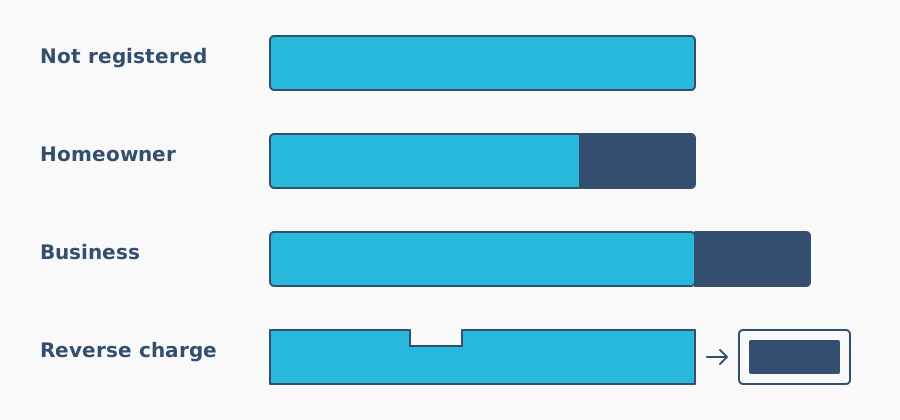
What goes on the quote, and what goes on the invoice
An invoice carries a statutory list of particulars. A quote carries one rule instead: a consumer has to be able to see the total they will pay.
Must be on it
Every line here is VAT Notice 700, section 16.3.1.
- A sequential number, from one or more series, that uniquely identifies the document.
- The time of supply, which is the tax point, and the date of issue where that falls on a different day.
- Your name, your address and your VAT registration number.
- Your customer's name and address.
- A description good enough to identify the work you supplied.
- For each description, the extent of the work, the rate of VAT and the amount payable excluding VAT.
- The gross total payable excluding VAT, and the rate of any cash discount you offered.
- The total VAT chargeable, expressed in sterling.
Worth showing
- The unit price. It bites on countable things, like an hourly rate or a price for a standard service. Where the job cannot be broken into countable elements, the tax-exclusive total is the unit price, and it need not appear at all where your sector does not normally provide one and the customer has not asked.Notice 700, s16.3.1
- Zero-rated or exempt items on a mixed invoice have to show clearly that no VAT is payable, with a separate total for their values.Notice 700, s16.5
- A simplified invoice is available where the transaction total including VAT is £250 or less and the customer agrees. A Northern Ireland supplier also needs a customer who is not from an EU member state. We never rule on it, because we do not ask where either of you is.Notice 700, s16.6.1 to s16.6.2
- The total VAT on an invoice may be rounded down to a whole penny, and line-level rounding is a consistent choice you make and keep. We round to the nearest penny, half up, and say so beside the figures.Notice 700, s17.5
The reverse-charge statement
- Everything a VAT invoice needs, plus a note making it clear that the domestic reverse charge applies and that your customer is the one who accounts for the VAT. State how much VAT is due under the charge, or the rate where that amount cannot be shown, and keep it out of the amount you are charging.Reverse charge technical guide: invoices and other VAT documents
- The words reverse charge have to appear somewhere on the document.VAT Regulations 1995, regulation 14(1)(o)
- Wordings HMRC gives as meeting the requirement: VAT Act 1994 Section 55A applies. S55A VATA 94 applies. Customer to pay the VAT to HMRC.Reverse charge technical guide
- If you are on the Flat Rate Scheme, reverse-charge supplies come out of the scheme calculation.Technical guide: Flat Rate Scheme
The CIS deduction line
- Work the deduction on the gross amount with the VAT you charged taken out of it, if you are VAT registered.CIS 340, s3.12 step one
- Then take off what you actually paid for materials, consumable stores, fuel other than travel fuel, plant hired from somebody else, and the cost of manufacture or prefabrication. Include the VAT you paid on them if you are not registered; leave that VAT out if you are.CIS 340, s3.12 step two
- Only what you paid for directly comes out. Plant you own does not count, though the consumables it burns do.CIS 340, s3.13 to s3.14
- Travelling expenses and subsistence stay inside the figure the deduction is worked on.CIS 340, s3.11
- The rate is 20% if you are registered for CIS, 30% if you are not, and nothing at all on gross payment status.GOV.UK: make deductions and pay subcontractors
- What lands in your bank is the invoice total less the deduction, not the deduction base less the deduction. HMRC's own worked examples do it that way.CIS 340, Appendix D
Common questions about VAT on quotes and invoices
Do quotes include VAT?
If your quote gives a homeowner the details and the price they need to decide whether to buy, show the total they will pay, VAT included. The Digital Markets, Competition and Consumers Act 2024 says an invitation to purchase must not leave out the total price, and the total price includes any taxes the customer will necessarily incur. For a business customer, net plus VAT is the familiar format, and a VAT-registered customer may reclaim input VAT subject to the normal rules.
Should I put "plus VAT" on a quote to a homeowner?
Not on its own. "Plus VAT" is trade shorthand, and a homeowner reads the big number as the price. Write both: the total they will pay, and the split underneath it. That is the whole argument prevented, in one line. If you would rather lead with the net figure, the total still has to be there and just as prominent.
What do I put on an invoice if I am not VAT registered?
Show the amount due and show nothing as VAT. No VAT line, no "plus VAT" or "inc VAT", and no VAT number you do not have. An unauthorised invoice showing an amount as VAT, or as including VAT, is a penalty matter under Schedule 41 of the Finance Act 2008, and the potential lost revenue is the amount you showed. Zero-rated and exempt describe the supply rather than your registration, so do not reach for either as a way of saying you are not registered.
What wording does a domestic reverse charge invoice need?
Everything a VAT invoice needs, plus a note making clear that the domestic reverse charge applies and that the customer must account for the VAT, plus the VAT amount or the rate: shown, but not included in what you are charging. The VAT Regulations require the words "reverse charge" somewhere on it. HMRC accepts "VAT Act 1994 Section 55A applies", "S55A VATA 94 applies" and "Customer to pay the VAT to HMRC".
How do I work out VAT backwards from a total?
Divide, don't subtract. Taking 20% off a gross figure gives you the wrong answer: 20% off £600 is £480, and the right answer is £500. At the standard rate the VAT is one sixth of the gross, so £600 divided by 1.20 gives £500 net and £100 of VAT. We work in whole pence, so the two figures always add back to the total exactly.
When do I have to register for VAT?
When your taxable turnover for the last 12 months goes over £90,000, or when you expect to go over it in the next 30 days. It is a rolling 12 months rather than your accounting year, so it can creep up on you in the middle of a good summer. Registration is not optional at that point, and whether to register early is a conversation for your accountant rather than for a web page.
How is the CIS deduction worked out on a labour-only job?
On a labour-only job the whole figure is the deduction base, so a registered subcontractor loses 20% of it and an unregistered one 30%. Where you supplied the materials yourself, those come off first: only what you actually paid for, and excluding the VAT if you are registered. The deduction is worked on the figure before VAT, but what lands in your bank is the invoice total less the deduction.
Is any of this different in Northern Ireland, Scotland or Wales?
The core rules here run across England, Scotland, Wales and Northern Ireland. The earlier energy-saving-materials split closed on 1 May 2023, although other Northern Ireland goods rules can still differ. The Channel Islands sit outside the UK for VAT. The Isle of Man is treated as part of the UK for VAT but has its own listed differences, so we do not cover Isle of Man jobs here.
VAT wording for UK trades, the short version
When a homeowner quote gives enough detail for a buying decision, show the total they will pay. A business quote normally leads with the net figure, with the VAT added underneath. Invoice a main contractor inside the Construction Industry Scheme and the price may carry no VAT at all: instead it carries a statement that the customer accounts for it, and the payment that lands will be short by a CIS deduction. Same job, same figure, three different correct documents.
If you're not VAT registered, don't charge an amount as VAT and don't show a VAT number you do not have. State the total plainly. Zero-rated and exempt classify the work itself. Neither is another way of saying you are not registered, so confirm the classification separately if it applies.
The one that catches everybody is the reverse charge. It only bites when both of you are VAT registered, the payment is reported under CIS, the work is standard-rated or reduced-rated, you are responsible for carrying out the construction work rather than only supplying staff who work under your customer's control, and your customer has not told you in writing that they are an end user. Miss one of those and the invoice goes back.
Where these figures come from
Every figure this page uses, and the page it came from.
| What | What it says | Source |
|---|---|---|
| VAT rates | Standard 20%, reduced 5%, zero 0%. Which one applies to your job is a rate you establish, not one we decide. | GOV.UK, VAT rates |
| Construction rates | The categories a trade meets: new qualifying dwellings, conversions, renovation of empty homes, mobility aids for people over 60, approved alterations to listed dwellings at 20%, and most work on existing homes at 20%. | VAT Notice 708 |
| Energy-saving materials | Zero-rated from 1 May 2023 to 31 March 2027, reverting to the reduced rate from 1 April 2027. Great Britain and Northern Ireland have been aligned since 1 May 2023. | VAT Notice 708/6 |
| Registration threshold | £90,000 of taxable turnover over the last 12 months, or expected in the next 30 days. Going over is what triggers it, so exactly £90,000 does not. | GOV.UK, when to register |
| Deregistration limit | £88,000. Registration can be cancelled where expected taxable turnover is less than that figure. | Notice 700/1 supplement |
| Reverse-charge conditions | HMRC's own list, and all of it has to hold at once: you registered for VAT in the UK, standard-rated or reduced-rated services, your customer registered for VAT in the UK, the payment reported under CIS, construction services the scheme covers, you responsible for the work rather than only supplying staff, and nothing in writing from your customer claiming end user or intermediary supplier status. | GOV.UK, how to use the reverse charge |
| Services in and out of scope | Six groups of work inside the charge. Nine groups fall outside it when they are supplied on their own, among them the professional work of architects and surveyors, delivering materials to site, security systems, and installing blinds and shutters. | GOV.UK, check when you must use it |
| End user and intermediary supplier | Defined in article 2(1), as amended by SI 2020/578. Being an end user is optional, and the charge stops applying only once your customer has told you so in writing. | SI 2019/892 |
| Reverse-charge invoice wording | The invoice states the VAT due under the charge but does not include it in the amount charged, and HMRC gives three wordings that meet the requirement. Flat Rate Scheme users leave reverse-charge supplies out of the scheme calculation. | Reverse charge technical guide |
| The words reverse charge | Required as a reference on the document by regulation 14(1)(o). | VAT Regulations 1995, reg 14 |
| CIS deduction rates | 20% for a registered subcontractor, 30% for an unregistered one, 0% on gross payment status. | GOV.UK, make deductions |
| CIS deduction base | The figure before VAT, less the materials, consumable stores, fuel other than travel fuel, hired plant and prefabrication the subcontractor paid for. Sections 3.11 to 3.14, with the worked examples in Appendix D. | CIS 340 |
| Invoice particulars and the rest | What a VAT invoice must show is section 16.3.1. Simplified invoices at £250 or less including VAT are 16.6.1 and 16.6.2. Rounding is 17.5. The Isle of Man and the Channel Islands are sections 2 and 4.7. | VAT Notice 700 |
| Total price to a consumer | An invitation to purchase must not omit the total price, and the total price includes any taxes the consumer will necessarily incur. In force from 6 April 2025. | DMCC Act 2024, s.230 |
| Off-premises and distance work | The trader gives the total price of the services inclusive of taxes. Most quoting done in somebody's kitchen is an off-premises contract. | Consumer Contracts Regulations 2013, Sch. 2 |
| Showing VAT you are not entitled to charge | A penalty is payable for the unauthorised issue of an invoice showing VAT, and the potential lost revenue is the amount shown as VAT. | Finance Act 2008, Sch. 41 |
More free tools for UK trades
-
Late payment interest and letter before action
The wording was right, the invoice went out, and the money still hasn't arrived. Work out what you're owed in interest and compensation, and send the letter that comes before a claim.
-
Risk assessment and method statement generator
The other paperwork a main contractor asks for before they'll let you on site, in the same shape: your own details in, a document you can hand over out.
Quoting clearly? Say so on your listing.
We do not charge you to claim your Industry Oversight listing, and businesses cannot pay to influence who we include or feature. If you already quote a clear total, that's the behaviour we want our listings to describe, so put it on the record.
The sections a customer arrives through are Plumbers, Electricians, Plasterers and Builders.
Keep this one
Copy shareable link puts the job in the address bar. Bookmark that link and the page opens with the same figure, the same customer and the same wording, which is quicker than working it out twice. Send it to whoever writes your invoices and they'll see exactly what you saw.