

Price comes first. Then the level your house needs, the Scottish difference, checking the firm, and what to do if it all goes wrong.
On this page
What a house survey costs
HomeOwners Alliance and Compare My Move measure different things, so here they are side by side.
| Survey | Who RICS says it suits | Typical price (HomeOwners Alliance) | Average quote (Compare My Move) |
|---|---|---|---|
| Level 1 (was the Condition Report) | Conventional, newer homes in good condition | £300 to £900 | £380 |
| Level 2 (was the Home Buyer Report) | Conventional homes in reasonable condition, simple in form and layout | £400 to £1,000 | £499 (range £465 to £685) |
| Level 3 (was the Building Survey) | Large, older, run-down, unusual or altered homes, or if you're planning major works | £630 to £1,500 | £656 (range £574 to £894) |
| Home Report (Scotland only) | Every home marketed in Scotland, apart from a few exceptions | £450 to £550 plus VAT for a home worth £100,000 to £200,000 (Allied Surveyors Scotland, October 2024) | Paid by the seller |
HomeOwners Alliance gives its ranges as indicative budgets for homes worth £100,000 to £1 million. Compare My Move averages quotes its own users received from RICS surveyors.
Averages sit well inside those ranges. Reallymoving's August 2026 figures put the average Level 2 at £520 across the UK, from £463 in the North East to £590 in London. Compare My Move's own average for a survey of any level is £445.
Price lists from individual firms land in the same territory. AMS Surveys, which covers the North West and North Wales, starts a Level 2 at £450 and a Level 3 at £990, both including VAT. Peer King Surveyors in Norwich lists its Level 2 at £499 including VAT.
Our own guide prices put a Level 2 survey without a valuation at £450 to £850 per report. A Level 3 detailed building survey runs £700 to £1,300. When you're ready for real numbers, ask house surveyors near you to quote for the level you've chosen.
Why two quotes for the same house can differ
RICS says a surveyor bases the fee on how much time the job needs, plus business costs such as travel time and overheads. A bigger, more complex home takes longer and costs more. So does a higher level.
The home's value moves the price as well. HomeOwners Alliance's bands run from £400 to £600 for a Level 2 on a home worth £100,000 to £249,000, rising to £800 to £1,000 for one worth £500,000 to £1 million. Location matters too, which is where that gap between the North East and London comes from.
Then there's the valuation. A Level 2 can come with or without one, and the version with it adds a market value and an insurance reinstatement figure, so you don't end up under- or over-insured. HomeOwners Alliance tells buyers to ask whether a quote includes the valuation rather than assume it does.
A cheaper quote for a different level isn't a cheaper version of the same thing.
Check whether the quote includes VAT
GOV.UK puts the standard VAT rate at 20%, the rate for most goods and services. Firms don't all show it the same way. AMS Surveys and Peer King print their prices including VAT. Allied Surveyors Scotland prints its Home Report prices "+ VAT". The difference is real money: a £450 + VAT quote is £540 once VAT goes on, and a £550 + VAT quote becomes £660. Put every quote on the same footing before you compare them, which is HomeOwners Alliance's advice too.
Which survey level your house needs
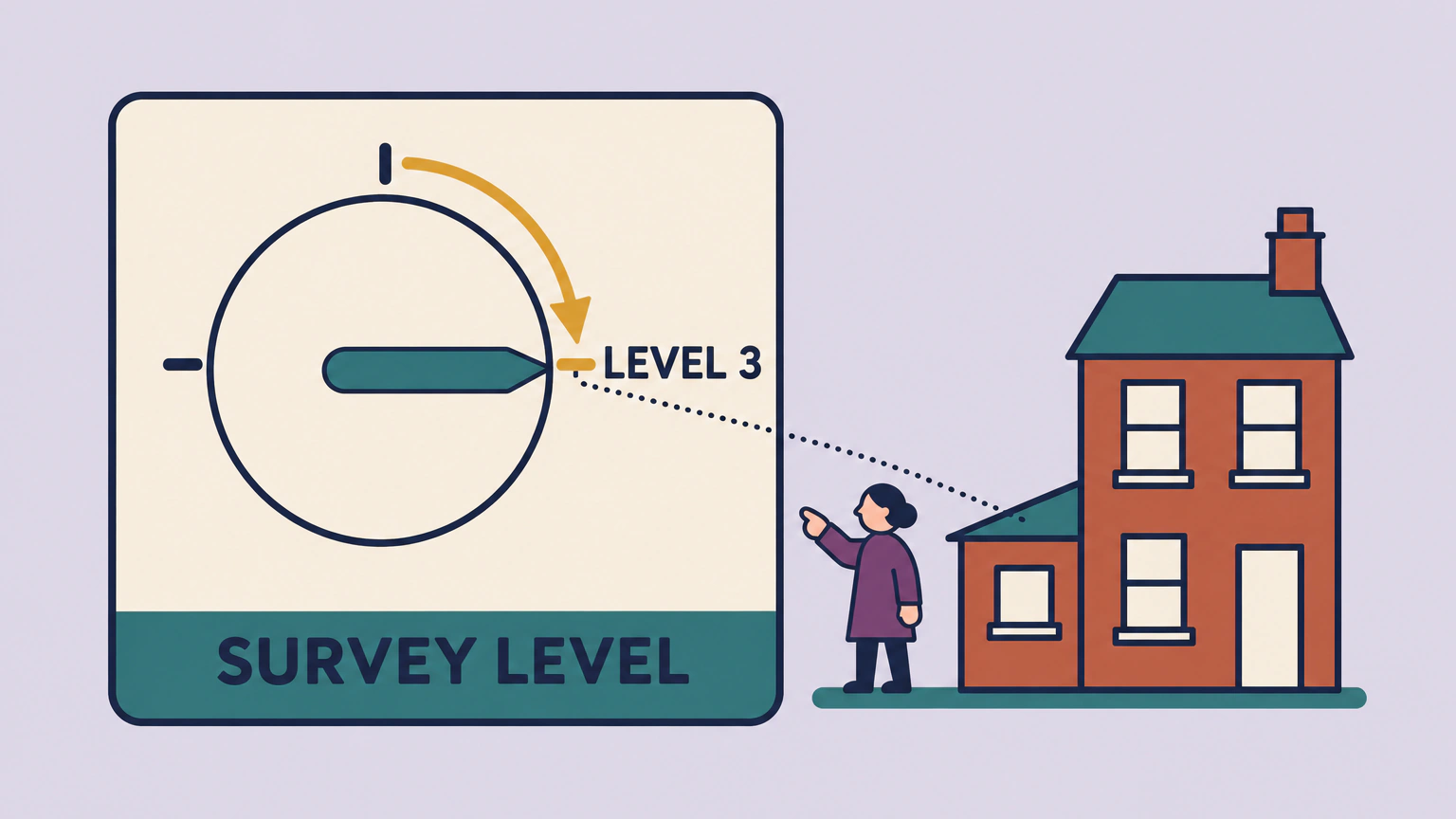
RICS's house survey guide says the right level usually depends on the home's age, size, condition, complexity and originality, and that an RICS member can advise. Hold your house up against its three descriptions.
| If the home is | RICS points you to | What that level adds |
|---|---|---|
| A conventional house, flat or bungalow, newer and in good condition | Level 1 | The condition, risks, possible legal issues and urgent defects, with little advice on what to do about them |
| Conventional and in reasonable condition, without multiple alterations or extensions | Level 2, with or without a valuation | Advice on repairs and upkeep, and a closer look at the roof space and drainage chambers |
| Large, older, run-down, unusual or altered, or you're planning major works | Level 3 | How it's built and how the materials will last, the risk of hidden defects, repair options with a timeline, and what happens if you don't repair |
Some homes need more care in the choosing. RICS names listed buildings, thatched roofs and timber frames among the cases where a survey is particularly useful. It also says the surveyor should have relevant experience of the type, age and construction of the property. On a house like that, ask about experience before you ask about price.
Whatever the house, tell the surveyor about anything that worries you when you book. That way they can pick the right level and look hardest where it matters to you.
A "full structural survey" isn't what it sounds like
You'll see the phrase a lot, and HomeOwners Alliance's own price table calls a Level 3 "this full structural survey". RICS's three Home Survey levels include nothing by that name. People who ask for one usually mean a Level 3, so a full structural survey cost is really a Level 3 price.
A structural engineer's report is something else again. The Institution of Structural Engineers (IStructE) puts it plainly: "Issues like damp, cracks in walls and subsidence can often signal deeper structural problems." An engineer diagnoses that kind of problem and proposes a fix. In practice the surveyor usually spots the sign and recommends further investigation, and the engineer comes after.
IStructE's checklist for choosing one is short. Look for experience of residential projects, membership of a recognised body such as IStructE, and professional indemnity insurance whose cover you understand. If your report points you that way, you can find structural engineers near you.
What no survey level will look at
Every level is a visual inspection. At Levels 1 and 2, RICS says the surveyor doesn't remove "secured panels, electrical fittings, inspection chamber covers and other similar features". A crack hidden behind plasterboard won't be in any report, and surveyors work to the time and access they're given. Some faults only show once floorboards come up or plaster comes off.
Where something is hidden or needs a specialist, RICS says the report should recommend further investigation and say why, when and roughly who should do it. That specialist needs the owner's say-so to get in, so ask the seller early and budget for the visit before you exchange.
One check is yours to make on the viewing. Look for paving, a patio or a flower bed built up above the damp-proof course, the waterproof layer near the bottom of an outside wall. Anything that bridges it can let damp across. If damp does come up, read whether you really need damp proofing. And since a surveyor looks at the electrics where an electrician tests them, it's worth knowing what an electrical condition report costs.
Scotland, Northern Ireland, England and Wales do this differently
In England, Wales and Northern Ireland nobody has to get a survey. RICS says there's no legal requirement on a buyer or a seller, so the buyer chooses the level and pays, usually once an offer is accepted. nidirect gives Northern Ireland buyers the same timing. Scotland turns all that round: under the Housing (Scotland) Act 2006, whoever is marketing a home must have a Home Report for it.
| Nation | Who arranges and pays | What you get | Required by law? |
|---|---|---|---|
| England and Wales | The buyer, usually once an offer is accepted | The level the buyer chooses, usually from an RICS surveyor | No |
| Scotland | The seller, before the home goes on the market | A Home Report: a single survey and valuation, a property questionnaire and an energy report | Yes, for most homes |
| Northern Ireland | The buyer, usually once an offer is accepted | The level the buyer chooses, usually from an RICS surveyor | No |
Scotland's duty comes from the Housing (Scotland) Act 2006. New homes sold to their first occupier, seasonal holiday homes and a few other cases are exempt, and the seller must still provide an energy performance certificate.
If you're buying in Scotland
Ask for the Home Report on any home that's publicly for sale. Under mygov.scot's Home Report guidance, the seller or their agent must hand it over within nine days of you asking, unless they reasonably doubt they'd sell to you. A seller who refuses for any other reason can be fined £500 by the council's trading standards service. The survey part is the equivalent of an RICS Level 2 with a valuation. Under the 2008 regulations, it must date from no more than 12 weeks before the home goes on the market.
Here's the part the price guides skip. You didn't pay for the survey, but RICS requires a standard set of terms at the front of every Home Report survey, and they say the surveyors' "duty of skill and care in relation to the Report is owed to the Seller and to the Purchaser". If you buy the home, the Purchaser is you. The same terms say a Single Survey is made available to buyers "in expectation that the successful Purchaser will have relied upon it".
That doesn't stop you getting a second opinion. If the Home Report flags something you want looked at harder, RICS's Scottish buying guide says you can still instruct your own survey.
How to check the surveyor before you pay
RICS is clear that the choice is yours: "You don't have to go with the firm recommended by your bank or estate agent." It's blunter about who you choose instead. Use a firm it doesn't regulate, it warns, and "you may not have any protection in place at all." Run each firm through these checks before you book.
- The firm says it's "Regulated by RICS", and the surveyor has AssocRICS, MRICS or FRICS after their name.
- You've checked them on RICS's own list of members, because the Find a Surveyor site also lists firms RICS doesn't regulate.
- If the survey includes a valuation, the surveyor is an RICS Registered Valuer.
- They've surveyed homes of this age and construction before.
- You've seen a sample report and could follow it.
- The quote names the level, says whether a valuation is included, and shows the VAT.
- You've read the terms of engagement, including what won't be inspected.
- The firm has professional indemnity insurance that covers this job.
RICS isn't the only route. Members of the Residential Property Surveyors Association (RPSA) offer their own Home Condition survey. The RPSA advertises a code of conduct and a free arbitration scheme for consumers. If you go that way, check the surveyor's membership with the association itself.
If the surveyor missed something
You've moved in, lifted a carpet or opened up a wall, and found something the report never mentioned. It's a sinking feeling, and the urge is to ring the surveyor that afternoon.
The first question is a colder one. Was the problem there to be seen, at the level you paid for?
The standard the surveyor is held to
If you hired the surveyor yourself, the Consumer Rights Act 2015 writes a term into your contract: the firm must do the job "with reasonable care and skill". Under section 57, a term that tries to exclude that liability isn't binding on you. The Act applies in all four nations.
The firm does get to set the scope, though. A Level 2 is a visual inspection, and the terms of engagement say what it covers and what it doesn't. Read them alongside the report before you decide you've got a case.
In Scotland the Home Report contract is the seller's, so a buyer's footing is the duty of care in those standard terms. They hold the surveyor to "the skill and care reasonably to be expected of a competent residential surveyor who is a member of the Royal Institution of Chartered Surveyors".
We're not your solicitor. Whether a surveyor was negligent turns on what a competent surveyor would have seen at the level you paid for, so get advice before you spend money on a claim.
Complain in this order
Gather your evidence first: the report, the terms, dated photos and at least two written repair quotes. ADR in step 2 stands for alternative dispute resolution: an independent scheme that reviews a complaint without going to court.
- Write to the firm under its complaints handling procedure. Every RICS-regulated firm must have one.
- If that doesn't settle it, take the complaint to the firm's ADR provider. It's free for consumers and can tell the firm to apologise or pay compensation.
- For a large loss or a negligence claim, get legal advice. The routes then are court, or a claim the firm's insurer may pay.
The three main UK consumer ADR providers RICS approves are the Centre for Effective Dispute Resolution (CEDR), The Property Ombudsman and the Property Redress Scheme. The firm's procedure says which one it uses.
RICS itself can't award compensation, though you can report a member or a regulated firm to RICS Regulation if you think they broke its rules. RICS's guide to how it supports consumers adds that ADR usually has a cap on the value of disputes it can consider, and that very high-value or negligence cases may still need a court.
How long you have to make a claim
Each of the UK's three legal systems runs its own clock, so go by the row for where you bought.
| Where you bought | General time limit | If you found the problem late | Final cut-off |
|---|---|---|---|
| England and Wales | 6 years | Negligence claims: 3 years from when you knew enough to claim, if that ends later | 15 years after the survey, for negligence |
| Scotland | 5 years from the loss | 5 years from when you knew, or should have known, about the loss, its cause and who caused it | 20 years after the survey |
| Northern Ireland | 6 years | Negligence claims: 3 years from when you knew enough to claim, if that ends later | 15 years after the survey, for negligence |
Limitation Act 1980 ss 2, 5, 14A and 14B. Prescription and Limitation (Scotland) Act 1973 ss 6, 7 and 11. Limitation (Northern Ireland) Order 1989 arts 4, 6, 11 and 12.
The three-year rule for England and Wales sits in section 14A of the Limitation Act 1980, and Northern Ireland's Order matches it. Scotland rewrote parts of its rules in 2022 and 2025, so if your survey is older than that, ask a solicitor which version applies. And don't let a long complaint quietly run down the clock. Take legal advice well before the earliest date that could apply to you.
House survey questions people ask
Is a mortgage valuation the same as a survey?
No. RICS describes the mortgage valuation as a limited check, done for the lender's benefit to make sure the home is worth the loan. It won't go into a survey's detail, and problems that would be costly to put right may not show up in it at all. If you want your own figure, a Level 2 survey can come with a valuation.
How long does a house survey take?
RICS says the inspection takes from about two hours to a full day, depending on the size and complexity of the home, and a very large property can take several days. Before you book, ask when the surveyor can visit and when the report will arrive, so it lands well before you exchange contracts.
Can I be there when the surveyor visits?
It's worth asking. RICS says you may be able to visit the property at the same time as the surveyor, so you can point out the things you're worried about. Arrange it through the surveyor and the estate agent first, because it's still the seller's home.
Do I need a survey on a new build?
It's your choice. RICS aims its Level 1 at conventional properties and newer homes. A snagging survey checks a new build is finished to standard before you move in, and Compare My Move puts the average at £394. In Scotland a new house sold to its first occupier doesn't need a Home Report, so don't expect one.
What happens if the survey finds problems?
Find out how serious each one is before you commit. RICS says to get written quotes from at least two experienced contractors, check whether the repairs need planning permission or building regulations approval, and then go back to the seller about the price. It also points out that you may decide not to buy at all. Before anyone quotes, read our guide on how to check a builder is registered.
Hold your house against the three levels RICS describes, check the firm on RICS's own list of members, and ask exactly what the quote includes. Then book as soon as your offer's accepted, so the report's back in time to act on.