

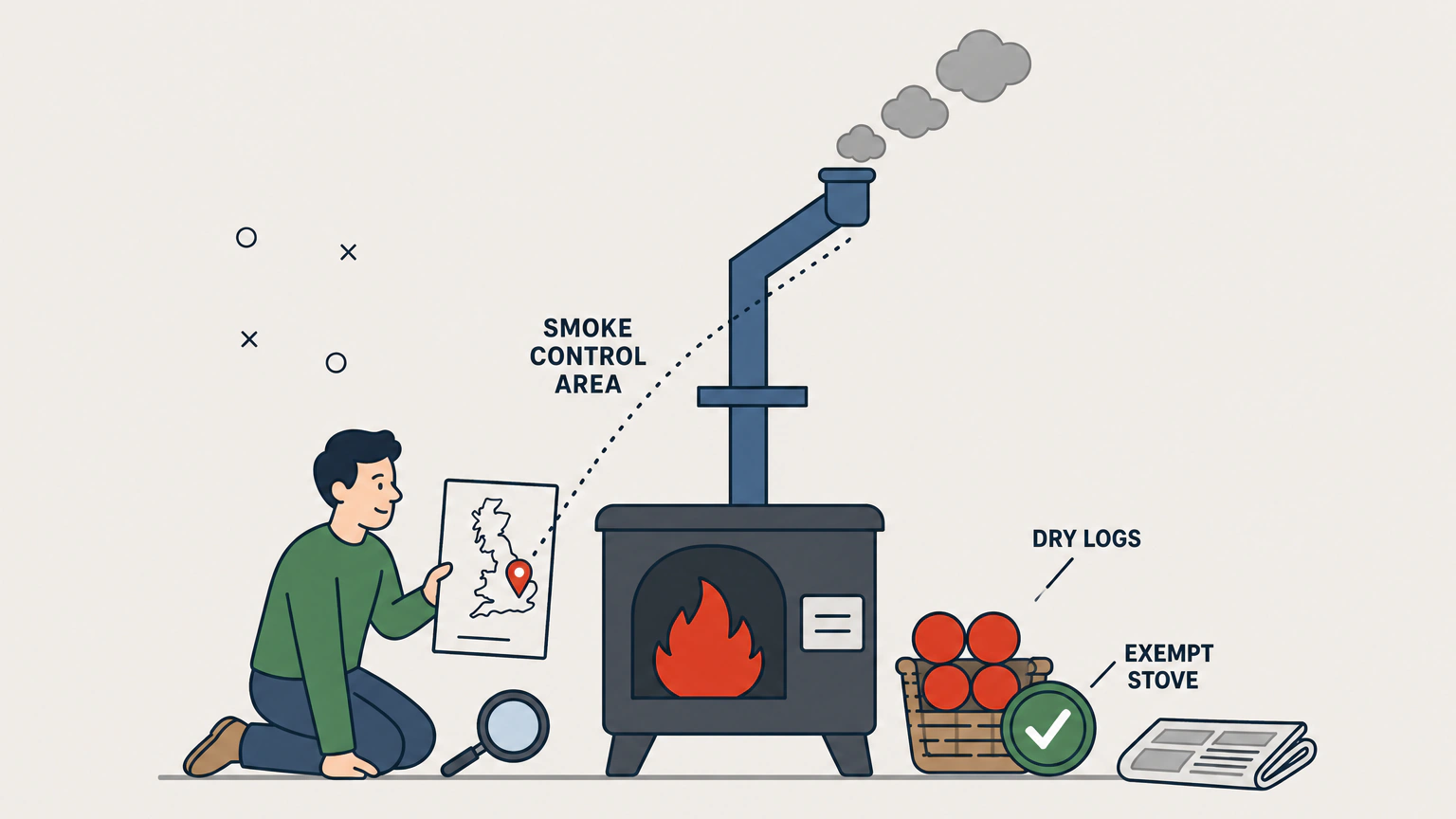
You haven't bought an ornament. The smoke-control laws here don't require every existing stove to be scrapped. What changes with your address is whether you're in a smoke control area. If you are, you generally need either an authorised fuel or an exempt appliance used with a fuel its listing allows. So start with the address for the smoke-control check. It doesn't settle every other rule.
On this page
- The short answer: it turns on your address, and on one list
- Step one, find out if your address is in a smoke control area
- What you are actually allowed to burn
- The wet wood rules bind the shop, not you
- What a smoky chimney actually costs
- What changed in Wales on 31 July 2025
- Before you light it this autumn
- Frequently asked questions
The short answer: it turns on your address, and on one list
The smoke-control rules people worry about hang off one question: has your council made a smoke control order that covers your building?
If the answer is no, these smoke-control rules don't apply to your chimney. Other law can still matter. In England, chimney smoke can be a statutory nuisance, the retail rules still bind fuel sellers, and installing a stove is controlled building work. If the answer is yes, two separate questions matter, and almost every page on this subject welds them together. One is the smoke, meaning what leaves the chimney. The other is the fuel, meaning what you put in the fire and where you bought it. They carry different consequences, and in two of the four nations they aren't even the same kind of law.
The answer also differs now in England, Wales, Scotland and Northern Ireland, because Wales rewrote its own rules in July 2025. No trade badge settles any of it, ours included, and what our vetting does and does not cover is worth knowing before you lean on anyone's logo. Start with your address.
Step one, find out if your address is in a smoke control area
A smoke control area isn't a postcode or a town. It's an order made by a council under the Clean Air Act, and the Act lets that order cover the whole district or just part of it. The same order can carve out particular classes of building, or even particular fireplaces. So two houses on one street can end up on opposite sides of the line, and your council's order is the document that settles it.
UK-AIR's Local Air Quality Dashboard lets you enter a UK postcode and includes smoke-control area locations. Treat it as a starting point, because the council's order is still decisive. Here are the nation-specific routes.
| Where you live | The law on smoke from your chimney | What it costs | Who publishes the fuel and appliance lists | How to check your address |
|---|---|---|---|---|
| England | Civil penalty under Schedule 1A to the Clean Air Act 1993, in force since 1 May 2022. Not a criminal offence. | £175 minimum, £300 maximum | The Secretary of State, on Defra's Clean Air Act Data Entry System | Defra's Smoke Control Area Interactive Map, then your council. Defra says its map data is indicative. |
| Wales | Schedule 1A extended to Wales on 31 July 2025, and Clean Air Act sections 20 to 23 repealed for Wales the same day. | £175 minimum, £300 maximum | The Welsh Ministers, on the same Defra system | Wales Smoke Control Areas Map on DataMapWales. Areas exist in parts of Flintshire, Newport, Swansea and Wrexham. |
| Scotland | Criminal offence under Clean Air Act 1993 section 20, with the authorised fuel defence at section 20(4). | Fine up to level 3 on the standard scale, currently £1,000 | The Scottish Ministers, on the same Defra system | Scotland's Spatial Hub interactive map, then your council. |
| Northern Ireland | Criminal offence under article 17 of the Clean Air (Northern Ireland) Order 1981, with the defence at article 17(3). | Fine up to level 3 on the standard scale, £1,000 under article 38(2) | DAERA, on the same Defra system | The district council table on Northern Ireland Air, then your district council. |
England and Wales: two maps, then your council
England has a national Smoke Control Area Interactive Map on UK-AIR. Defra says its data is indicative and can omit designated areas, so confirm it with the local council. Use the map to narrow the search, then ask the council's environmental services department whether an order applies to your building.
Wales has its own map. The Wales Smoke Control Areas Map sits on DataMapWales, the Welsh Government's own service, with the issuing authority and the date of each order attached. Under it is the fact most Welsh readers actually need: the Welsh Government's list of smoke control areas runs to four places, parts of Flintshire, Newport, Swansea and Wrexham. That's the whole list. If you're in Powys or Ceredigion, check the map anyway, but you can probably guess how that goes.
Scotland and Northern Ireland: two more maps, two more answers
Scotland publishes its smoke control areas on the Spatial Hub as an interactive map. Air Quality in Scotland points readers there, then adds the qualifier that matters: your council's environmental services department is still the authority. The map shows you where to look. The order is what binds.
Northern Ireland does something better than a map. DAERA's Northern Ireland Air site publishes a table of all eleven district councils and whether each has declared any smoke control areas. Eight are marked partial. Causeway Coast and Glens says to check with the council. Fermanagh and Omagh has none, and neither does Mid Ulster. Live in either of those two and almost none of this reaches you.
What you are actually allowed to burn
Once a smoke control order covers your building, two things decide the answer, not one. It's the fuel, and it's the appliance you burn it in. Neither settles the question on its own. Get both right and you can burn wood legally all winter. Get one wrong and you're either on an unauthorised fuel or in an appliance nobody ever cleared for it. Here's how the common cases fall.
| What you want to burn | Open fire in a smoke control area | Exempt appliance in a smoke control area | What to check first |
|---|---|---|---|
| Wood logs | Not allowed. Wood is unauthorised fuel. | Allowed, if the manufacturer's permitted fuels include wood logs | Your stove's make and model on the exempt appliance list for your nation |
| Anthracite or semi-anthracite | Allowed. GOV.UK names it as smokeless. | Allowed if the manufacturer says the appliance can use it | That the bag says anthracite, not house coal |
| Manufactured smokeless briquettes | Only if the product is on your nation's authorised fuels list | Only if the product is authorised or listed for the appliance | Both the fuel list and the appliance listing |
| House coal, meaning bituminous coal | Not allowed | Not allowed unless the appliance's permitted fuels include it | In England no shop may sell it to you pre-packed anyway |
| Treated waste wood, including old furniture, pallets and fence panels, or household rubbish | Do not burn | Do not burn | Whether the material was painted, glued, treated or salvaged |
The smokeless fuels you can burn in anything
GOV.UK names four fuels in the clear, and they work in any grate: anthracite, semi-anthracite, gas and low volatile steam coal. Those are the ones you never have to look up.
Everything else manufactured, meaning the briquettes and heat logs stacked outside the petrol station, is legal only if that exact product sits on your nation's authorised fuels list. The lists live on Defra's Clean Air Act Data Entry System, and fuels are authorised separately in each of the four countries, so there are four of them. Pick yours rather than whichever loads first, and search the brand name printed on the bag, not the shop's description of it.
Wood, and the stove that makes it legal
Wood is unauthorised fuel. That one sentence clears up most of the confusion on this subject. An open fire in a smoke control area can't legally burn logs, however dry they are. What makes wood legal isn't the wood. It's the appliance.
An exempt appliance, which you'll also see called a Defra approved stove, has been tested at an accredited centre and listed as emitting smoke below the acceptable limits. Find the manufacturer's plate or manual, note the make and model, then search for both on the exempt appliance list for your nation.
Read the conditions on the listing while you're there. An exemption comes attached to the fuels the manufacturer permits, and GOV.UK is blunt about it: use only those. If your stove isn't listed, burn only authorised fuel, choose a listed appliance or use a different heat source. That's a conversation with heating engineers in your area, and the heat pump grant and who qualifies covers the money side of a full switch.
The wet wood rules bind the shop, not you
Here's the part almost every page on this subject gets slightly wrong. The 2020 wet wood rules are supply rules. They tell shops and merchants what they may sell you, and when one is broken the offence belongs to the seller. They don't make it an offence for the customer to burn a damp log already owned. But in England, that burning can still produce smoke that breaches smoke-control or statutory-nuisance rules, and an appliance exemption can limit which fuels may be used. The household question therefore turns on the smoke, the area, the fuel and the appliance, not the retail moisture certificate alone.
They also apply in England only, which the regulations say in their own opening lines. So a page telling you the UK banned wet wood is describing English retail law and calling it national.
Small bags, and the twenty per cent line
Wood sold in units under two cubic metres for burning in an English home has to be certified. An approved body tests a sample, and the certificate is issued only if the moisture content comes in at 20% or less. Above that is what the regulations call the prohibited level.
The bag then has to carry three things: the certification logo, the number of that certificate, and the name of whoever obtained it. That last one names the person who obtained the certificate. A net of logs with no logo and no certificate number doesn't meet the marking requirement. Don't buy it until the seller explains.
Bulk loads, and the notice they have to hand you
Buy two cubic metres or more in one go and the rules change completely. That wood doesn't have to be dry. What it has to come with is a notice, and the regulations set out the exact words:
"This wood is not suitable for burning until it has been dried. You should not burn wood until it has a moisture content of 20% or less. ... Dry it in a sunny, well-aired space for at least two years, keeping rain off in the winter. Radial cracks and bark that comes off easily suggests wood that is ready for burning. Test the wood when you think it is ready for burning, ideally with a moisture meter. First calibrate the meter and then measure a freshly split surface to get the best reading."
Those aren't a merchant's words, or ours. They're the schedule to the regulations, which is why the detail at the end is worth taking seriously: calibrate the meter, then read a freshly split face rather than the weathered outside. If you've got somewhere to stack a load and the patience to wait, buying in bulk is entirely legal, and the notice tells you exactly what the job is.
Coal, and what left the forecourt
House coal, meaning bituminous coal, has quietly gone from English retail. Since May 2021, barring one antique exception for coal dug in the Forest of Dean, shops can't supply it pre-packed and can't sell it loose direct to a household. Members of the Approved Coal Merchant Scheme had 24 months longer for loose sales, and that ran out in May 2023.
Manufactured smokeless briquettes carry their own certification and their own list. If a supplier offers you house coal for a domestic fire in England, the sale breaches the supply rules. Buying it can also be an offence if you mean to use it in a building or fireplace covered by an English smoke control order, unless the fireplace is an approved type. Your local council enforces the supply rules rather than Defra. Council officers can enter a supplier's premises, inspect the goods and make test purchases.
What a smoky chimney actually costs
The numbers on this subject get piled together, and they shouldn't be. In England and Wales, smoke from a chimney in a smoke control area is handled through a council civil penalty rather than criminal prosecution. The penalty doesn't itself create a criminal conviction. An appeal goes to the First-tier Tribunal, and an unpaid penalty can be recovered as a civil debt. In Scotland and Northern Ireland it's still a prosecution. That difference isn't cosmetic: it changes who decides, what standard of proof they use, and what you can do about it.
England and Wales: a civil penalty, and a clock
Schedule 1A to the Clean Air Act 1993 replaced the criminal offence in England on 1 May 2022, and it was extended to Wales on 31 July 2025. The penalty runs from a minimum of £175 to a maximum of £300. The council decides on the balance of probabilities, a lower bar than a criminal court uses, and the money is recovered as a civil debt.
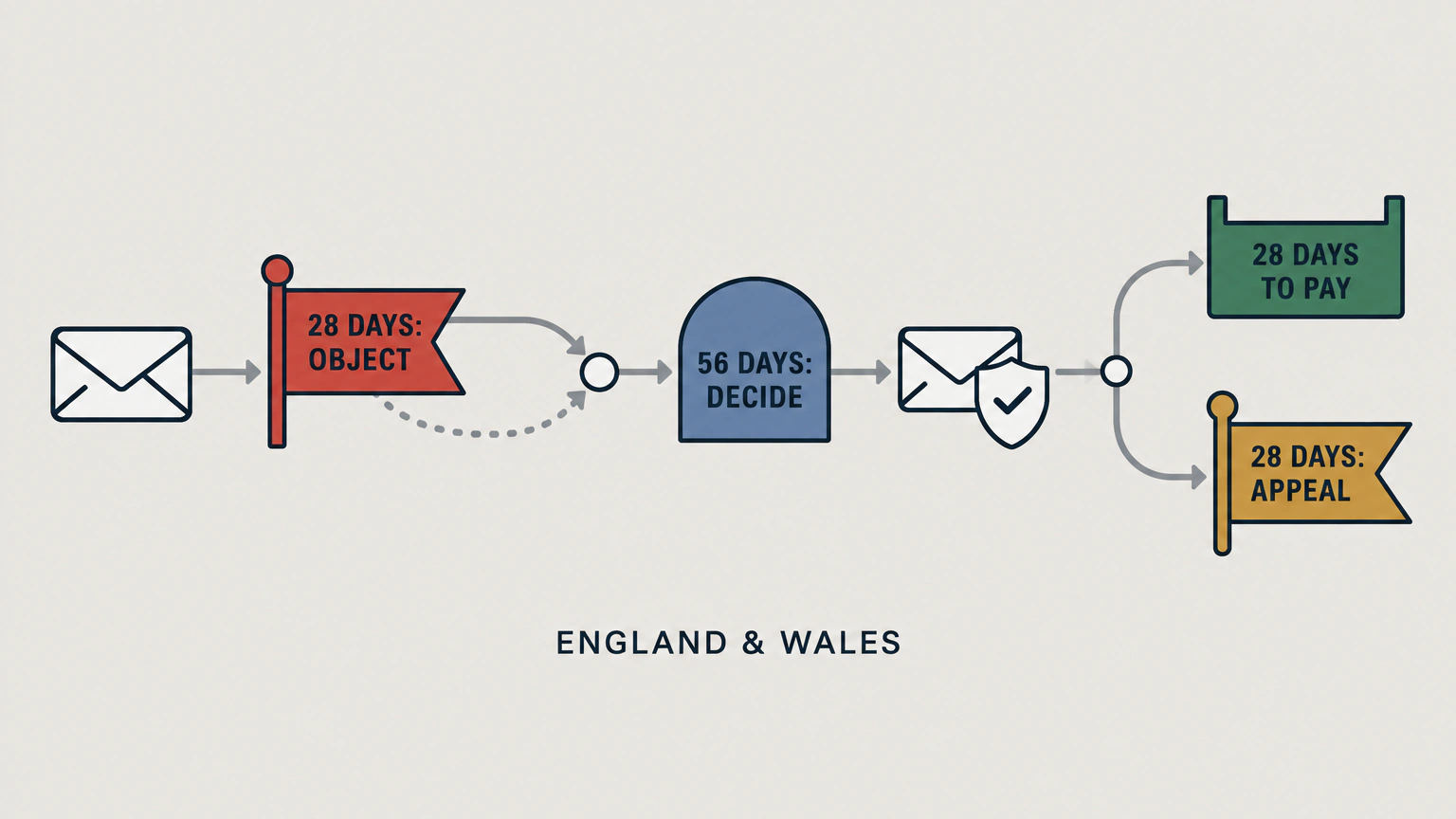
The part nobody tells you is that a penalty doesn't arrive as a fine. It arrives as a notice of intent, and a clock starts.
Pro tip: a notice of intent is not a fine, and you have 28 days. If a notice of intent lands on your mat, you have 28 days beginning with the day after it was given to object in writing, and Schedule 1A names exactly four grounds you can use. That no smoke came from the chimney on the occasion in the notice. That the chimney was not one a smoke control order applied to that day. That you were not the person liable for it. Or that there are other compelling reasons why the penalty should not be imposed. Send your evidence with the objection. The council then has 56 days to decide, and if it lets that run out it cannot impose the penalty at all.
If the council does decide to impose it, a final notice follows. It has to state the amount, the reasons and how to pay. The payment period is 28 days beginning with the day after the notice was given. The appeal period runs for the same 28 days from that final notice, on three grounds: an error of fact, a decision wrong in law, or an unreasonable decision. File the appeal and the notice is suspended until the tribunal has finished with it. The tribunal can quash or confirm the notice, cut the amount, or send the decision back to the council.
Scotland and Northern Ireland: still a criminal offence
North of the border and across the Irish Sea, the older structure survives. In Scotland, section 20 of the Clean Air Act still makes it a summary offence for the occupier if smoke comes from a building's chimney in a smoke control area. The fine goes up to level 3 on the standard scale, currently £1,000. Northern Ireland runs the same shape under article 17 of its own 1981 Order, and article 38 sets the same £1,000 ceiling.
Both keep something England and Wales gave up. It's a defence to prove the smoke wasn't caused by any fuel other than an authorised fuel. So keep the bags and the receipts, because they can support that defence. What you lose is the objection window and the tribunal on the other side of it. The paperwork here is a prosecution, not a penalty notice.
What changed in Wales on 31 July 2025
On 31 July 2025, Wales stopped sharing England's law on this and started running its own. Sections 20 to 23 of the Clean Air Act 1993 were repealed for Wales that day, and the Environment (Air Quality and Soundscapes) (Wales) Act 2024 put a Welsh regime in their place.
Three things changed. The civil penalty in Schedule 1A now reaches Wales, so a smoking chimney in a Welsh smoke control area brings a council penalty of £175 to £300 rather than a prosecution. A separate criminal offence covers buying or selling unauthorised fuel for use in a Welsh smoke control area, with a fine up to level 3. And the lists changed hands: an authorised fuel in Wales is now one on a list published by the Welsh Ministers, and the same goes for exempt fireplaces.
For a household in Swansea or Wrexham, the practical effect is smaller than the paperwork suggests. The check is still the map, then the council. The stove is still what makes wood legal. What's genuinely different is what arrives if something goes wrong, and the 28-day objection window that now comes with it.
One caution, and we'd rather say it plainly. This regime is barely a year old and Welsh councils are still working to guidance published in July 2025, so if a decision of yours turns on it, ring the council and ask them directly.
Before you light it this autumn
None of this takes an afternoon. It's an evening with a torch and a phone, and it's the difference between a season you never think about and a letter you weren't expecting.
One thing worth doing whatever your address turns out to be is arranging a regular sweep. Defra's practical guide says soot build-up cuts efficiency and raises chimney-fire risk, and recommends using a qualified sweep. You can find chimney sweeps near you the same way you'd find any other trade. If the sweep finds a problem with the stack, pot or flashing, call roofers who work on chimney stacks rather than the sweep. While the diary's open, the boiler is usually on the same autumn list, and what a yearly service is supposed to cover is worth a read first.
- Find out whether your address sits in a smoke control area, by the route for your nation above. Start with Defra's map and your council in England, DataMapWales in Wales, the Spatial Hub in Scotland, or the district council table in Northern Ireland.
- Find the make and model on the manufacturer's plate or manual. Search both on your nation's exempt-appliance list, then read the permitted fuels.
- Check that bagged logs carry a certification logo and a certificate number, and that any bulk load turned up with its warning notice.
- Book a sweep before the season starts, and keep any record the sweep gives you with the property paperwork.
- If a stove is going in this autumn, agree in writing which certificate you get and the date you should have it by.
- Keep the appliance paperwork, any sweep record and the installation certificate together, because each one answers a different question later.
Frequently asked questions
Can I still use my log burner if I live in a smoke control area?
Yes, if it's an exempt appliance. The exemption sits with the stove, not with the wood, so a listed stove can legally burn logs in a smoke control area while an open fire in the same room can't. Check your make and model on the exempt appliance list for your nation, and use only the fuels the manufacturer permits. If it isn't listed, you're limited to authorised fuels.
How do I know if my stove is Defra approved?
Use the manufacturer's plate or manual to find the make and model. Then search those exact words on Defra's exempt appliance list for your nation. Defra publishes four lists, one per nation, so use yours rather than the first that loads. The listing also names the fuels the exemption covers, which is the half people skip.
Are log burners being banned in the UK?
There is no UK-wide ban in these rules. They restrict what may be burned in a smoke control area and what a shop may sell you in England. They don't ban stove ownership or require every existing stove to be scrapped. Outside a smoke control area, those restrictions end. Other laws remain.
How do I find out if I am in a smoke control area?
It depends on your nation. In England, start with Defra's Smoke Control Area Interactive Map, then confirm the result with your council because the map is indicative. In Wales, use the Wales Smoke Control Areas Map on DataMapWales. In Scotland, use the Spatial Hub map. In Northern Ireland, check the district council table on Northern Ireland Air. In every case, the council's own order is what binds.
Is it illegal to burn wet wood?
The 2020 moisture rule binds the seller, not the person lighting the stove. It applies in England only. Wood sold in units under two cubic metres has to be certified at 20% moisture or less. Bulk loads of two cubic metres or more can still be wet, and arrive with a drying notice instead. Burning damp wood can still breach separate smoke or appliance rules.
Do I need building regulations approval to install a log burner?
In England, installing a solid fuel appliance must comply with the Building Regulations. You don't have to obtain approval yourself if the installer is registered with a competent-person scheme. Approved Document J covers the air supply, discharge of combustion products, hearth, flue and chimney. The other nations have their own rules. Fitting one is a different job from using one, so how to check whether the person fitting it is registered picks up that side.