

On this page
- The short answer, and the two questions that tell you who to call
- What changed on 1 October 2011, and what it did not touch
- Who owns which pipe, in one table
- The four nations do not work the same way
- How to find out whose pipe it is before you pay anyone
- What it costs when the pipe really is yours
- If you are told it is your pipe and you do not believe it
- Frequently asked questions
The short answer, and the two questions that tell you who to call
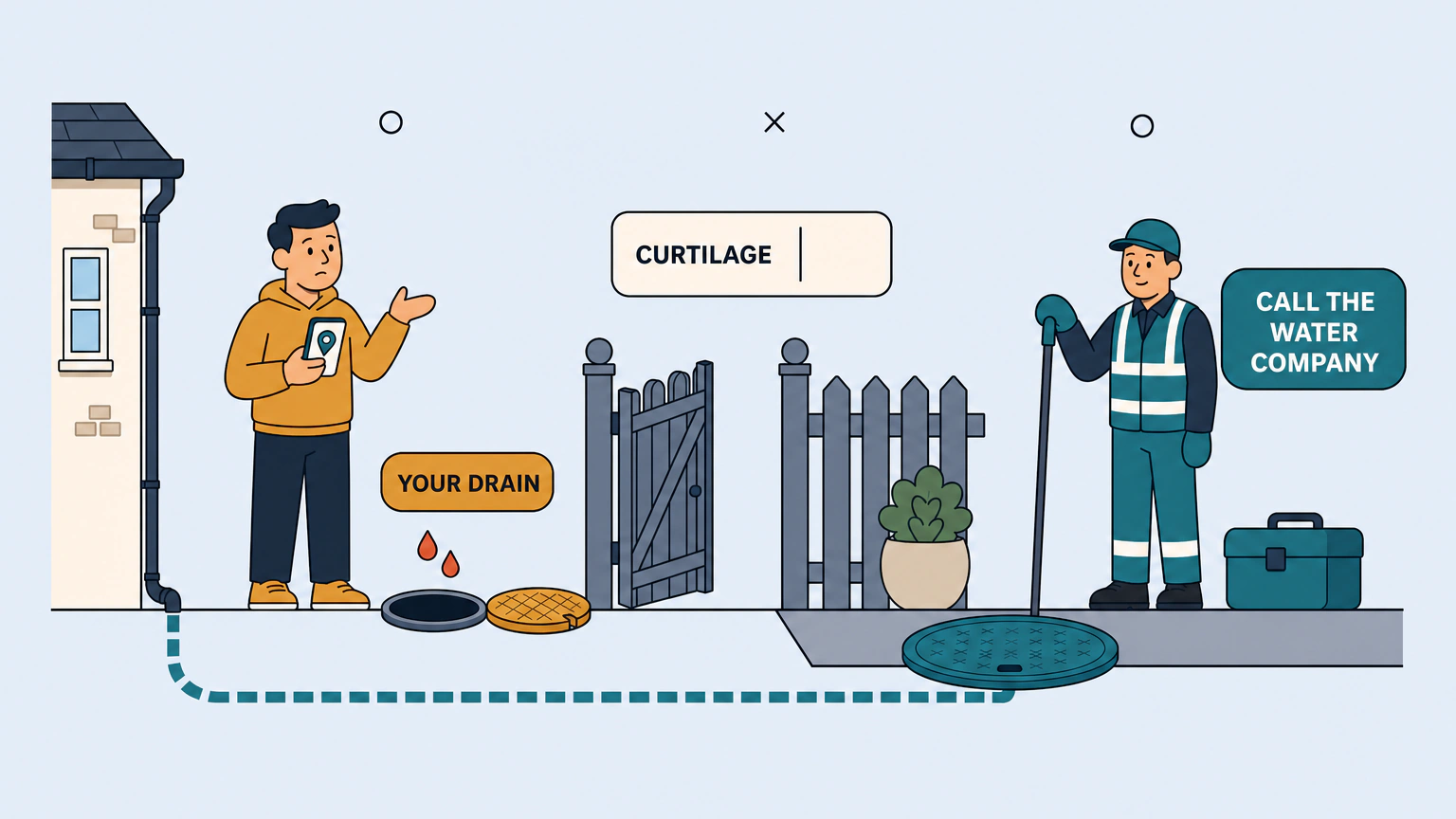
There's a chamber in the garden standing full of something you would rather not look at, and you want to know whether this is about to cost you money. Here is the part most people get wrong about who is responsible for blocked drains. If the blocked pipe runs beyond your property's curtilage, or carries waste from more than one home, call your sewerage provider first. In England and Wales, most older pipes in those categories transferred to the company in 2011. Newer and unadopted pipes can still be private, and the other nations use their own rules. A drain inside your boundary serving only your home is usually yours to pay for.
One thing first. If wastewater is coming up inside the house, report it now and settle ownership afterwards. Sewage indoors is a health hazard, and a flooded room needs sewage clean-up specialists as well as somebody to clear the blockage.
Does the pipe serve anyone else's home as well as yours
Start here, because it tells you who to call. If waste from a neighbouring property joins your pipe before the blockage, report that shared length to your sewerage provider first. In England and Wales, most shared sewers that existed before July 2011 transferred, but newer and unadopted pipes can still be private. Thames Water puts it plainly for its network: "If your drain joins up with your neighbours, we own the joint part." The same page confirms it owns shared sewers "even if they are under your garden or driveway".
Does the pipe run beyond your curtilage, and what curtilage actually means
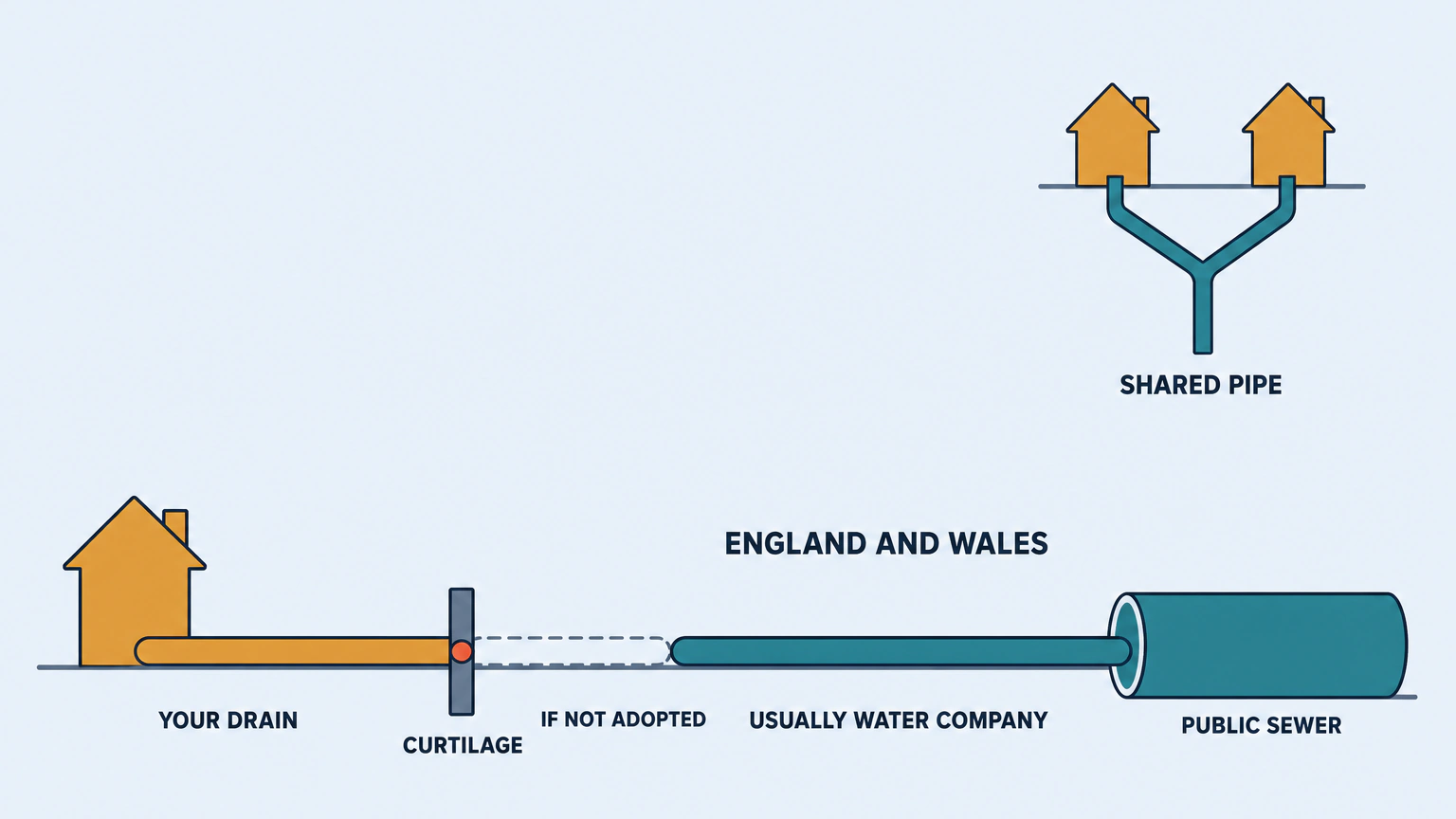
The second question is where your pipe stops being yours. The law doesn't say "boundary". It says curtilage. Under section 219(1) of the Water Industry Act 1991, a lateral drain is the part of a drain running "from the curtilage of a building (or buildings or yards within the same curtilage) to the sewer with which the drain communicates". Once a lateral drain belongs to or vests in the undertaker, section 94(1)(a) puts the duty to cleanse and maintain it on that company.
Scottish Water calls curtilage "usually the land surrounding a building that belongs to the owner". Usually, not always, which is how the fence line and the legal line come apart. One curtilage can also hold several homes, a block of flats being the obvious case, and shared pipework inside it stays private.
What changed on 1 October 2011, and what it did not touch
Most of the wrong advice you'll hear about this was accurate once. It stopped being accurate in October 2011.
The pipes that transferred
Before then, huge numbers of homeowners owned pipe they had never seen: the run from their curtilage out to the sewer, and the shared sewers taking waste from a whole terrace. Schemes under the Water Industry (Schemes for Adoption of Private Sewers) Regulations 2011 changed that in one step. Subject to the scheme's exclusions, a private sewer in the undertaker's area or a private lateral drain communicating with its public sewer immediately before 1 July 2011 was due to vest on 1 October 2011. Pumping stations were due to vest no later than 1 October 2016, unless an outstanding appeal prevented the declaration from naming that date. Nobody had to apply, and the state of the pipe made no difference.
The pipes the 2011 scheme left out
Four categories sat outside that automatic transfer. Pipes not connected to a public sewer immediately before 1 July 2011 never moved, which covers everything running to a septic tank, a cesspit or a treatment plant. Pipework laid after the transfer generally stays with the homeowner or the developer, and Northumbrian Water says exactly that about properties built after 2011. Pipes already the subject of a vesting declaration before 1 July 2011 sat outside the scheme. And regulation 5 carved out two narrow classes: sewers owned by a railway undertaker, and pipes on Crown land where the company had written notice before 1 July 2011 that they should be exempt.
Why the 2011 regulations no longer exist, and why that does not give your pipe back
None of the pages we read on this question mentions that those regulations are gone. Regulation 1(2) said so from the day they were made: "They cease to have effect at the end of 30th June 2018." Look the instrument up today and legislation.gov.uk prints "(revoked)" in the title.
It does not hand your pipe back. The vesting happened in 2011 and stands. What expired was the machinery for new declarations under that scheme. A connected 2009 pipe that met the scheme criteria transferred; an identical pipe laid in 2014 did not transfer under the 2011 scheme and may remain private unless it was separately adopted. And there is no "Private Sewers Act 2011". A title search of UK Public General Acts returns nothing of the sort.
Who owns which pipe, in one table
That's the principle. Here's how it lands on the pipes around an ordinary house.
| The pipe | Where it runs | Who owns and maintains it | Who to contact first |
|---|---|---|---|
| Your drain | Inside your boundary, serving only your home | You, or your landlord | A drainage or plumbing contractor |
| Lateral drain | From your curtilage to the public sewer, usually under the pavement or road | Your water company if the drain transferred in 2011 or was later adopted | Your water company first |
| Shared drain or private sewer that transferred | Often under gardens and driveways, taking waste from two or more homes | Your water company in England and Wales, since 1 October 2011 | Your water company |
| Public sewer | Under roads and footpaths | Your water company | Your water company |
| Road gully or highway drain | The grated opening at the road edge | The relevant highway or roads authority | The local roads authority; DfI Roads in Northern Ireland |
| Shared pipework inside one curtilage, such as a block of flats | Within a single boundary serving several dwellings | The owners jointly | Your freeholder or managing agent |
| Septic tank, cesspit or treatment plant, and any pipe not connected to a public sewer | Anywhere on your land | You | A specialist contractor |
The pipes that are yours
Everything inside the house, obviously. Outside, you are usually responsible for gutters, downpipes, gullies and soil stacks, plus any manhole cover or underground pipe inside your boundary that serves only your home. Septic tanks and private treatment plants are yours too. A blockage in that lot is a job for a local plumber or a drainage firm rather than your water company.
The pipes your water company owns
Public sewers under roads and footpaths. Lateral drains that belong to or have vested in the undertaker. And most shared sewers, where several homes' drains join before reaching the public sewer, including the stretches under private gardens and driveways.
Section 94(1)(a) is the obligation underneath all of it. The undertaker must cleanse and maintain its sewers "and any lateral drains which belong to or vest in the undertaker" so that its area "is and continues to be effectually drained". That is a duty owed to every household it serves, not a favour.
The two cases the simple rule gets wrong, road gullies and flats
Two exceptions catch people out, and they run in opposite directions.
Road gullies, the grated openings at the kerb that drain the highway, belong to the relevant highway or roads authority. On local roads in England and Wales that usually means the council. In Scotland local authorities drain local roads, while motorways and major trunk roads sit with Transport Scotland. Northern Ireland uses DfI Roads.
The second reverses the usual rule. Where shared pipework sits inside a single curtilage, a block of flats being the classic case, it stays private and the owners share the cost, usually through the freeholder or managing agent. Northumbrian Water names Tyneside flats specifically.
The four nations do not work the same way
Sewerage law isn't UK-wide, and the differences aren't cosmetic.
| Nation | Who owns the pipe once it leaves your curtilage or joins another home's | Published basis | Who to contact first |
|---|---|---|---|
| England | The sewerage undertaker, for lateral drains and shared sewers that transferred or were later adopted | Water Industry Act 1991 ss.94, 219(1); S.I. 2011/1566 regs 3(5) to 3(8) | Your water company |
| Wales | The sewerage undertaker, on the same terms, under schemes made by the Welsh Ministers | Water Industry Act 1991 ss.94, 219(1); S.I. 2011/1566 regs 3(2), 3(8) | Your water company |
| Scotland | Scottish Water, from the curtilage, or from the point the pipe joins drains from a separate curtilage | Scottish Water, "A guide to drains and sewers", December 2023 | Scottish Water, 0800 0778778 |
| Northern Ireland | NI Water, where the problem is outside your boundary or more than one property is affected | NI Water, "Blockages", ownership test and service standards | NI Water, 03457 440088 |
England and Wales
Same Act, same transfer, two sets of ministers. The Secretary of State made the adoption schemes for undertakers whose area is wholly or mainly in England, and the Welsh Ministers made them for Wales. For a householder the position is identical on both sides of the border.
Scotland
Scotland did not use the 2011 England-and-Wales transfer. Scottish Water's guide says that from the point the drain leaves the curtilage of your property, "or joins up with drains coming from within a separate curtilage of another property, it becomes a public sewer". That second trigger is the one English pages leave out.
Scottish Water also holds the public drainage duty for rainwater run-off from roofs and paved surfaces inside your boundary, while pipework and guttering within it stays with you. Its helpline is free and staffed around the clock on 0800 0778778. Scotland gets more than 36,000 blocked drains and sewers a year, around 80% of which Scottish Water attributes to things that should never have gone into a toilet or a sink.
Northern Ireland
NI Water publishes the clearest ownership test we found anywhere.
It may be yours if only one property is affected, nothing else drains into your pipes, and there is no other flooding locally. It may be NI Water's if the problem is outside your boundary, more than one property is affected, or there is widespread sewer flooding nearby.
Then the promises. If your home floods with wastewater from one of its sewers, NI Water says it will be there within four hours of your call. A blocked public sewer gets cleared within eight hours if you ring before 2pm, and before midday the next day if you ring after. Afterwards it cleans and disinfects. The line is 03457 440088, 24 hours a day. Road drainage works differently in Northern Ireland: report a blocked road gully to DfI Roads.
How to find out whose pipe it is before you pay anyone
Three moves, in this order.
The sewer map you are entitled to inspect free
The map shows your company's assets and not your private drains, so an absence tells you something too. Citizens Advice puts it in one line: your sewerage company must make sewer maps available if you ask.
Pro tip: the map you can see for free. Your sewerage company has to keep records of where every public sewer and vested lateral drain runs. Under section 199(4) it has to let the public inspect those records at its office free of charge, in map form. A copy posted out to you is a different matter, and companies may charge an administration fee for that.
The signs that point to a shared or public pipe
You can usually tell before anybody lifts a cover. Thames Water's own test runs the other way, and it's worth knowing: if upstairs is affected while downstairs drains normally, the blockage is probably inside the house.
Red flag: four signs it is probably not your pipe. Neighbours are hit at the same time as you. A manhole in the pavement or road is standing full. A chamber on your land takes flow from more than one direction. Sewage is surfacing in a garden or a street rather than only inside your home. On any one of them, report it to your water company before you instruct anyone.
What to say when you ring, and what to write down
Have this ready before you call. The last item earns its place: CCW advises keeping a record of the contact, in case the company calls the blockage private and you find out later that it was not.
- Your address and postcode, and whether the problem is inside or outside the house
- Whether any neighbours have the same problem right now, and how many
- Where the blockage appears to be: an inside gully, a chamber in your garden, a chamber in the pavement, or the road
- Whether any chamber is surcharging, that is, standing full or overflowing
- Whether more than one pipe appears to feed the chamber that is backed up
- That you are asking them to confirm whether the pipe is a public sewer, a lateral drain or a private drain
- The date and time of the call, the name of the person you spoke to and the reference number
What it costs when the pipe really is yours
Sometimes it genuinely is yours, and then the only question left is what a fair price looks like.
What our own cost profiles show, and what a fair quote looks like
Our drain cleaning contractors listings currently show a £282 national average, with a £113 minimum and £717 maximum. The same panel says its average range is based on 927 cost profiles. Those are our platform's own figures, not a market survey.
A straightforward jetting visit sits at the lower end. A CCTV survey earns its money when blockages keep coming back, when you suspect the pipe has collapsed, or when you need evidence for an insurer or an ownership argument. Sold on a first visit for a one-off blockage, it's usually early. Get more than one quote, and check the firm before you let it start. If a leaking drain has marked your walls, settle whether you really need damp proofing first.
If you are told it is your pipe and you do not believe it
A verdict given on the phone is not a verdict.
Ask which pipe, get it in writing, then escalate
Ask three questions and write down the answers: which pipe exactly, where the blockage sits, and whether the company treats it as a public sewer, a lateral drain or a private drain. Get that in an email. A named classification can be checked against the sewer map. "It's private" cannot.
Then one rule before you ring anyone else. Northumbrian Water says that if you hire a private contractor before you contact the company, it won't reimburse you even where the fault turns out to be on its own asset, because it never got the chance to investigate. Ring first, be wrongly told the pipe is private, and it says it will reimburse reasonable contractor costs.
If the company won't move, use its complaints process, then the Consumer Council for Water, the independent consumer body for water customers in England and Wales. Damage to a drain you do own is where buildings insurance comes in. And if you have already paid for work on a pipe that was never yours, getting money back from a trader is a separate fight.
We're describing how the ownership rules work, not giving legal advice about your pipe. In a real dispute the answer turns on facts only your sewerage company's records can settle.
Frequently asked questions
These are the questions people actually type when it's happening to them.
Is a shared drain a public sewer?
In England and Wales, usually yes. A qualifying shared pipe that connected to the public sewer before July 2011 transferred to the water company on 1 October 2011, even where it runs under a garden. Newer or unadopted pipes can still be private. Shared pipework inside a single curtilage, such as a block of flats, is another exception.
What is a lateral drain?
It is the length of drain running from the curtilage of your building to the public sewer it connects to. That is the definition in section 219(1) of the Water Industry Act 1991. It usually sits under the pavement or road. In England and Wales, the water company has to cleanse and maintain it once it belongs to or vests in the company.
How do I know if my drain is public or private?
Answer two questions. Does the pipe carry waste from any home but yours before the blockage? Does it run past your curtilage? A yes to either points at your water company. If you can't tell, ring the company and ask it to classify the pipe and show you its sewer map.
Will my water company charge me for clearing a blockage?
We couldn't find a water company page that publishes a flat charging position, so treat any promise of a free visit with care. What the companies do say is consistent: report a problem on their own pipework and they'll come out, and they won't work on a private drain. Thames Water says its engineer will discuss it with you if the blockage turns out to be yours.
Who is responsible for a blocked drain, the landlord or the tenant?
A landlord is normally responsible for the property's private drains. A tenant may have to pay when their misuse caused the blockage. The pipe-ownership rules still apply to a rented home, so a water-company blockage does not become the landlord's bill.
Does buildings insurance cover blocked drains?
It depends on your policy, which is worth reading before you need it. Citizens Advice points out that you can insure work on private drains, and that some properties have to carry that cover. Insurance for a drain you don't own is beside the point. Look for underground services on your schedule.
Who do I call about a blocked drain in the road?
Call the roads authority for that road. In England and Wales, a local-road gully usually goes to the council. Scotland splits local roads from the trunk roads handled by Transport Scotland, while Northern Ireland uses DfI Roads. A surcharging manhole may be part of the sewer network instead, so report that to your sewerage provider first.
Are the rules different in Scotland and Northern Ireland?
Yes. The 2011 transfer covered England and Wales, not Scotland. Scottish Water's guide says a drain generally becomes public when it leaves the curtilage or joins drainage from a separate curtilage. Northern Ireland uses NI Water's own published ownership test and service standards.