

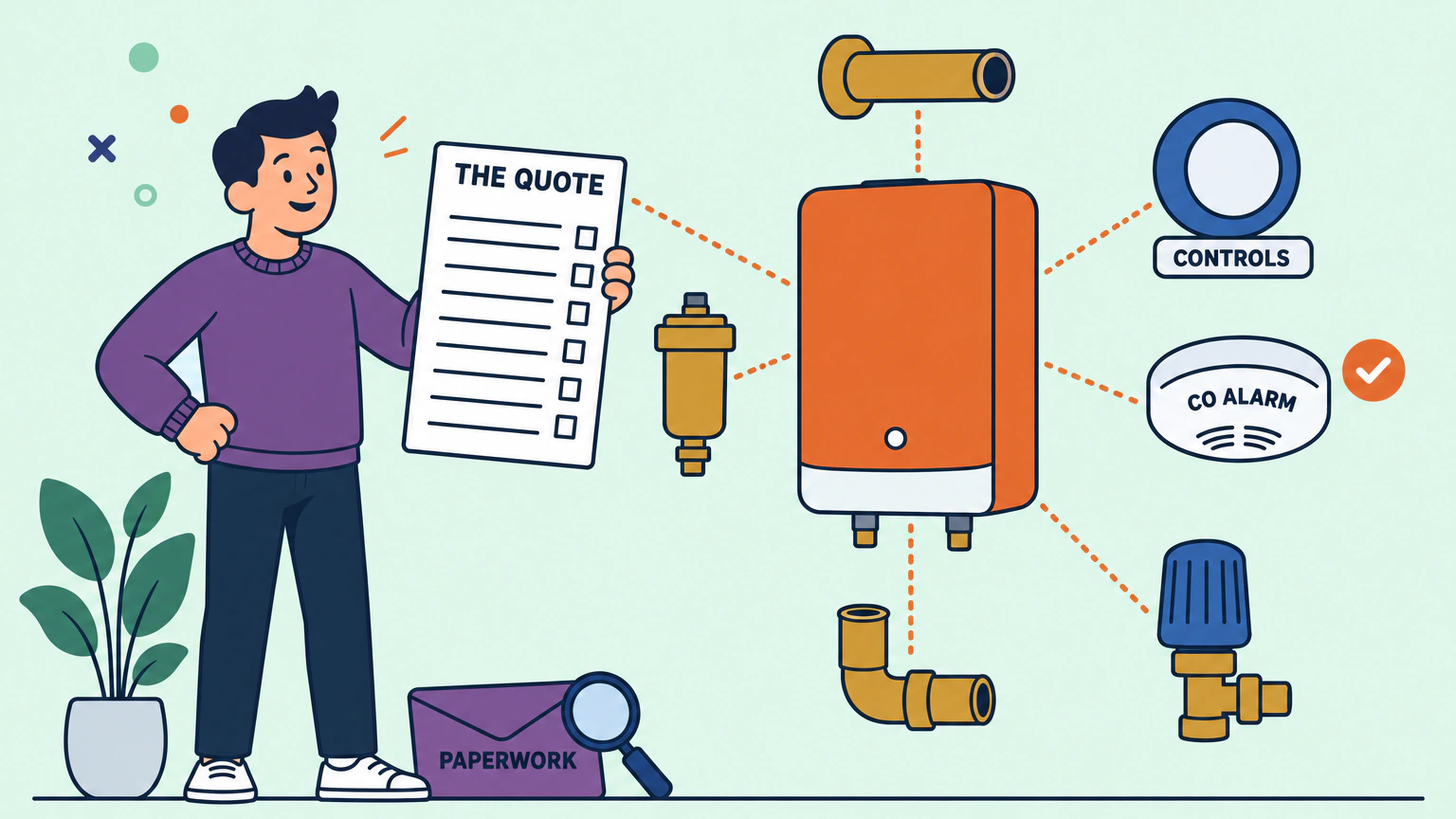
A like-for-like combi swap costs about £1,200 to £3,500 fitted, going by two price guides that disagree mostly at the cheap end, while swapping a tank-fed or back boiler system for a combi runs £2,500 to £6,000. Whatever you pay, the price should include the controls and carbon monoxide alarm your nation's rules require. And in England and Wales, a Building Regulations Compliance Certificate should reach you within weeks of the job.
So the cheapest quote isn't automatically the best deal. Sometimes it's just the one missing what the law asks for.
On this page
What a new boiler costs for the job you actually need
"A new boiler" is really one of five jobs, and the job sets the price far more than the boiler does. A like-for-like boiler replacement, with the new boiler going where the old one hung, is the cheap end. Every change of type, tank or position adds labour and pipework, which is how a straight combi swap at about £1,200 to £3,500 turns into a conversion or back boiler removal at £2,500 to £6,000.
If you want one number to hold a quote against, Heatable's is the most useful we found. Its median quote for a standard combi swap was £2,300.
To find your row, open the airing cupboard. A hot water cylinder in there means a system or regular boiler, and tanks in the loft as well mean regular. No cylinder and no tanks, and it's almost certainly a combi.
| The job | Heatable guide price, fitted | MyJobQuote guide price, fitted | Time on site (MyJobQuote) |
|---|---|---|---|
| New combi in place of an old combi, same spot | £1,800 to £3,500 | £1,200 to £3,500 | 4 to 6 hours |
| New system boiler, cylinder kept | £1,800 to £3,500 | £1,250 to £4,000 | 4 to 6 hours |
| New regular boiler, loft tanks kept | £1,800 to £3,000 | £2,500 to £4,500 | 4 to 6 hours |
| Regular boiler and loft tanks swapped for a combi | £3,000 to £5,700 | £2,500 to £4,500 | 1.5 to 2 days |
| Back boiler behind a fire swapped for a combi | £3,500 to £6,000 | £3,200 to £5,800 | 2 to 3 days |
Both are guide prices for the whole job, boiler and fitting together. Heatable's come from its own online quotes (its median for a standard combi swap was £2,300 across 2,000 quotes in early 2026) and MyJobQuote's from quotes on its platform. Heatable's conversion row covers system boilers as well as regular ones.
Read along any row and the two guides never quite agree. That's worth understanding before you ring anyone.
Why the price guides disagree on the same job
The two guides are built differently. Heatable's figures come from its own online quotes, MyJobQuote's come from quotes posted on its platform, and neither is a survey of what people finally paid.
The widest gap is the like-for-like regular boiler, where MyJobQuote's cheapest figure (£2,500) sits above the middle of Heatable's whole £1,800 to £3,000 range. We won't average that away. It shows how rough any published price is.
The Energy Saving Trust gives a neutral check: £3,500 in Great Britain for replacing an old G-rated gas boiler with an A-rated one, thermostatic radiator valves included. That's the top end of the straight-swap ranges. Which? adds that engineers in London and the South East will probably cost more, and that rural homes can pay more too.
Use the guide prices to spot an outlier, not to price your own job.
The extras that can fairly push the price up
Plenty of engineers quote one sum for the whole job. Which? accepts that, but says they "should still be able to explain the costs to you in a more detailed breakdown". Ask for it.
A handful of extras can legitimately make one quote dearer than another, and none of them is a scandal on its own. Each one should come with a reason. Re-piping is where double-charging hides: Which? prices it at £400 to £800 on its own, but Heatable's and MyJobQuote's conversion prices already include it.
| Extra | When it comes up | Which? price guide |
|---|---|---|
| A bigger gas pipe to the meter | A larger boiler than your gas supply can feed | £100 to £400 |
| Re-piping for a combi conversion | Swapping a heat-only or system boiler for a combi | £400 to £800 extra |
| Vented hot water cylinder | Swapping a combi for a boiler with a tank | £350 to £750 |
| Unvented hot water cylinder | The same swap, with an unvented tank | £900 to £1,400 |
| Smart thermostat | Better control, and it can meet the combi rule | £100 to £250 |
| Smart radiator valve | Room-by-room control on a smart system | £35 to £80 each |
| Standard thermostatic radiator valve | Rooms without a room thermostat | About £15 each |
| Power flush | A heavily sludged system | £300 to £750 for five radiators |
Which?'s guide prices for each extra on its own. The conversion prices in the table above already include the re-piping, so a quote shouldn't charge for it twice.
One cleaning line belongs on every quote. In England and Wales, the building regulations guidance says the heating circuits should be "thoroughly cleaned and flushed out" before a new boiler goes on. A full power flush is only one way to do that, so check whether your system needs a power flush before paying for one.
Does your new boiler really need a bigger gas pipe?
Sometimes. Which? says you might need a bigger supply line to the gas meter if you're fitting a larger boiler, for example after an extension or an extra bathroom. It puts that at £100 to £400. Moving the boiler means new piping too.
But a gas pipe upgrade should be a measured decision, not a standard line. Ask the engineer what reading or sizing check told them your existing pipe can't feed the new boiler, and expect that answer on the quote itself.
If the upgrade only appeared on the day, read up on when a final bill can go past the quote before you pay the difference.
Swapping tanks for a combi: check your water first
A combi heats water as you draw it, so it can only be as good as the water coming in. The Energy Saving Trust says combis may be less suitable for homes with several bathrooms or low water pressure. Which? prices the extra labour and re-piping for a conversion at £400 to £800.
Pressure and flow aren't the same thing, and it's flow that matters. Before recommending a combi, the engineer should turn on a tap and measure the flow in litres a minute, so ask what they measured. Then there's winter. On a cold morning the mains comes in colder, and the same combi gives you cooler water or a slower tap.
It's also fair to ask why a combi is being recommended at all. Sometimes it's simply the easiest boiler to fit.
If your cylinder and valves already sit in the airing cupboard, a like-for-like regular or system boiler is a real option, and usually the cheaper job. If you'd like the flow measured independently, a plumber can do it before you agree to a conversion.
What the rules say your new boiler must come with
Some lines on a boiler quote aren't extras at all. They're the law, and the law depends on which of the four nations you live in.
England brought in its Boiler Plus standards in 2018 (that's the government's own name for them). They set a 92% efficiency floor for a new gas boiler, and a rule that a combi must come with one of four efficiency extras. England's and Wales's current Approved Documents, the official guidance on meeting the building regulations, both carry the two rules.
The detail differs by nation on three things: the efficiency extra, room-by-room temperature control and the carbon monoxide alarm. The paperwork at the end differs too. New 2026 editions for England and Wales keep these rules for existing homes. They take effect on 24 March 2027 in England and 4 March 2027 in Wales.
These are the rules for gas boilers in homes. If your installer or your council's building control tells you something different about your home, ask them to put it in writing.
| Nation | Extra efficiency measure | Room-by-room controls | Carbon monoxide alarm | Paperwork at the end |
|---|---|---|---|---|
| England | Combi only: at least one of four | Yes, when the boiler is replaced | Yes, in the boiler's room | Building Regulations Compliance Certificate |
| Wales | Combi only: at least one of four | Yes, when the boiler is replaced | Yes, with any new flued appliance | Building Regulations Compliance Certificate |
| Scotland | Any boiler: at least one of four | Yes, such as TRVs in all rooms | Yes, and in any bedroom or living room a flue runs through | No warrant needed; keep the commissioning checklist |
| Northern Ireland | Not in Northern Ireland's current guidance | Ask your council's building control | Yes, in the room or just outside a boiler cupboard | Ask your council before work starts. If it requires a Building Notice, a completion certificate follows. |
The four measures are flue gas heat recovery, weather compensation, load compensation, or a smart thermostat with automation and optimisation. England, Wales and Scotland also set a 92% efficiency floor for a new gas boiler, with a lower figure allowed only in exceptional cases.
The four extras that satisfy the combi rule
In England and Wales, a gas combi fitted in an existing home needs at least one of four measures "appropriate to the system". Two of them work on the flow temperature, meaning how hot the water is when it leaves the boiler.
- Flue gas heat recovery pre-heats your hot water using heat from the boiler's exhaust.
- Weather compensation uses an outdoor sensor, so the boiler runs cooler on mild days.
- Load compensation turns the flow temperature down as the house warms up.
- A smart thermostat with automation and optimisation learns your routine and starts the heating at the right time. Wales asks for one "with remote access".
That last option needs care. Plenty of smart thermostats just switch the boiler fully on and off rather than telling it how hard to run, so ask which item on your quote meets the rule, and how.
A condensing boiler works best when the water coming back from the radiators is cool, which is what the compensation controls help with. Whatever gets fitted, ask the installer to set the flow temperature for efficiency when they commission the boiler (set it up and test it). New boilers are often left turned up to maximum, and you pay for that every winter.
Why Scotland asks more of every boiler swap
In Scotland you don't need a building warrant, the council's formal approval, for an ordinary domestic gas boiler, but the work still has to meet the building standards. And Scotland's compliance guide asks more of a replacement. On any boiler swap it wants a boiler interlock (controls that switch the boiler and pump off when nothing needs heat), TRVs in all rooms, separate time and temperature control, and at least one of the same four efficiency extras. England and Wales ask for that last item on combis only.
So picture the same job in two cities: a system boiler replaced, cylinder kept. In Manchester, no weather compensation or equivalent is required. In Glasgow, the guide applies the rule to "replacement of the boiler" of any type, so one of the four must be on the quote.
The warrant exemption has edges. It doesn't cover a gas appliance with a net input above 70 kW, or work on a chimney, flue pipe or hearth, though a balanced flue serving a room-sealed boiler is exempt in its own right.
Radiator valves and a carbon monoxide alarm
In England and Wales, replacing a boiler means each room should get its own temperature control. Usually that's a room thermostat in one room and thermostatic radiator valves (TRVs, which turn a radiator down as its room warms) everywhere else. England's guidance adds that a TRV shouldn't go in the room with the thermostat. Which? puts a normal TRV at about £15. A quote that skips them to look cheaper saves you very little and leaves the job short of the rules.
A carbon monoxide alarm is required in all four nations when a boiler is fitted. It goes in the room with the boiler, or just outside a boiler cupboard in Northern Ireland. Scotland also wants one in any bedroom or living room that a flue passes through. England asks for an alarm with a battery built to last its working life, or a mains alarm wired in. A plug-in alarm doesn't count.
The paperwork that proves it was fitted legally
The paperwork tends to matter on a day you won't see coming. You're selling or remortgaging, and someone asks for a certificate nobody ever mentioned. It's part of what you paid for. The Energy Saving Trust says your installer will make sure you get all the documentation to prove the job meets the building regulations, and that you'll need it when you sell.
In England and Wales, expect three documents: the Building Regulations Compliance Certificate, the Benchmark commissioning checklist and the manufacturer's warranty registration. Scotland and Northern Ireland work differently. Here's what should arrive, and what to do when it doesn't.
England and Wales: the certificate in the post
The building regulations give the installer 30 days after finishing to hand you a certificate and tell building control. A Gas Safe registered engineer does this by notifying Gas Safe Register. Gas Safe says it then informs your council, and your Building Regulations Compliance Certificate arrives in the post in 10 to 15 working days.
Put those together. Thirty days, plus 15 working days (three weeks, without bank holidays), comes to 51 days. So about seven weeks from the last day of the job is the point to start chasing. There's no legal deadline on the posting step itself, so treat seven weeks as a nudge rather than a breach.
Chasing is partly your job. Gas Safe says that, as the homeowner, it's up to you to follow the rules "by making sure your engineer notifies the installation". If nothing arrives, ask the installer first. If that goes nowhere, Gas Safe points you to itself, your council's building control department or Citizens Advice Consumer Services. Lost the certificate later? You can order a replacement copy from Gas Safe Register.
Keep it with the house deeds. Gas Safe's point is that the certificate belongs to the property, not to you.
Scotland and Northern Ireland do it differently
In Scotland there's no warrant and no Gas Safe certificate in the post. Keep the commissioning checklist and the installer's invoice as your record that the job met the standards.
Northern Ireland runs its own route. Building Control NI's homeowner guidance says "It is important that a Building Notice is submitted before any work is started". That's a form lodged with your council, with your installer named as your agent. Afterwards the commissioning record goes to the council's surveyor: the Benchmark checklist for gas, or the CD/11 report for oil. Getting the boiler inspected is your job. If the work complies, you'll get a completion certificate.
Councils don't all read it the same way. Ards and North Down says an application generally isn't required if the boiler alone is changed like for like, in the same position, using the existing flue. So ask your own council before the installer starts. On oil, the Energy Saving Trust puts a typical Northern Ireland replacement at £3,200.
The commissioning checklist and your warranty
The Benchmark commissioning checklist is the installer's record that the boiler was set up properly. The guidance in England and Wales names it as a way to show commissioning was done, and Gas Safe says you should receive it from your engineer. If it hasn't appeared, ask for it before the final payment.
The warranty is where assumptions get expensive. Gas Safe's guidance says the registration "needs to be completed and returned by the appliance owner". Plenty of installers do it for you, and Heatable lists warranty registration in its standard quote. So ask who's doing it, and keep the confirmation. Long warranties often come with conditions, such as a yearly service, so it's worth knowing what a proper boiler service includes.
How to compare three boiler quotes
Get more than one quote. The Energy Saving Trust says at least three, and Gas Safe says two or three. Once you've chosen, Gas Safe suggests confirming the job in writing. That includes whether the job must be reported to building control and, if a certificate applies, when it should arrive.
Then hold each new boiler quote against these nine lines. A missing line isn't always a trick, but it's always a question.
- The boiler's make, model and output in kW, so three quotes can be compared like for like.
- The warranty length, who registers it, and any conditions such as an annual service.
- Which of the four efficiency extras is included, if it's a combi in England or Wales, or any boiler in Scotland.
- Thermostatic radiator valves, or a line confirming each room already has temperature control.
- A carbon monoxide alarm in the room with the boiler, or just outside a boiler cupboard in Northern Ireland.
- How the system will be cleaned before the new boiler goes on, the inhibitor going in, and whether a filter is included.
- Any gas pipe or flue work, with the reason the engineer gave for it.
- Whether building control needs to be told, who handles it, and when you should expect any paperwork.
- Taking away the old boiler, and whether the total includes VAT.
Before anyone lifts a spanner, here's how to check the engineer is on the Gas Safe Register. Then take the quote that shows every line, not the one with the smallest number. You can find heating engineers near you in our directory, and see how we vet the firms we list.
New boiler questions people ask
How long does it take to fit a new boiler?
A like-for-like swap in the same place usually takes 4 to 6 hours, according to MyJobQuote. Changing to a different boiler type takes 1.5 to 2 days, and converting a back boiler to a combi takes 2 to 3 days. Heatable puts a typical like-for-like combi at one day. Ask for the days on the quote, so you know how long you'll be without heating or hot water.
Do you need building regulations approval for a new boiler?
The work has to meet the rules everywhere, but in most of the UK you won't apply for anything yourself. In England and Wales, a Gas Safe registered installer self-certifies the job and notifies within 30 days. Scotland needs no building warrant for an ordinary domestic gas boiler, or for a balanced flue on a room-sealed one, though the standards still apply. In Northern Ireland, Building Control NI says to lodge a Building Notice before work starts, but one council says a like-for-like swap on the existing flue generally doesn't need one. Ask yours.
How long does the building regulations certificate take to arrive?
Usually within about seven weeks of the job finishing, in England and Wales. The installer has up to 30 days to notify, and Gas Safe Register says the certificate then arrives in the post in 10 to 15 working days. If nothing has come after seven weeks, chase the installer first, then Gas Safe or your council's building control.
Is there VAT on a new boiler?
Yes, normally at the standard 20% rate. HMRC treats a heating system built around a conventional boiler as one standard-rated supply. The 5% rate applies only where the installation is grant-funded for someone aged 60 or over, or on one of HMRC's listed benefits, and only to the grant-funded part. Heat pump installations are zero-rated until 31 March 2027, so if you're weighing one up, look at the heat pump grant too.
Are gas boilers being banned in the UK?
No. There's no ban on replacing a gas boiler in an existing home. England's Future Homes and Buildings Standards, from 24 March 2027, are about new homes being built with low carbon heating. England's 2026 guidance still sets a 92% minimum for a gas boiler in an existing home and keeps the combi rule, and Wales's 2026 edition, from 4 March 2027, keeps the combi rule too. Scotland's April 2026 handbook still covers replacing one, and nothing we read in Northern Ireland's guidance stops you. If a heat pump appeals anyway, start with the heat pump grant.
Is it worth replacing a 15-year-old boiler?
On running costs alone, the case is weak if it still works. The Energy Saving Trust says a gas boiler fitted after 2005 is a condensing boiler, and a plastic flue with a plastic drain pipe is the tell. Its savings figures are for older boilers: about £350 a year in a semi-detached house replacing a G-rated boiler, or £190 from a D-rated one, at July 2026 fuel prices, against its typical £3,500 replacement cost. It gives no figure for replacing a newer condensing boiler.
Who registers the warranty on a new boiler?
You do, unless your installer does it for you, so find out which. Gas Safe's guidance says the registration "needs to be completed and returned by the appliance owner", meaning the homeowner or landlord. Many installers include it in the job, and Heatable lists warranty registration in its standard quote. Keep the confirmation. Long warranties often depend on a yearly service, so it's worth knowing what a proper boiler service includes.