

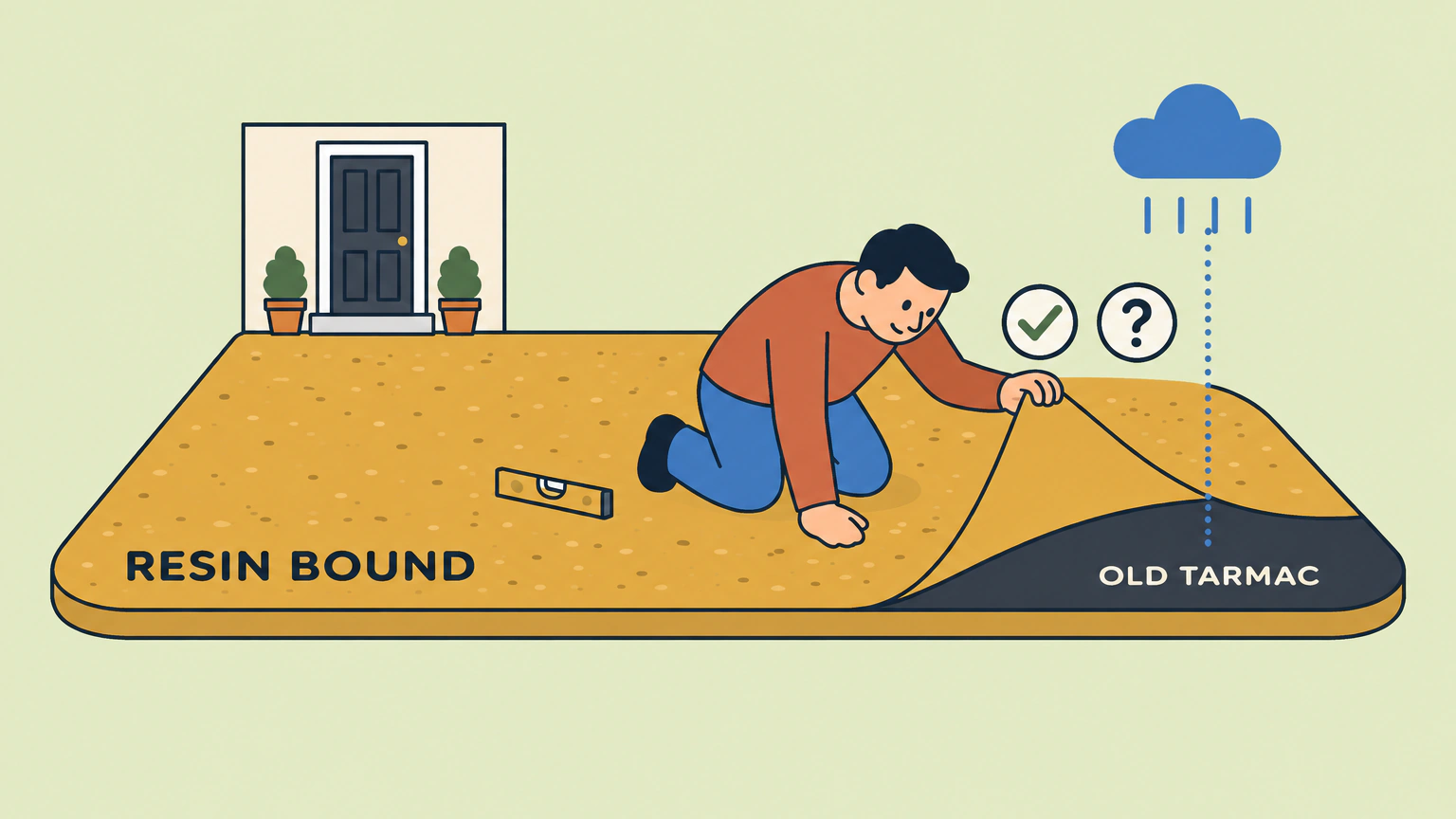
Current UK price guides put a resin bound driveway at roughly £60 to £110 per m² installed, so a 50 m² two-car drive usually costs £3,000 to £5,500, and more if the old base has to be dug out. The cheaper route, resin laid over your old tarmac or concrete, lets rain through the stones but not the slab beneath, so plan on it counting as a sealed drive. In an English front garden over 5 m², that avoids planning permission only if its water runs onto your own lawn, border or a soakaway.
Wales, Scotland and Northern Ireland draw that line in different places. And if the kerb needs dropping, that's a second application wherever you live.
On this page
What a resin driveway costs in 2026
The per m² prices the guides publish
Look up the cost of a resin driveway per m² and every guide gives you a different number.
| Guide | Resin bound, per m² | Base work | Resin bonded, per m² | What the figure is |
|---|---|---|---|---|
| MyJobQuote (updated August 2026) | £60 to £95 | Not split out | Not priced per m² | Quotes given to homeowners on its platform |
| MacColl & Stokes, Glasgow installer (updated July 2026) | £60 to £100 on a sound base, VAT included | Add £25 to £50 per m² to rebuild the base | £40 to £70 | One installer's published prices |
| Clearstone, resin bound installer and supplier | £65 to £110 installed | Inside the range | Not priced | One firm's installed range |
| Checkatrade (figures dated December 2024) | £120, materials £70 plus fitting £50 | Excavation and disposal £28 per m², sub-base £23 per m² | Not priced | Ballpark averages |
None of them is wrong. They're just measuring different things. MyJobQuote reports the quotes homeowners get on its own platform. MacColl & Stokes is one Glasgow installer's list, VAT included, and it assumes your existing base is sound. Clearstone's range moves with the base preparation a job needs. Checkatrade's £120 is a ballpark average dated December 2024.
Where a guide prices the base on its own line, that line is what moves the number. Checkatrade's extras for digging out and a new sub-base add up to £51 per m², and MacColl & Stokes adds £25 to £50. So most of the gap between your quotes is the base.
What a two-car drive usually comes to
MyJobQuote works its figures up by size, materials and labour together: £1,800 to £3,000 for a 30 m² drive, £3,500 to £5,500 for 60 m² and £5,000 to £8,000 for 90 m². A typical two-car drive is about 50 m², so it lands between the first two.
For a wider view, our own cost profiles for driveway jobs put a typical job at £3,747 to £8,262. That's 640 profiles covering driveway work of every kind, so read it as what a new drive costs in general, not as a resin price.
Whichever figure you start from, ask what it leaves out. A resin driveway cost quoted per m² won't cover dropping the kerb, which is its own job with its own fee. New edging and the skip for a dig-out may be extra too.
What's under the resin sets the price
Laid over your old drive, or dug out and rebuilt
Every resin quote is one of two jobs.
The first is an overlay. The installer cleans and primes your existing tarmac or concrete and lays the resin straight onto it. That only works on a sound surface, because cracks and movement in the old drive carry through to the new one. Block paving, setts and slabs can't be overlaid, because the joints between them end up as cracks in the resin. Loose stone is out too: resin can't usually go onto Type 1 (the crushed stone under most drives), gravel or sand.
The second is a dig-out. The old drive is lifted and taken away. An open-graded Type 3 sub-base goes down (crushed stone with the fine dust left out so water can pass), and a porous layer goes on top of that before the resin: open-textured asphalt, or a concrete mixed without sand that the trade calls no-fines. MacColl & Stokes adds £25 to £50 per m² when the base has to be rebuilt.
If your quote splits the work, you can price the trades separately: a groundworks firm for the dig-out, and concrete contractors who lay no-fines bases. If the skip is down to you, check what a skip costs, and when it needs a permit.
Two cautions. An overlay lifts the surface by the depth of the resin, and a raised drive can bridge the damp-proof course if the level creeps up the house wall. And "new base" on a quote can still mean a sealed one. Ask for the layer directly under the resin by name.
Bound and bonded are two different products
A resin bound driveway is the one most people mean. Stone and resin are mixed first, then trowelled out into a smooth layer with tiny gaps that let water through. Clearstone lays it 18 mm deep on a driveway, and SureSet gives 16 to 20 mm depending on the size of the stone.
A resin bonded driveway is a coat of resin with loose stone scattered onto it. It's cheaper, at £40 to £70 per m² on MacColl & Stokes's list, and it has a rougher finish. It's also sealed. The stone sits on a complete layer of resin, so "water cannot pass through", as Resin Bonded Aggregates puts it.
Two products that share a word and almost nothing else. Here are the three builds you're likely to be offered, with one installer's rates multiplied out for a 50 m² drive.
| Build | Per m² | 50 m² drive | Where the rain goes |
|---|---|---|---|
| Resin bonded on your existing drive | £40 to £70 | £2,000 to £3,500 | Runs off the top, because the resin coat is sealed |
| Resin bound laid over sound old tarmac or concrete | £60 to £100 | £3,000 to £5,000 | Through the stones, then across the old surface underneath |
| Resin bound on a dug-out, new permeable base | £85 to £150 | £4,250 to £7,500 | Down through every layer into the ground |
Rates are MacColl & Stokes's 2026 figures, with its £25 to £50 base-rebuild allowance added for the third row.
When a resin driveway needs planning permission
The 5 m² front garden rule in England
Start with the reassuring part: the cheaper build can be kept legal, often with nothing more than a border and the right slope.
Whether you need planning permission for a resin driveway comes down to one condition. In England, the right to pave a house's grounds without applying, known as permitted development, comes from a rule called Class F. Its condition only bites on the ground between the front wall of the house and the road. Where the surface there is over 5 square metres, the rule says "either the hard surface is made of porous materials, or provision is made to direct run-off water from the hard surface to a permeable or porous area or surface within the curtilage of the dwellinghouse".
In plain terms, the rain either soaks through the drive, or it runs onto ground inside your own boundary that can soak it up. Either will do.
Two details catch people out.
Resurfacing counts. Class F covers "the replacement in whole or in part" of a hard surface, and the 5 square metres includes "the area of hard surface replaced". A new top on an old drive is caught just like a new drive.
And the condition stops at the front. A drive at the side or back of the house is outside it.
All of this applies to houses only.
Why resin over old tarmac usually counts as a sealed drive
This is where the cheap quote meets the planning rule.
Resin bound stone is porous. The old tarmac or concrete under an overlay isn't. Rain goes down through the stones, hits the slab and runs sideways until it finds an edge.
The resin makers say so themselves. Resin Bonded Aggregates puts it flatly: "Laying a resin bound system onto an impermeable base will not be SUDS compliant". SuDS is short for sustainable drainage systems, the trade's label for a surface that deals with its own rainwater.
Even a new base can be sealed. The government's guidance on paving front gardens says ordinary Type 1 "has a lot of fine material in it (sand and silt) that stops water passing through it easily", which is why permeable drives sit on open-graded stone such as Type 3.
So with a resin driveway over tarmac, plan on meeting the second half of the condition. That means falls, the slight slopes built into the surface to send the water onto your own lawn or border. Or it means a channel drain along the low edge feeding a soakaway, a gravel-filled pit that lets water sink into the ground. MacColl & Stokes prices channel drains or a soakaway at £300 to £1,000. If there's no bed on the low side, hire a landscaper to plant a border for the run-off.
One warning from the same guidance: on clay the ground may not soak the water up, and sending it to the drains instead "might not be permitted development". On heavy clay, ask the council before work starts.
With the slopes designed in, an overlay is a legitimate job. We'd ask the installer to show you the falls on site and to write on the quote where the rain ends up.
Our Front Garden Permission Check asks five questions about your own drive and tells you which rule decided the answer.
Front Garden Permission Check
For a house whose paving rights are intact:
On a front drive over 5 m², rain that soaks through or runs onto your own border needs no application. Rain that runs to the road does.
- Soaks through: no application
- To your border: no application
- To the road: planning needed
It depends on where the water goes
Resin laid over old tarmac or concrete lets rain through the stones but not through the slab underneath, so treat it as a sealed drive. If the falls take the water onto your own lawn, border or a soakaway, you don't need to apply. If it runs into the road, you do. Ask the installer to show you the falls, and put the answer on the quote.
- England's paving rights still apply in a listed building's grounds. If the work touches the building itself or an old garden wall, ask your council's conservation officer about listed building consent first.
- Conservation areas are where councils most often remove these rights with an Article 4 direction, so check yours.
- Wales adds one more condition: the surface has to stay that way, so don't seal it or block its drainage later.
- In England these rights also don't cover a home created by converting another building, such as an office or a barn, under permitted development. If that's your house's history, ask the council.
- In England the application fee for work in a house's grounds is £272.
- This assumes your council hasn't removed these rights with an Article 4 direction or a condition on your home's original planning permission. A condition will be on the council's planning register. Ask the planning team whether an Article 4 direction covers your street.
Crossing the pavement to reach the drive? A new dropped kerb is a separate application to your council's highways or roads team (DfI Roads in Northern Ireland), whatever this check says.
Onto an A or B road, or another classified road? In England a new access onto one needs planning permission too. Your council can tell you if your road is classified.
Wales, Scotland and Northern Ireland do it differently
Cross a border and the rule changes, sometimes to the opposite answer.
| Nation | Where the rule applies | Size that triggers it | Homes left out of the paving rights | Dropped kerb consent from |
|---|---|---|---|---|
| England | Between the front wall and the road | Over 5 m², new or replaced | Flats, maisonettes and some converted homes | The highway authority, usually your council |
| Wales | In front of the front wall, facing the road | Any new surface. Replacement over 5 m², including earlier replacement that did not meet the drainage condition in the last six months | Flats, maisonettes and listed buildings | The highway authority, usually your council |
| Scotland | Between the house and any road next to its grounds | Any size | Flats, maisonettes, listed buildings and conservation areas | Your council's roads team |
| Northern Ireland | Between the front wall and the road | Over 5 m², new or replaced | Flats, maisonettes and listed buildings, unless listed building consent is already granted | DfI Roads |
In all four nations, the surface passes if it's porous or permeable, or if its rain runs onto a lawn, border or other permeable ground inside your boundary. Wales adds that it has to be kept that way.
Three of those differences change real decisions. In Wales, any brand-new surface in front of the house has to meet the drainage condition, however small, and the 5 m² allowance only covers patching what's already there. In Scotland the condition applies at any size, and it reaches any surface between the house and a road, the side included. Scotland also gives no paving rights in a conservation area or in the grounds of a listed building. Northern Ireland follows England with one exception: a listed building's grounds are out unless listed building consent for the work has already been granted.
England's rule has no carve-out for listed buildings or conservation areas, though listed building consent is a separate question for the council.
Flats, Article 4 directions and the fee if you do need permission
Flats and maisonettes get none of these paving rights in any of the four nations. In England the rights also skip homes created by converting another building, such as an office or a barn, under permitted development.
A council can take the rights away from an ordinary house too. It does that with an Article 4 direction, which is a local order switching off a permitted development right, or with a condition attached to the house's original planning permission. The Welsh Government notes that Article 4 directions "are most common in conservation areas". A condition will be on the council's planning register, and the planning team can tell you whether a direction covers your street.
If you do have to apply in England, the fee for work within a house's grounds is £272 at 2026-27 rates. Find out before you pay a deposit. An installer's "no planning needed" isn't a decision the council has made.
The paving rules are about where rainwater goes, and your council's planning team has the final word on an unusual drive. A two-minute call before the crew is booked costs nothing.
The dropped kerb is a separate application
Planning rules cover the drive. Getting a car onto it is a different permission from a different office.
If your car has to cross the pavement, you need a dropped kerb, and Planning Portal is blunt that driving over the pavement without one is illegal.
In England and Wales the crossing has to be agreed by the highway authority, usually your council, under the Highways Act 1980. Councils charge to assess the request before anyone prices the work. Oldham's fee is £218, non-refundable. Coventry wants £130 if its own contractor will do the job, or £200 if you use an approved outside one. Bedford charges £177.25 for a site visit and an estimate, and builds every crossing itself. The construction is quoted on top, and MyJobQuote puts the average cost of dropping a kerb at around £2,000.
England has a trap for busier roads. A new access onto a classified road, meaning an A or B road or one the council has classified without a number, needs planning permission as well.
In Scotland the permit comes from the council's roads team. Edinburgh, for one, requires a road occupation permit to create a dropped kerb or alter a driveway access. In Northern Ireland the consent comes from DfI Roads, part of the Department for Infrastructure.
Ask every installer who's applying for the kerb, and whether it's in the price.
Getting a quote you can hold them to
Eight things to get in writing before you sign
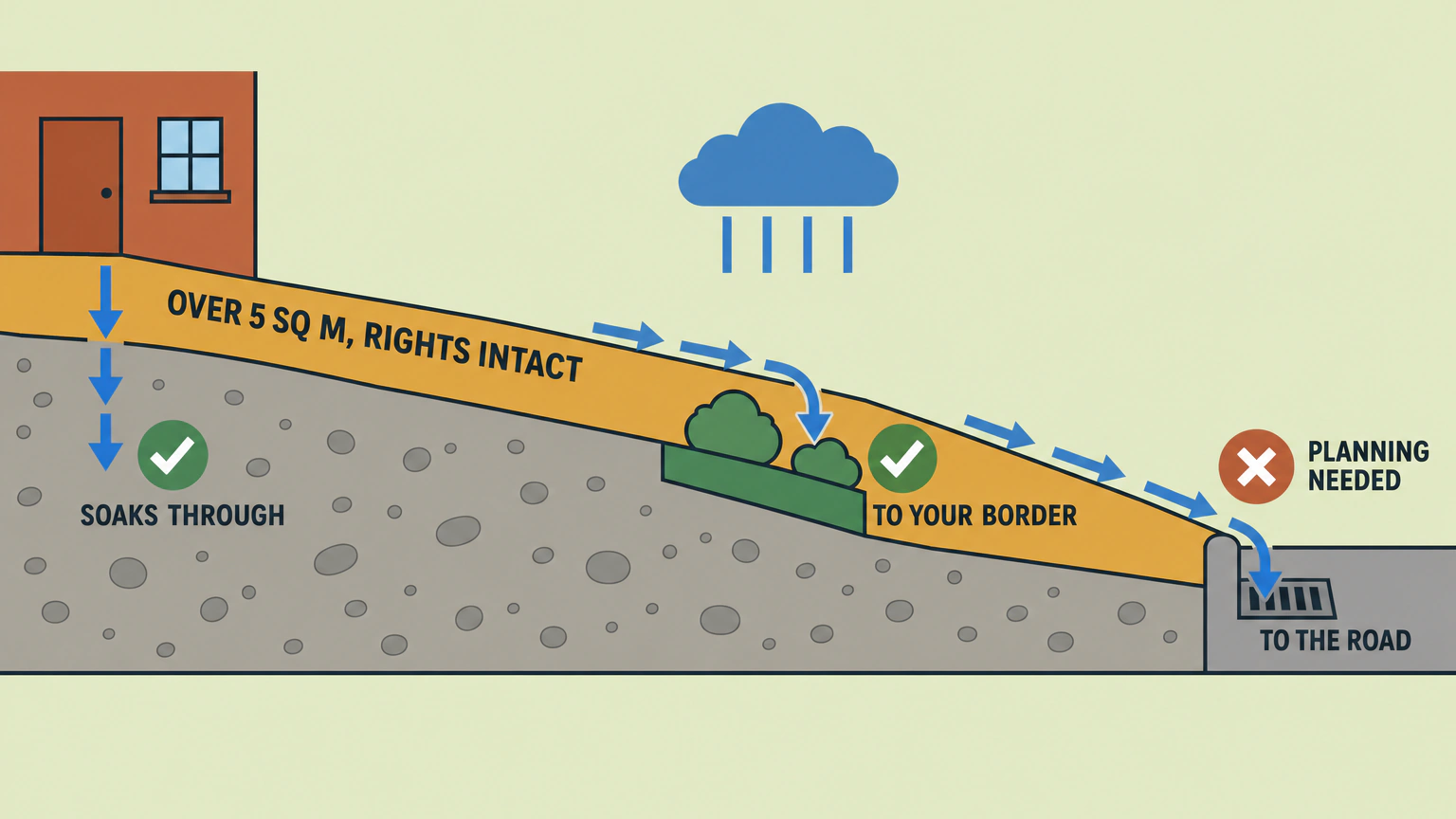
Ask an installer where the rain will go and there are only three possible answers: down through the drive, across it to your own border, or down the slope and into the road. For an ordinary house whose paving rights are intact, the first two need no application for a front drive over 5 m², and the third needs planning permission.
Put these eight questions to two or three driveway installers near you and have each one answer in writing. The answers are also your defence if the price goes up once the old drive is lifted.
- Whether it's an overlay on your existing drive or a dig-out, and the name of what goes directly under the resin: old tarmac, old concrete, porous asphalt or no-fines concrete.
- Where the rain will go: down through the build, or across it to a named lawn, border, channel drain or soakaway inside your boundary.
- Whether it's bound or bonded, and the name of the resin system, so you can read the maker's data sheet yourself.
- That the resin is UV-stable, written on the quote in those words. Addagrip's data sheet for its non-UV version says that resin "will darken when subjected to UV exposure", which leaves a paler patch wherever a car is always parked.
- The depth of the resin layer. Clearstone lays driveways at 18 mm, and on a layer that thin a few millimetres short is a large share of what you paid for.
- Who applies for the dropped kerb, and whether the kerb is in the price.
- Whether VAT, edging and taking away the old surface are in the total.
- The guarantee: how long it runs, who stands behind it, and what it excludes, such as loose stones, cracking or colour change. Clearstone's five-year guarantee covers all three, which makes a fair yardstick.
Booking for autumn? Ask about the weather
Resin has hard weather limits, and an October or November booking is exactly when they bite.
Pro tip: Addagrip's data sheet for its resin bound system says don't lay it below 5°C, with the surface at least 3°C above the dew point and humidity at 80% or less. Full cure takes seven days. An autumn slot is fine if your installer has a plan for a cold or damp morning, so ask what it is before you pay a deposit.
The dew point is the temperature at which damp settles out of the air.
Published advice on when you can park on it is all over the place. MyJobQuote and Clearstone both say about 24 hours. HomeHow says 72. Addagrip's seven days is for a full chemical cure. We'd keep the car off for three days in cold weather.
If the installer rings to push the start back because rain is forecast, take it as a good sign. MacColl & Stokes calls rushed laying in marginal weather one of the most common causes of complaints about resin driveways.
Driveway work offered at the door
Your job at the door is to say no. The checking happens later, at the kitchen table, with nobody standing on the step.
Red flag: Monmouthshire Trading Standards warned residents about doorstep driveway callers in July 2026. Its advice comes down to four warning signs:
- Someone says they're working on behalf of the council.
- Pressure to decide on the spot, or to let them start straight away.
- Reluctance to show identification or let you check it.
- A demand for an excessive payment, or work left unfinished.
Say no at the door, take a name, and report it to the Citizens Advice consumer service on 0808 223 1133.
If you've already said yes to something, you have a way back. A contract agreed at your home comes with a cooling-off period of at least 14 days, Citizens Advice explains, and a trader who starts work inside that period without your go-ahead owes you a full refund if you cancel.
We've set out how to check a tradesperson's credentials. If a driveway firm takes a deposit and vanishes, here's what you can do.
Your resin driveway questions
Is a resin driveway cheaper than block paving or tarmac?
Usually it's dearer than tarmac and close to block paving. MacColl & Stokes lists tarmac at £45 to £65 per m², resin bound at £60 to £100 and block paving at £80 to £120. MyJobQuote has tarmac at £45 to £80, resin at £60 to £95 and block paving at £70 to £120. The ranges overlap, so the top of the tarmac range costs more than the bottom of the resin one.
Can resin be laid over my existing tarmac or concrete drive?
Yes, if the old surface is sound and free of cracks, and it's the cheaper route. It can't go over block paving or slabs. In a front garden, treat an overlay as a sealed drive for planning purposes. The falls need to take the rain onto your own lawn or border, or into a soakaway.
Do I need planning permission for a resin driveway?
Not if you live in a house, the drive is porous all the way down or drains onto your own garden, and your council hasn't removed the rights. In England, a front surface over 5 m² that drains to the road needs an application. Wales and Scotland are stricter on size. England's paving right includes listed buildings. Wales and Scotland exclude them. Northern Ireland includes them only when listed building consent for the work is already granted. Our Front Garden Permission Check gives the answer for your drive.
Can a resin driveway be laid in winter or in the rain?
In winter, yes, on a dry day that's warm enough. In the rain, no. Addagrip's data sheet sets the floor at 5°C, with the surface 3°C above the dew point and humidity at 80% or under. MacColl & Stokes rules out heavy rain, and any day with rain forecast within a few hours of laying. Expect the date to move.
How long before I can drive on a new resin driveway?
The guides disagree. MyJobQuote and Clearstone both say about 24 hours, while HomeHow says 72 hours. Addagrip's data sheet gives seven days for a full cure. We'd keep cars off for three days in cold weather, and ask the installer for their own system's figure.
How long does a resin driveway last?
About 20 years if it's laid properly, going by the published estimates. HomeHow says at least 15 to 25 years, MacColl & Stokes 20 to 25, MyJobQuote 21 to 25 and Clearstone 20 years or more. All of them assume a sound base and a careful installation. The base decides which end of that range you see.
Do I need permission for a dropped kerb as well?
Yes, if the kerb isn't already dropped where you'll drive across, and it's separate from planning. The highway authority has to agree the crossing: DfI Roads in Northern Ireland, the council elsewhere. Expect an assessment fee, often non-refundable. In England, a new access onto a classified road needs planning permission too.